
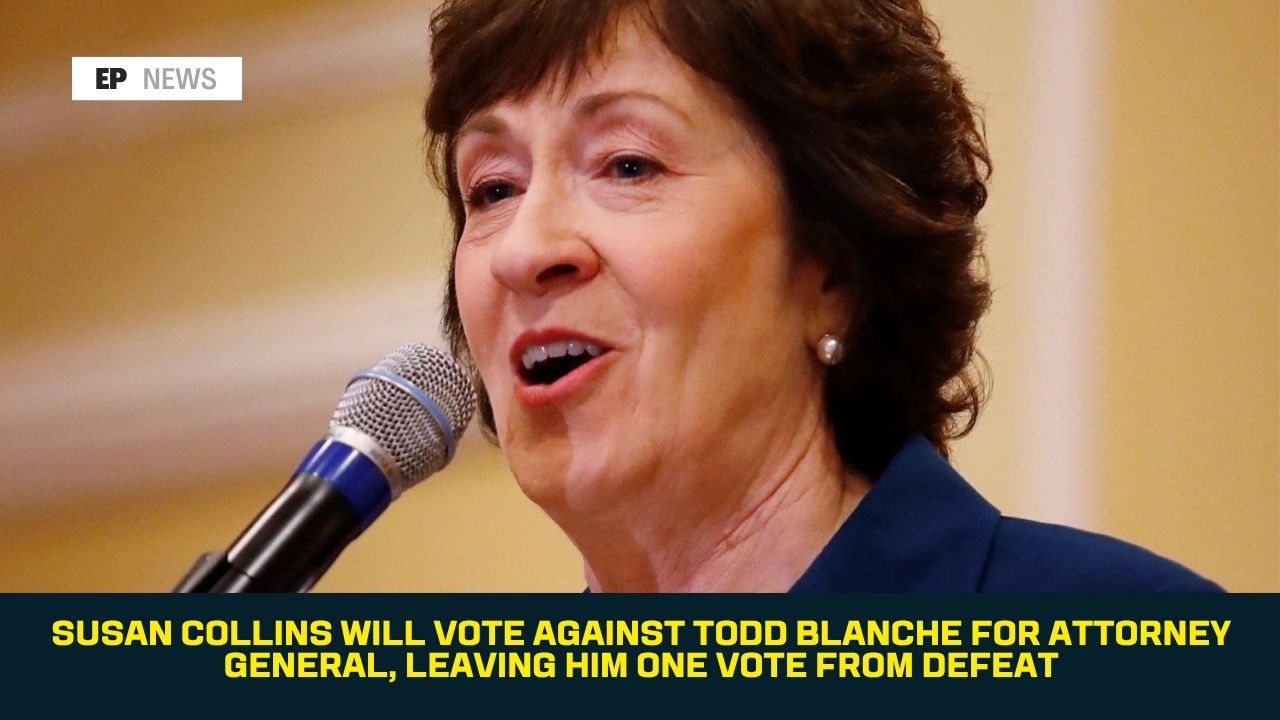
Susan Collins Will Vote Against Todd Blanche for Attorney General, Leaving Him One Vote From Defeat
Sen. Susan Collins, R-Maine, announced Tuesday, August 4, that she will vote against Todd Blanche’s confirmation as attorney general, becoming the first Senate Republican to publicly oppose the nomination just hours after it cleared the Senate Judiciary Committee — and narrowing Blanche’s path to confirmation to the thinnest possible margin.
Where the Math Stands
Blanche was approved by the Senate Judiciary Committee on a 12-10 vote Tuesday morning, sending his nomination to the full Senate floor. But Collins’s announcement that evening means Blanche can now afford to lose only one more Republican vote and still be confirmed.
The math is tight because of an absence, not just partisan alignment. Senate Republicans hold 53 seats, but Sen. Mitch McConnell, R-Ky., remains absent from the chamber due to an extended, serious health issue, effectively leaving Republicans with 52 available votes. With all Democrats expected to oppose Blanche and Collins now a confirmed “no,” a second GOP defection would leave Blanche with 49 votes — one short of what he’d need for confirmation.
That puts the outcome in the hands of two remaining undecided Republicans: Sen. Bill Cassidy of Louisiana and Sen. Lisa Murkowski of Alaska. Neither had publicly stated a position as of Tuesday night.
Why Collins Is Opposing Blanche
Collins laid out her reasoning in a statement posted to X. “While I believe Mr. Blanche is a capable lawyer, the Department of Justice has become increasingly political,” she said. “Mr. Blanche has taken several actions that have further eroded the Department’s independence, and that is the basis for my vote to oppose his confirmation.”
She cited several specific actions, according to The Hill: Blanche’s role in creating the roughly $1.8 billion “anti-weaponization fund” intended to compensate people who claimed they were victims of politically motivated prosecutions; his approval of an order shielding Trump, his sons, and the Trump family business from IRS audits — protections Collins said are “unavailable to other American taxpayers”; his involvement in charging two Democratic senators with sedition; and what Collins described as a commitment to an anti-abortion organization to pursue a nationwide ban on mailing abortion medication, according to reporting from [your]NEWS.
Collins also noted, according to MSNBC’s ms.now, that more than 1,200 former Department of Justice employees have publicly opposed Blanche’s nomination, arguing he has undermined the institution — a detail she cited directly in her statement.
Notably, Collins did credit Blanche for one specific action: a trip he took last month to remote communities in rural Alaska to better understand law-enforcement challenges facing tribal leaders in isolated areas, according to The Hill.
A Reversal From Just One Day Earlier
Collins’s opposition arrives in an ironic twist, landing just one day after the two senators who had spent weeks blocking Blanche’s nomination — John Cornyn of Texas and Thom Tillis of North Carolina — dropped their own opposition and cleared the way for his committee vote. According to Axios, Cornyn and Tillis reached a written agreement with Blanche confirming that the anti-weaponization fund would be terminated and that the scope of the IRS settlement’s audit protections for Trump would be narrowed.
In other words, the very issues that led Cornyn and Tillis to back down are now among the core reasons Collins cited for opposing Blanche — the fund and the audit protections. The agreement that resolved one senator’s objections became part of the basis for another senator’s opposition.
The Two Senators Who Could Decide the Outcome
Attention has now shifted squarely to Cassidy and Murkowski. Both have previously raised concerns that could point toward opposition. According to NBC News affiliate WAVY, Murkowski was an outspoken critic of Trump’s DOJ-IRS settlement and, like Collins, supports abortion rights — two positions that overlap directly with Collins’s stated objections.
Cassidy has focused his concerns elsewhere, questioning whether Blanche can act independently of Trump given his history as the president’s personal attorney. “I have to make sure that is the attorney general who used to be the president’s personal attorney, not the personal attorney who’s also the attorney general,” Cassidy said last week, according to WAVY. He has also raised concerns about a reported criminal investigation into former White House aide Cassidy Hutchinson, who testified before the House committee investigating the January 6 Capitol attack, asking pointedly why a grand jury was reportedly being empaneled to pursue her.
MSNBC’s Rachel Maddow Show blog noted that Cassidy has shown increasing independence from the administration in recent months — a dynamic shaped in part by the fact that Trump helped end a primary challenger’s chances against Cassidy’s Senate seat earlier this year, giving Cassidy less incentive to fall in line.
What Happens Next
Senate leaders had hoped to hold Blanche’s confirmation vote this week before the chamber departs for its August recess, according to MSNBC’s ms.now. With Collins’s opposition now public and Cassidy and Murkowski still undecided, that timeline — and the outcome itself — remains genuinely uncertain heading into the floor vote.
FAQ
How many more Republican votes can Blanche afford to lose? Just one. With Collins opposed and Sen. Mitch McConnell absent from the Senate due to a health issue, Republicans effectively have 52 available votes; losing one more would leave Blanche with 49, short of the 50 he needs.
Why is Susan Collins opposing Blanche? She cited concerns about the Justice Department’s independence under his leadership, including his role in creating the “anti-weaponization fund,” approving IRS audit protections for the Trump family, involvement in sedition charges against two Democratic senators, and a reported commitment to an anti-abortion group.
Did Blanche already resolve concerns about the anti-weaponization fund? He reached a written agreement with Sens. Cornyn and Tillis confirming the fund’s termination, which secured their votes — but Collins cited the fund’s creation, not its current status, as part of her reason for opposing him regardless.
Who are the remaining undecided senators? Sens. Bill Cassidy of Louisiana and Lisa Murkowski of Alaska had not stated their positions as of Tuesday night; either one voting against Blanche would sink his confirmation.
When is the Senate expected to vote on Blanche’s confirmation? Senate leaders had hoped to hold the vote before the chamber’s August recess, though the exact timing remained unclear given the unresolved votes.
Conclusion
What looked like a resolved standoff after Blanche’s committee vote Tuesday morning turned into a fresh crisis for his nomination by Tuesday evening, with Collins’s opposition leaving him with zero margin for error. The outcome now rests entirely on two senators who have each, in different ways, shown a willingness to break from the administration — making this one of the most genuinely uncertain confirmation votes of Trump’s second term as it heads toward the Senate floor.
Sources: Axios, CNBC, The Hill, [your]NEWS, The Daily Beast, WAVY/NBC News, MSNBC/ms.now (reporting dated August 4-5, 2026).