
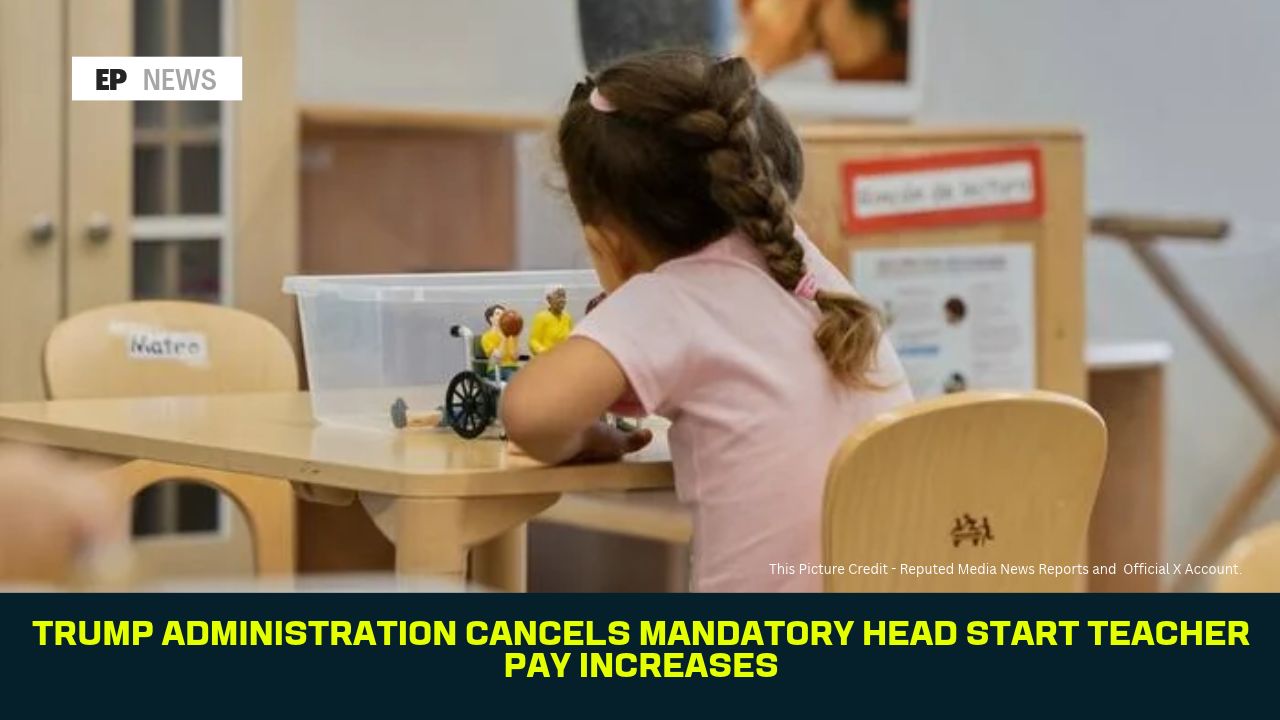
Trump Administration Cancels Mandatory Head Start Teacher Pay Increases
Category: U.S. News / Education
The Trump administration is moving to eliminate a federal rule that would have required large Head Start programs to increase teacher salaries and expand employee benefits, reversing an important education policy introduced during President Joe Biden’s administration.
The decision, announced on November 13, 2026, affects the federally funded Head Start program, which provides early education and other support services to children from low-income families across the United States.
The Biden-era regulation was designed to improve compensation for Head Start educators and bring their salaries closer to those of public preschool teachers in their local communities. It also included requirements involving employee benefits and compensation structures.
The Trump administration argues that removing the requirements will give local Head Start organizations greater financial flexibility and help them serve more children with existing federal funding.
However, education advocates and organizations representing early childhood educators have raised concerns that eliminating mandatory salary improvements could make it harder for Head Start programs to recruit and retain qualified teachers.
The policy debate is important because Head Start serves more than 700,000 children, many of whom come from households facing economic challenges.
The administration’s decision does not automatically reduce the salaries of teachers who already work in Head Start programs. Instead, it removes specific federal requirements that would have required participating organizations to implement certain pay and benefit improvements.
What Did the Trump Administration Announce?
The Trump administration announced that it was finalizing the repeal of a Biden-era regulation requiring large Head Start programs to gradually improve employee compensation.
The original regulation, introduced in 2024, was intended to address longstanding concerns about low salaries, staff shortages and employee turnover in early childhood education.
Under that policy, affected Head Start organizations would have needed to develop or update compensation structures and move education staff toward wage levels comparable with local public preschool teachers.
The rule also included provisions concerning employee benefits and compensation for other program staff.
The Department of Health and Human Services, through its Administration for Children and Families, has now finalized a rule removing those wage and benefit requirements.
The official document is titled Restoring Flexibility to Support Head Start Program Access.
The administration says the change will restore local decision-making authority and reduce financial pressure on Head Start organizations.
According to the final rule, the agency estimates that the changes will result in more than $2 billion in future cost savings for Head Start programs.
The final rule was scheduled for publication in the Federal Register on November 16, 2026. Its stated effective date is 60 days after publication.
What Is the Head Start Program?
Head Start is a federal early childhood education program established in 1965 as part of the government’s broader effort to reduce poverty and improve opportunities for children.
It primarily supports children from low-income households, including children who may face additional challenges because of homelessness, foster care or disabilities.
The program provides more than preschool education. Its services can include health and developmental screenings, nutrition support, family engagement, social services and assistance preparing children for kindergarten.
Head Start also operates Early Head Start services for eligible pregnant women, infants and toddlers.
The program is administered through local organizations that receive federal funding and are responsible for providing services in their communities.
For many families, Head Start offers access to early education and support that might otherwise be difficult to afford.
The federal government’s official regulatory document describes the program as providing early education and comprehensive services to low-income pregnant women and children from prenatal stages through age five.
Because Head Start serves families with limited financial resources, the availability and quality of its local services can have a significant impact on communities.
Why Did the Biden Administration Introduce the Pay Rule?
The 2024 regulation was introduced to address workforce problems affecting Head Start organizations.
Many programs were struggling to recruit and retain qualified teachers because salaries were often lower than those available in public schools and other education settings.
The Biden administration argued that improving compensation was necessary to build a more stable workforce and maintain the quality of early childhood education.
The regulation sought to establish stronger expectations for salaries and employee benefits.
Among its objectives was bringing Head Start education staff compensation closer to the wages paid to comparable public preschool teachers in their local areas.
The policy also aimed to encourage structured salary scales and more consistent compensation practices across Head Start organizations.
Supporters believed that better pay could make the profession more attractive, reduce employee turnover and help programs keep classrooms open.
The underlying concern was straightforward: Head Start programs cannot provide consistent education services if they cannot recruit and retain enough qualified staff.
However, the Trump administration argues that the requirements created financial obligations without providing sufficient additional federal funding to cover them.
Why Is the Trump Administration Repealing the Rule?
The administration’s main argument is that mandatory compensation requirements could force local Head Start organizations to make difficult financial decisions.
Programs operate in different communities, with different labor markets, operating costs and available resources.
Federal officials say a uniform compensation policy may not reflect those differences.
The final rule argues that requiring organizations to increase wages and benefits without additional congressional appropriations could force them to redirect money away from other services.
That could mean fewer funded enrollment places, reduced staffing or changes to the services available to children and families.
The Administration for Children and Families estimates that approximately 106,000 funded Head Start enrollment slots could need to be eliminated if programs had to meet the original compensation requirements without additional funding.
The administration therefore argues that local organizations should have more control over how they allocate their available budgets.
It says local leaders are better positioned to decide whether they need to prioritize salary increases, additional staff, classroom operations or other services.
The final rule also estimates more than $2 billion in future savings for Head Start programs.
Importantly, this is the administration’s policy rationale. It does not mean that every local program will use the additional flexibility in the same way or that every community will see more available preschool places.
What Happens to Head Start Teacher Salaries Now?
One of the biggest questions surrounding the announcement is whether Head Start teachers will immediately lose their existing salaries or benefits.
The answer is no: the final rule does not require Head Start organizations to reduce current employee compensation.
The official federal document specifically states that organizations are not required or encouraged to cut existing wages.
It also makes clear that local programs can continue to provide salary increases and benefits voluntarily.
In practical terms, this means that individual Head Start organizations will have greater discretion over their compensation decisions.
A program facing recruitment difficulties may still decide to increase teacher salaries to compete with public schools or other employers.
Another organization may decide to use its available resources to maintain more classrooms or provide additional services.
The final decision will depend on local budgets, workforce needs and management priorities.
The repeal also does not eliminate existing federal, state and local labor protections. Organizations must continue to comply with applicable minimum wage and employment laws.
Therefore, the change should not be described as an immediate nationwide pay cut for Head Start educators.
It removes a federal requirement for specific salary and benefit improvements, leaving more of those decisions to local program administrators.
Why Are Education Advocates Concerned?
Organizations representing early childhood educators have warned that removing mandatory compensation improvements could make existing workforce problems worse.
Head Start teachers work with young children during an important stage of their development.
Their responsibilities can include classroom instruction, child development activities, communication with parents and coordination with other support services.
Many educators also need professional training and relevant qualifications.
Advocates argue that compensation should reflect the responsibilities and expertise required for the job.
The Associated Press reported that more than 20% of Head Start teachers left their positions in 2022.
It also reported that in 2026, average salaries for Head Start teachers with bachelor’s degrees were below $50,000, while those with master’s degrees earned below $60,000 on average.
By comparison, public schoolteachers earned approximately $75,000 on average, according to the National Education Association figures cited in the report.
These differences help explain why some educators may consider moving to other education jobs that offer higher salaries or stronger benefits.
The National Association for the Education of Young Children criticized the administration’s decision, warning that programs may struggle to retain qualified teachers.
Its position reflects a wider concern among education advocates: funding a preschool place does not guarantee that a classroom can operate if there are not enough qualified educators.
The administration, however, argues that local flexibility will help organizations manage their resources and protect access to services.
Could the Decision Affect Children and Families?
The policy is focused on employee compensation, but its effects could extend to the families who depend on Head Start.
There are two competing possibilities.
The administration believes that removing the compensation mandate will help organizations preserve more enrollment places and use federal funding more efficiently.
Under that approach, local programs could avoid diverting large portions of their budgets toward mandatory pay increases and instead maintain or expand services.
Education advocates worry about the opposite outcome.
If lower salaries make it harder to recruit and retain teachers, some programs could struggle to keep classrooms operating.
That could limit the number of children they are able to serve, even if federal funding is available.
Teacher turnover can also affect continuity for young children. Stable relationships with teachers and caregivers are important parts of early childhood education.
The final effect may vary from one community to another because Head Start organizations have different financial circumstances and workforce needs.
For parents, the most useful information will come from their local Head Start provider. Families should check directly with their program about enrollment, classroom availability and any changes to services.
The federal announcement does not itself mean that existing children will immediately lose their places.
What Does the Official Federal Rule Say?
The final rule published for the Federal Register explains the administration’s reasoning in detail.
It removes the wage and benefit requirements introduced through the 2024 Head Start regulation.
Those provisions included requirements related to:
- Developing or updating compensation scales for staff.
- Moving education staff wages toward comparable public preschool teacher salaries.
- Establishing salary expectations linked to basic living costs.
- Improving wage comparability across Head Start and Early Head Start.
- Providing specified employee benefits.
The government says these requirements were too prescriptive and could create significant financial pressure on local organizations.
The final rule also explains that local programs can continue to offer competitive salaries and benefits voluntarily.
It does not remove the Head Start program’s broader responsibilities to provide education, health, nutrition and family support services.
Nor does it eliminate the underlying federal and local employment laws that apply to program staff.
The document also confirms that the government considered public comments, including concerns from people who supported higher compensation and those who favored greater local flexibility.
When Will the Repeal Take Effect?
The administration announced the final rule on November 13, 2026.
The official Federal Register document states that it was scheduled for publication on November 16, 2026.
Its effective-date provision specifies that the rule will take effect 60 days after publication.
That means the regulatory change is expected to take effect in January 2027, subject to the official publication date and any subsequent legal developments.
The original compensation requirements were intended to be phased in over several years, with full implementation extending toward 2031.
The administration says it is removing them before programs make further operational and financial changes in anticipation of those future deadlines.
Head Start organizations should review the final federal rule and any guidance issued by the Administration for Children and Families before making compensation or budget decisions.
What Happens Next for Head Start Programs?
The next phase will involve local Head Start organizations reviewing their budgets and deciding how to manage staff compensation and services under the revised rules.
Some organizations may continue improving salaries because they believe competitive pay is necessary to retain experienced educators.
Others may prioritize maintaining enrollment capacity, keeping classrooms open or supporting other program services.
The federal government has made clear that the repeal does not prevent local organizations from providing salary increases.
However, the decision removes the federal requirement that would have compelled affected programs to meet the specific compensation benchmarks established in 2024.
This makes local leadership and available funding increasingly important to the future of Head Start workforce policies.
Parents and educators should watch for updates from their local providers and the Administration for Children and Families.
The wider debate over teacher compensation, early childhood education quality and federal funding is likely to continue.
Frequently Asked Questions
1. Did Trump cancel Head Start teacher pay increases?
Yes. The Trump administration finalized a rule removing the Biden-era federal requirements that would have required affected Head Start programs to improve wages and benefits.
2. Will Head Start teachers’ current salaries be reduced?
No. The final rule does not require organizations to reduce existing salaries or benefits. Local programs can continue providing raises voluntarily.
3. How many children does Head Start serve?
Head Start serves more than 700,000 children, primarily from low-income families, according to the Associated Press report.
4. Why did the Trump administration cancel the pay rule?
The administration argues that the requirements created significant financial pressure without sufficient additional federal funding and could force programs to reduce enrollment or other services.
5. How much money could the repeal save?
The Administration for Children and Families estimates more than $2 billion in future cost savings for Head Start programs.
6. Does the repeal affect Early Head Start?
Yes. The final rule removes the specified wage and benefit requirements across the relevant Head Start and Early Head Start compensation provisions.
7. When will the new rule take effect?
The final rule was scheduled for publication in the Federal Register on November 16, 2026, and states that it will take effect 60 days after publication.
8. Can local Head Start programs still increase teacher salaries?
Yes. Local organizations can voluntarily provide higher salaries and benefits based on their budgets, workforce needs and local labor market conditions.
Final Thoughts
The Trump administration’s decision to repeal the mandatory Head Start teacher compensation requirements marks a major change in federal early childhood education policy.
The administration says local organizations need more financial flexibility to protect enrollment and maintain services for children from low-income families.
Education advocates, meanwhile, warn that removing mandatory salary improvements could make it harder to recruit and retain qualified teachers in a sector that already faces workforce challenges.
The most important distinction is that the repeal does not automatically cut current teacher salaries. It removes specific federal requirements for future compensation and benefit improvements, leaving local organizations with more discretion.
How the change affects children, families and educators will depend largely on the decisions made by individual Head Start programs and the funding available to them.
The issue will remain important as the new rule takes effect and local organizations begin adjusting their budgets and workforce plans.
Sources and Reporting
- Associated Press — November 13, 2026: Trump administration cancels mandatory pay hike for Head Start teachers
- U.S. Federal Register — Final Rule: Restoring Flexibility to Support Head Start Program Access
- ABC News / Associated Press: Trump administration cancels mandatory pay hike for Head Start teachers
Editorial note: The repeal removes mandatory federal compensation requirements. It does not require Head Start programs to cut current employee pay or benefits.