
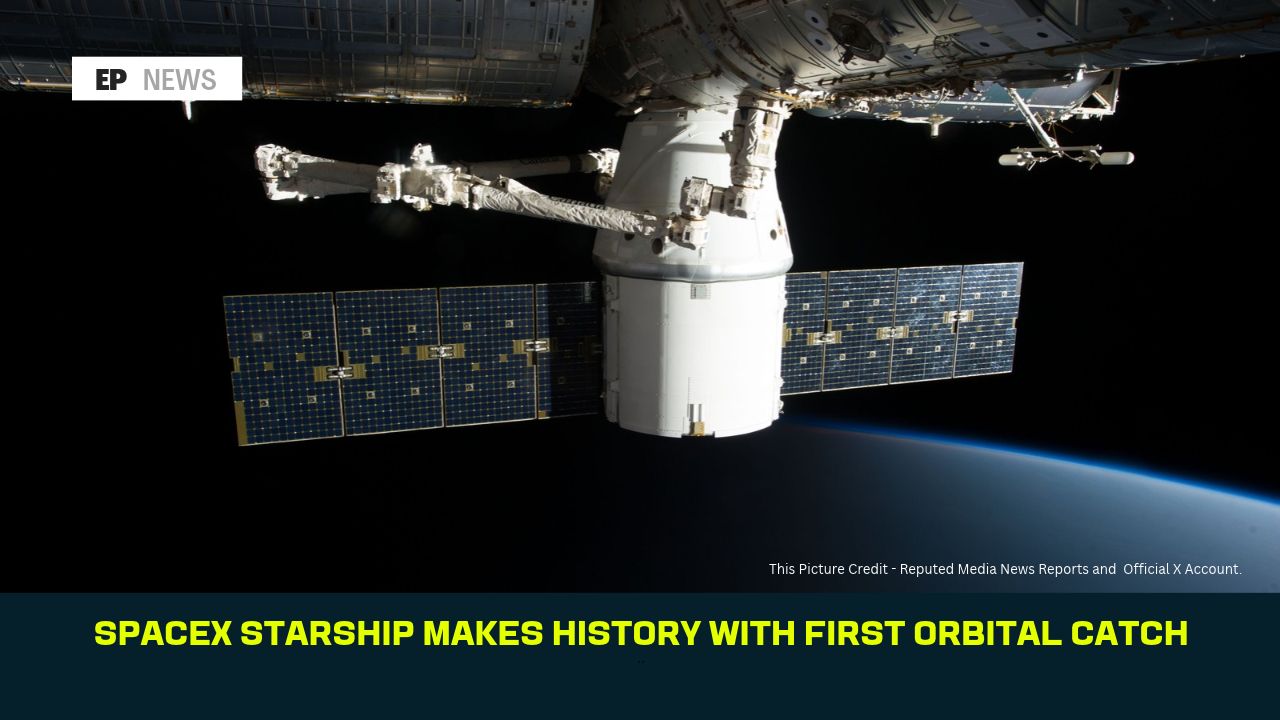
SpaceX Starship Makes History With First-Ever Catch After Returning From Orbit
Category: U.S. News / Technology / Space
SpaceX has achieved a major milestone in rocket technology after its Starship spacecraft returned from orbit and was successfully caught by giant mechanical arms attached to its launch tower in Texas. The historic recovery took place on Saturday, November 14, following an approximately 22-hour flight that demonstrated a new step toward making the world’s largest rocket system fully reusable.
The successful catch marked the first time SpaceX recovered a Starship spacecraft returning from an orbital flight using the launch tower’s mechanical arms, often described as the company’s giant chopsticks.
However, the mission was not a complete success. The Super Heavy first-stage booster failed to return for its planned recovery and exploded over the Gulf of Mexico after its guidance system aborted the catch attempt.
Despite losing the booster, the spacecraft completed its orbital mission, deployed Starlink satellites and returned to the launch site. The achievement is an important development for SpaceX’s long-term plans to reduce launch costs and support future missions to the Moon and potentially Mars.
The test also matters to NASA, which is relying on a modified version of Starship as part of its Artemis program to return astronauts to the lunar surface.
SpaceX Completes First-Ever Starship Catch From Orbit
The most significant moment of the latest Starship test flight came when the spacecraft returned to Starbase, SpaceX’s launch and development facility in South Texas.
After spending approximately 22 hours in flight, Starship descended toward its launch tower and positioned itself for a controlled recovery.
The spacecraft maneuvered into an upright position as it approached the tower. Its giant mechanical arms then caught and supported the vehicle above the ground.
The operation was a major demonstration of SpaceX’s recovery technology.
The company had previously demonstrated the ability to catch the Super Heavy booster using the launch tower’s mechanical arms. This flight marked the first successful catch of the Starship upper-stage spacecraft after an orbital journey.
The achievement is important because SpaceX wants to recover and reuse both stages of the launch system rather than discard them after each mission.
A fully reusable rocket could reduce the cost and time associated with preparing vehicles for future launches.
The successful recovery also provides engineers with valuable information about Starship’s flight-control systems, atmospheric return and landing operations.
The Mission Lasted Around 22 Hours
The spacecraft launched from Starbase, Texas, on Friday, November 13, 2026.
Following liftoff, Starship separated from its Super Heavy booster and continued toward orbit.
According to Associated Press reporting, the spacecraft completed 14 trips around Earth during the mission, a substantial increase compared with the previous test flight, which completed only one or two orbits.
The vehicle also released 26 Starlink satellites into space.
The mission was designed to test multiple technologies and operational procedures, including orbital flight, satellite deployment, spacecraft performance and recovery.
SpaceX said the spacecraft and its important heat shield appeared to perform well.
The heat shield is particularly important because Starship must withstand extreme temperatures when returning through Earth’s atmosphere.
The successful return suggests progress in the company’s efforts to develop a vehicle capable of repeated orbital flights.
However, one successful recovery does not mean the spacecraft is ready for routine commercial or crewed operations. Additional tests will be necessary before the system can be considered operationally mature.
Why the Booster Exploded During the Test
While the upper-stage spacecraft completed its return, the first-stage booster experienced problems during its recovery attempt.
SpaceX had hoped to recover both stages of the rocket at the launch site. That would have represented an even bigger achievement for the company.
However, the Super Heavy booster did not reach the planned recovery position.
SpaceX officials said the booster’s engines stopped firing too early during its return. Its guidance system detected that the vehicle was not in the correct position to proceed with the catch.
The system automatically initiated a safety response, sending the booster away from the launch tower before it exploded over the Gulf of Mexico.
The explosion prevented the planned recovery of the first stage.
Engineers are investigating what caused the engine shutdown and the resulting recovery failure.
The distinction matters because the booster failure did not mean the entire Starship spacecraft mission failed. The upper stage continued its journey, completed its orbital objectives and returned successfully.
The test therefore delivered both a major technical achievement and important engineering problems that SpaceX will need to address.
What Makes the Starship Catch So Important?
SpaceX’s long-term goal is to develop a fully reusable launch system.
Traditional rockets generally discard major components after launch. Rebuilding or replacing those components can make space missions expensive and time-consuming.
SpaceX wants to change that approach by recovering both stages of Starship and preparing them for future flights.
The mechanical arms installed on the launch tower are central to that plan.
Instead of relying on a conventional landing system, the tower’s arms are designed to catch the returning vehicle and hold it in place.
The approach could reduce the need for separate landing legs and make it easier to move recovered vehicles through the launch infrastructure.
If the system becomes reliable, SpaceX could eventually launch, recover, inspect and prepare Starship vehicles for repeated missions at a much faster rate.
That would be particularly valuable for missions requiring large amounts of cargo, equipment or fuel to be transported into orbit.
However, full reusability involves more than catching a rocket. Engineers must also demonstrate that recovered vehicles can be inspected, refurbished and safely launched again without lengthy or expensive rebuilding.
The latest test is an important step, but further demonstrations will be needed.
How Big Is SpaceX Starship?
Starship is one of the largest and most powerful rocket systems ever developed.
The complete launch vehicle, including its Super Heavy booster, stands approximately 407 feet tall.
It consists of two major components:
- Super Heavy booster: The first stage that provides the initial power needed to lift the rocket away from Earth.
- Starship spacecraft: The upper stage designed to continue into space, transport cargo or crew and eventually return to Earth.
Both stages are intended to be reusable.
The upper spacecraft is designed to carry substantial payloads and support a variety of missions, including satellite deployment, cargo transportation and human spaceflight.
The vehicle is also central to Elon Musk’s ambition to make space transportation more affordable and eventually support human exploration of Mars.
However, these ambitions depend on overcoming significant engineering challenges, including reliable propulsion, heat-shield performance, orbital refueling and safe recovery.
The November test provides encouraging evidence of progress, but it does not resolve all of those challenges.
Why NASA Is Watching the Starship Program
The Starship program is not only important to SpaceX. It also has a major role in NASA’s plans for future lunar exploration.
NASA selected a modified version of Starship as a human landing system for its Artemis program.
The spacecraft is intended to help transport astronauts from lunar orbit to the Moon’s surface during a future crewed mission.
NASA is also supporting the development of other lunar transportation technologies through commercial partnerships.
The agency has committed billions of dollars to the Starship human landing system, making the rocket’s development relevant to America’s wider space-exploration strategy.
The Artemis program aims to return astronauts to the lunar surface and establish the groundwork for more sustained exploration.
NASA’s future mission plans require several complex operations, including spacecraft docking, transferring astronauts between vehicles and safely transporting crews to and from the lunar surface.
Starship must demonstrate that it can perform the required tasks before it can be used for an operational crewed lunar landing.
The latest successful catch is therefore an encouraging technical development, but it is only one part of a much larger testing program.
What Does This Mean for the Artemis Moon Missions?
NASA’s Artemis program is designed to return humans to the Moon after more than half a century.
The agency is working with commercial companies, including SpaceX and Blue Origin, to develop systems capable of transporting astronauts and equipment.
According to AP reporting, NASA is targeting a lunar landing as soon as 2028 through its Artemis program.
Starship is expected to play an important role in future lunar landing operations.
The spacecraft will need to demonstrate reliable flight operations, the ability to support astronauts and the capability to dock with other spacecraft.
One major challenge is orbital refueling.
Starship is expected to require fuel transfer in space to support certain lunar missions. This technology must be demonstrated before the spacecraft can carry out the planned operations.
The November test did not demonstrate every capability required for a lunar landing.
Instead, it provided evidence that the vehicle can complete a longer orbital flight and return to its launch tower for recovery.
That progress is relevant to NASA’s plans, but the agency and SpaceX still face several development milestones.
SpaceX Plans to Expand Starship Launch Operations
SpaceX has also been preparing to expand Starship operations beyond its Texas facility.
The company expects to begin launching Starships from Florida’s Kennedy Space Center in the coming months, according to AP reporting.
Florida launches could become important for future missions requiring access to different orbital paths and launch infrastructure.
The expansion would also give SpaceX another location for testing and operating its next-generation rocket system.
However, increasing launch frequency will depend on regulatory approvals, infrastructure readiness, vehicle reliability and the results of additional tests.
SpaceX has ambitious plans for Starship, including more frequent launches and eventual missions beyond Earth orbit.
The company’s ability to achieve those goals will depend on whether it can turn experimental successes into repeatable operations.
What Happens After the Historic Catch?
The next stage for SpaceX will involve examining the recovered spacecraft and analyzing the booster failure.
Engineers will need to evaluate the spacecraft’s structure, engines, heat shield and other systems to determine how well they performed during the mission.
The company will also investigate why the Super Heavy booster did not complete its planned return.
Test flights are designed to identify problems as well as demonstrate progress. The information collected during a failure can be as important as the data from a successful operation.
SpaceX will likely use the findings to improve future vehicle designs and flight procedures.
The company must also demonstrate that Starship can be recovered, inspected and prepared for another mission safely and efficiently.
The successful catch is a major milestone, but repeated recoveries will be needed before the system can establish a reliable record.
Could Fully Reusable Starship Change the Space Industry?
If SpaceX succeeds in making Starship fully reusable, it could have significant implications for the global space industry.
Reusable launch vehicles could potentially reduce the cost of sending satellites, scientific equipment and other payloads into orbit.
They could also make ambitious missions more practical by increasing the amount of cargo that can be transported during each launch.
For NASA, a reliable heavy-lift system could support lunar exploration and other deep-space missions.
For commercial companies, lower launch costs could create additional opportunities in satellite communications, research and space-based infrastructure.
However, the actual economic benefits will depend on the cost of vehicle maintenance, refurbishment, launch operations and safety requirements.
A reusable rocket is not automatically inexpensive simply because it can fly more than once.
SpaceX must demonstrate that its recovery technology can work consistently and that recovered vehicles can be returned to service without excessive delays.
The November 14 catch is an important step toward that objective.
Frequently Asked Questions
1. What happened during SpaceX’s Starship test on November 14, 2026?
SpaceX successfully caught its Starship spacecraft with mechanical arms attached to the launch tower after an approximately 22-hour orbital flight.
2. Was this the first time Starship was caught after returning from orbit?
Yes. It was the first successful recovery of a Starship spacecraft returning from an orbital flight using the launch tower’s mechanical arms.
3. Did the entire Starship mission succeed?
No. The upper-stage spacecraft completed its mission and was caught successfully, but the Super Heavy booster failed to complete its planned recovery and exploded over the Gulf of Mexico.
4. How long was Starship in flight?
The spacecraft spent approximately 22 hours on its mission before returning to the Texas launch site.
5. How many times did Starship orbit Earth?
The spacecraft completed 14 trips around Earth during the test flight.
6. How many Starlink satellites did Starship deploy?
According to Associated Press reporting, Starship released 26 Starlink satellites during the mission.
7. Why is the Starship catch important for NASA?
NASA plans to use a modified Starship as a human landing system for future Artemis lunar missions. The successful recovery demonstrates progress in spacecraft operations, although additional testing is required before crewed lunar use.
8. Is Starship now fully reusable?
Not yet. The latest test demonstrated the successful recovery of the upper spacecraft, but the booster recovery failed. SpaceX must also demonstrate reliable refurbishment and repeated flights.
9. Where did the Starship test take place?
The mission launched from and returned to SpaceX’s Starbase facility in South Texas.
Final Thoughts
SpaceX’s successful recovery of Starship after an orbital flight represents an important moment in the development of reusable rocket technology.
For the first time, the spacecraft returned from orbit and was caught by the giant mechanical arms of its launch tower. The approximately 22-hour mission, which included 14 orbits around Earth and the deployment of 26 Starlink satellites, demonstrated significant progress in the company’s engineering program.
The failed booster recovery shows that major technical challenges remain. SpaceX must investigate the problem, improve the system and demonstrate that both stages can be recovered reliably.
For NASA, the achievement is particularly relevant because Starship is expected to support future Artemis lunar missions.
The next challenge will be turning this historic demonstration into a repeatable and dependable launch system. If SpaceX can achieve that goal, Starship could become an important part of the future of space transportation.
For now, the successful catch is a major milestone, but not the end of the road toward fully reusable rockets and human missions to the Moon.
Sources and Reporting
- Associated Press — November 14, 2026: SpaceX’s Starship returns from orbit and is captured by launch pad arms in a dramatic first
- UPI — November 14, 2026: SpaceX catches Starship at launch tower for first time
- The Washington Post — November 15, 2026: SpaceX catches Starship rocket on return to Earth
Editorial note: The spacecraft recovery succeeded, but the booster recovery did not. Do not describe the entire two-stage recovery as a complete success.