
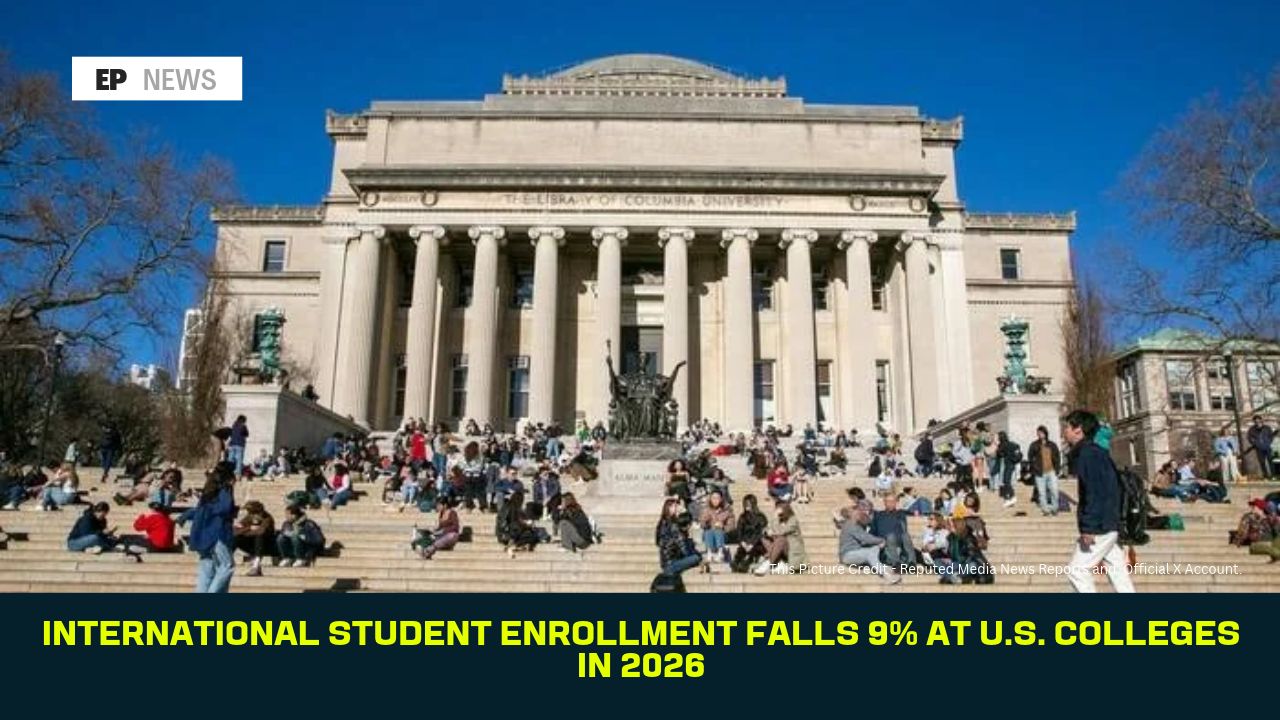
International Student Enrollment Falls 9% at U.S. Colleges in 2026
November 16, 2026 | U.S. Education News
The United States is experiencing another decline in international student enrollment, raising concerns across colleges, universities and the wider higher education sector. New figures released Monday show that the number of international students at U.S. campuses decreased by 9% during the fall 2026 semester compared with the previous year.
The latest findings come from the Institute of International Education (IIE), which surveyed more than 800 American colleges and universities. The report also found that the number of new international students entering the United States for the first time fell by 15%.
The figures point to continuing challenges for American higher education institutions that depend on international students for tuition revenue, academic research, campus diversity and other contributions.
Several factors may be influencing students’ decisions, including visa application difficulties, travel restrictions, rising education costs, uncertainty surrounding immigration policies and increasing competition from universities in other countries.
The decline is particularly significant for graduate programs, where international enrollment dropped by 15%. Undergraduate enrollment also decreased, although by a smaller amount.
For international students considering the United States, the latest figures highlight an increasingly complicated environment. For American universities, they raise questions about future enrollment, institutional finances and the country’s position as a leading destination for global education.
What the New International Student Report Reveals
The Institute of International Education released its Fall 2026 Snapshot on International Student Enrollment on November 16.
The preliminary report is based on responses from 809 U.S. higher education institutions. It provides an early picture of enrollment trends for the 2026–27 academic year.
According to the findings, international student numbers declined across several categories.
The overall number of international students, including those enrolled in academic programs and participating in Optional Practical Training, fell by 9%.
The report identified a 15% decrease in new international student enrollment. Graduate-level enrollment also fell by 15%, while undergraduate enrollment declined by 3%.
Participation in Optional Practical Training, commonly known as OPT, decreased by 6%.
These figures suggest that the challenges are not limited to students entering American universities for the first time. They also involve graduate education and the temporary employment opportunities available to international graduates.
The survey is preliminary rather than a complete count of every international student in the country. The IIE plans to provide a broader picture through its future reporting.
Nevertheless, the results offer an important indication of the direction of international education in the United States.
Why Are Fewer International Students Choosing American Universities?
There is no single explanation for the enrollment decline. The IIE survey points to several factors that colleges believe are influencing prospective students.
1. Visa Application Difficulties
Visa processing has become one of the major concerns for international students planning to study in America.
According to the survey, 88% of responding institutions identified issues in the visa application process as a factor contributing to declining enrollment.
For students applying from overseas, delays or uncertainty can create serious practical problems. University admission, financial planning, housing arrangements and travel bookings often depend on receiving the necessary visa within a particular period.
When students cannot predict whether they will receive permission to travel on time, they may decide to postpone their education or accept an offer from another country.
Universities can provide admission letters and academic support, but they cannot independently control federal visa processing decisions.
2. Travel Restrictions and Immigration Uncertainty
Travel restrictions were another major concern identified by American colleges.
Around 70% of institutions surveyed said travel restrictions contributed to the decline in international enrollment.
International students and their families often consider more than academic rankings when selecting a country. They also evaluate whether they will be able to enter the country, maintain their immigration status and complete their studies without unexpected interruptions.
Recent immigration enforcement actions and policy changes have contributed to uncertainty for some students.
The Associated Press reported that the administration’s actions have included terminating the legal status of thousands of international students, as well as detentions and deportations involving some students.
The administration has said its policies are intended to address immigration enforcement and perceived weaknesses in the student visa system. However, university representatives say uncertainty can make the United States less attractive to prospective applicants.
3. Rising Cost of American Education
The financial cost of studying in the United States is another important consideration.
Tuition, accommodation, food, transportation, health insurance and other living expenses can make an American degree expensive, particularly for students coming from countries where currency exchange rates make U.S. education more costly.
The IIE survey found that 45% of institutions identified costs as a factor contributing to declining international enrollment.
Students may compare the total cost of studying in the United States with options in Canada, the United Kingdom, Australia, Germany and other destinations.
If another country offers a suitable degree at a lower overall cost, some students may choose that alternative.
4. Growing Competition From Other Countries
American universities continue to attract students from around the world, but they are no longer competing in an environment where the United States is the only major destination for internationally mobile students.
Universities in several countries are actively recruiting international applicants. Some offer English-language degree programs, research opportunities, scholarships and post-study employment pathways.
According to the IIE findings, 60% of responding institutions said students choosing other countries over the United States was a factor behind the decline.
This competition could become increasingly important if students believe that other destinations offer more predictable immigration arrangements or better value for money.
Graduate Programs Face a Larger Decline
One of the most notable findings in the report is the difference between graduate and undergraduate enrollment.
International graduate enrollment decreased by 15% in fall 2026, while undergraduate enrollment declined by 3%.
The larger graduate-level drop matters because international students play an important role in many American graduate programs.
They contribute to research projects, laboratories, engineering departments, business schools and other specialized academic areas.
Universities also recruit international graduate students for master’s and doctoral programs that require advanced academic preparation.
A sustained decline could make it harder for some institutions to maintain enrollment levels in particular departments.
It may also affect research activity if fewer international students apply for graduate opportunities.
However, the survey does not establish that every university or academic department is experiencing the same situation. Enrollment patterns can vary significantly between institutions, states and fields of study.
What the Decline Means for Indian Students
The findings are particularly relevant to students from India, one of the largest sources of international students attending American universities.
The Associated Press reported that the latest survey identified declines among students from India, although the report did not provide a specific current percentage for the fall 2026 decrease in Indian enrollment.
For Indian applicants, the United States remains an important destination for higher education, especially in technology, engineering, business, computer science and research-based programs.
However, students considering American universities may now need to pay closer attention to several issues.
These include the timing of visa applications, the financial cost of education, university refund policies, accommodation arrangements and the rules governing work opportunities after graduation.
Students should also verify immigration information through official U.S. government sources rather than relying entirely on social media posts or unofficial claims.
A decline in overall enrollment does not mean that American universities have stopped accepting Indian applicants. Individual admission decisions continue to depend on university requirements, academic qualifications, available places and applicable immigration rules.
The important point is that prospective students should make decisions using current, verified information.
OPT Program Adds Another Layer of Uncertainty
Optional Practical Training is an important consideration for many international students completing degrees in the United States.
The program allows eligible international graduates with F-1 status to undertake temporary practical work related to their field of study, subject to applicable rules.
For some students, OPT is an important opportunity to gain professional experience after completing a degree.
However, the latest IIE survey found that participation in OPT declined by 6% during fall 2026.
The decline comes as the Department of Homeland Security has proposed a rule that would require colleges and universities to pay a $70,000 fee for every student participating in the program.
The proposal has not been finalized. It should therefore not be treated as an existing fee that universities are already required to pay.
The proposal has nevertheless become part of the discussion about the future of international graduate employment.
The IIE survey found that 95% of responding institutions believed prospective international students would likely consider another country if OPT opportunities were limited.
That finding suggests that post-graduation employment options are an important part of how students evaluate international study destinations.
For universities, uncertainty around OPT could affect recruitment even before any proposed regulation becomes final.
American Universities Could Face Financial Pressure
International students contribute to university finances through tuition payments, housing, campus services and other spending.
Some universities depend more heavily on international enrollment than others. A decline can therefore create different levels of financial pressure across the higher education sector.
The Associated Press reported that Cleveland State University experienced a 46% decrease in international enrollment over two years.
The university’s international student population fell from 1,542 in fall 2025 to 828 in fall 2026. Its provost estimated that the budgetary impact could range from $2 million to $4 million.
This example illustrates how declining enrollment can affect an individual institution. It should not be interpreted as the financial experience of every U.S. university.
NAFSA, an association representing international education, also examined the economic impact of the enrollment decline with JB International.
Its analysis projected that the fall 2026 decline would translate into more than $2.4 billion in lost revenue and more than 31,000 fewer jobs.
These are estimates based on the enrollment data and economic analysis, not a final government count of jobs already eliminated.
The broader concern is that international education supports economic activity beyond university tuition. Students also spend money on rent, food, transportation, shopping and local services.
A prolonged decline could therefore affect communities surrounding universities as well as the institutions themselves.
Will the United States Lose Its Position as a Leading Study Destination?
The United States remains one of the world’s major destinations for international higher education.
Its universities offer a wide range of academic programs, research facilities, professional networks and opportunities to study with students from different countries.
However, maintaining that position requires more than strong academic institutions.
Prospective students also consider whether the admission and visa process is understandable, whether they can afford the degree and whether they have a realistic opportunity to complete their education.
The latest enrollment report suggests that these factors are becoming increasingly important.
Other countries may benefit if international applicants decide that their education and career plans are easier to pursue elsewhere.
Still, the new figures do not prove that the United States will lose its position as a leading destination. The country continues to attract a large international student population, and future enrollment will depend on how policies, university recruitment and global competition develop.
The IIE’s preliminary survey provides an early warning rather than a final judgment about the future of American higher education.
What Happens Next?
The next important development will be whether international student enrollment stabilizes or continues to decline during the 2026–27 academic year.
Universities may respond by strengthening international recruitment, providing clearer visa guidance, expanding scholarship opportunities and improving support services for overseas students.
Federal immigration decisions will also remain important.
Any final action involving OPT fees, student visa rules or international travel could influence how prospective students and universities plan for future academic years.
For now, the IIE’s fall snapshot shows that American institutions are facing a difficult enrollment environment.
The full picture will become clearer when more comprehensive data becomes available.
Frequently Asked Questions
1. Did international student enrollment fall in the United States in 2026?
Yes. The Institute of International Education’s preliminary Fall 2026 Snapshot found that international student numbers at responding U.S. institutions declined by 9% compared with the previous year.
2. How much did new international student enrollment decline?
The survey found that new international student enrollment fell by 15% in fall 2026.
3. Which student category experienced the largest decline?
Graduate enrollment experienced a 15% decline. Undergraduate enrollment decreased by 3%, while participation in Optional Practical Training declined by 6%.
4. Are fewer Indian students going to the United States?
The Associated Press reported that the latest survey identified declines among students from India. However, the preliminary findings did not provide a specific fall 2026 percentage for the decline in Indian enrollment.
5. Why are international students choosing other countries?
The survey identified visa application difficulties, travel restrictions, rising education costs and competition from other study destinations as contributing factors.
6. Has the proposed $70,000 OPT fee become law?
No. The Department of Homeland Security has proposed the fee, but it has not been finalized. Students and universities should follow official government announcements for updates.
7. How could the decline affect American universities?
Lower international enrollment can reduce tuition revenue and spending in university communities. The impact will vary depending on how much each institution relies on international students.
Final Thoughts
The 9% decline in international student enrollment is an important development for American higher education. The latest findings show that international students are weighing visa procedures, immigration uncertainty, education costs and future employment opportunities when deciding where to study.
For U.S. universities, the challenge will be to remain attractive to talented students from around the world while navigating changes in immigration policy and global competition.
The United States continues to offer significant academic opportunities. However, the latest figures suggest that universities and policymakers will need to pay close attention to the concerns of international applicants if they want to maintain the country’s appeal as a destination for global education.
Reporting date: November 16, 2026
Data source: Institute of International Education, Fall 2026 Snapshot on International Student Enrollment.
Sources and Further Reading
- Associated Press — Fewer students are traveling from abroad to study at US universities, report shows.
- Institute of International Education — Fall 2026 Snapshot on International Student Enrollment: Key Findings.
- NAFSA — Fall 2026 International Student Enrollment Snapshot & Economic Impact.
- Inside Higher Ed — International Student Enrollment Down 9% in Fall 2026.