
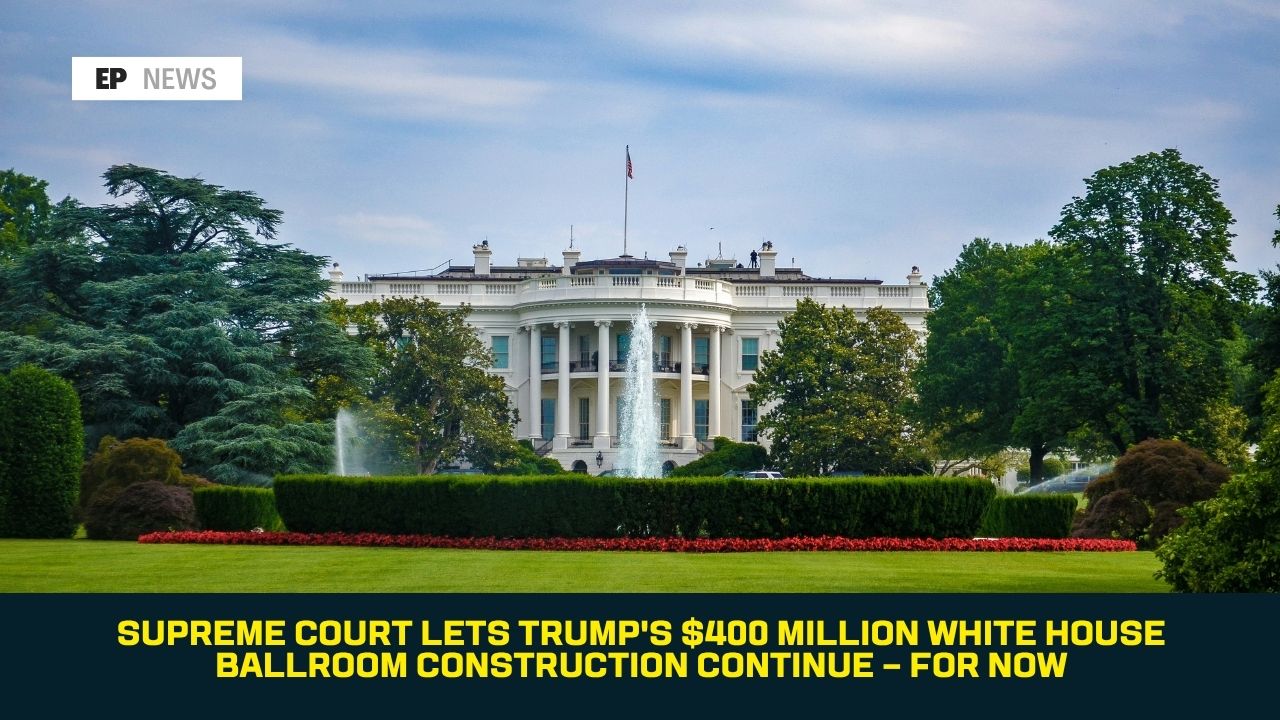
Supreme Court Lets Trump’s $400 Million White House Ballroom Construction Continue — For Now
The Supreme Court on Friday, August 21, temporarily allowed President Trump to continue construction on his controversial $400 million White House ballroom, pausing a lower court order that would have halted work at midnight. The decision doesn’t resolve the underlying legal fight over whether Trump had authority to demolish the East Wing and build the massive addition without congressional approval — it simply buys the justices more time to consider the administration’s emergency appeal.
What the Court Actually Decided
Chief Justice John Roberts, who oversees emergency appeals arising from the Washington, D.C. area, signed a brief, one-page administrative stay Friday afternoon, according to Newsweek. The order froze a ruling from the U.S. Court of Appeals for the D.C. Circuit that would have required construction to stop while a lawsuit challenging the project proceeded.
CNN was explicit about what the order does and doesn’t mean: “Friday afternoon’s order doesn’t address the legality of the project, which two other courts have said Trump is pursuing unlawfully because Congress hasn’t approved it. Instead, it’s meant to give the justices additional time to consider Trump’s request that the adverse rulings be paused indefinitely.” A spokesperson for the National Trust for Historic Preservation, the group challenging the project, echoed that characterization directly to Newsweek: “We are aware of the administrative stay. To be clear, this is not a final decision on the merits of the government’s stay application, and we await further action.”
How the Case Got Here
The legal fight traces back to December 2025, when the National Trust for Historic Preservation sued Trump and several federal agencies, arguing the president needed congressional authorization before demolishing the East Wing and constructing a massive addition. The suit alleged violations of the Administrative Procedure Act and the National Environmental Policy Act, according to Fox News’s coverage of the case’s early stages.
U.S. District Judge Richard Leon, a George W. Bush appointee, initially declined to block construction in February, finding the National Trust hadn’t shown “irreparable harm” under its original complaint, though he left the door open for the group to amend its filing, according to NPR. The National Trust’s amended complaint eventually succeeded: Leon ruled against the administration in March, finding construction needed to stop unless it involved safety and security additions specifically, according to NPR’s more recent reporting.
The case then moved to the D.C. Circuit, which issued a 2-1 ruling siding with the preservation group. “Whether or not a massive ballroom should be constructed is for Congress to decide and is not a matter for Executive self-help,” the two Democratic-appointed judges wrote, according to Al Jazeera. A third judge, appointed by Trump, dissented, arguing the National Trust lacked legal standing to sue and calling the injunction a “blatant abuse of discretion.” The appeals court paused its own ruling for 14 days to give the administration time to petition the Supreme Court — the deadline that Friday’s stay ultimately intervened to block.
The Administration’s Argument
Solicitor General D. John Sauer told the justices the ballroom was necessary given past threats to the president’s life, national security needs, and architectural considerations, according to CNN. “The President of the United States of America is not a tenant, but rather the sole, elected head of the Executive Branch, and Congress has authorized him to renovate,” Sauer argued, urging the court to stay the injunction “for the sake of the President’s safety, the continuity of government, and the separation of powers.”
Axios noted that the White House has pointed to an alleged plot against a July UFC fight at the White House and an attack at the White House Correspondents’ Dinner as evidence of a heightened threat environment justifying the project’s security features, which Trump has said will include bomb shelters, a hospital, sniper nests, and a drone-restricted roof.
The National Trust’s Argument
The National Trust has maintained throughout the litigation that the scale of the project — now a 90,000-square-foot addition, compared to the White House’s own 55,000 square feet — requires congressional sign-off that Trump never sought. In its brief filed ahead of Friday’s ruling, the group argued that allowing construction to continue would effectively end the case altogether: “Rather than obtain permission from Congress, Petitioners have instead decided to try to outrun judicial review” by accelerating construction, according to NPR.
National Trust President and CEO Carol Quillen has previously argued the addition “may also permanently disrupt the carefully balanced classical design of the White House,” according to earlier AOL reporting on the case.
How Fast the Project Has Moved
Court filings paint a picture of construction proceeding at an unusually rapid pace. According to The Washington Post and NBC News, a White House official told the Supreme Court that as of August 14, the project was 65% complete, with a 250-person crew working 20 hours a day, seven days a week, and underground facility construction nearly finished.
The project’s price tag has also grown substantially since it was first announced. According to earlier Yahoo News coverage, the ballroom’s estimated cost rose from an initial $200 million to $300 million and eventually to $400 million, with Trump telling reporters in December that the project would be privately funded through donations rather than taxpayer dollars.
The Political Reaction
Trump celebrated the ruling on Truth Social. “We are grateful for the Decision of the United States Supreme Court,” he wrote, according to CNBC. “The Military/Ballroom Complex being built on the hallowed grounds of the White House, which is so vital for National Security, will be THE GREATEST OF ITS KIND!” He added that construction remained “under budget and ahead of schedule.”
Senate Minority Leader Chuck Schumer offered a sharply critical response on X, according to CNBC: “The MAGA Supreme Court is rubber stamping Trump’s vanity-driven, gilded corruption.”
What Happens Next
Friday’s order is explicitly temporary and doesn’t resolve the underlying question of whether Trump exceeded his authority. The Supreme Court has not indicated when it will rule on the administration’s full request to pause the lower court’s adverse rulings indefinitely, meaning the ballroom’s ultimate legal fate — and whether construction could still eventually be forced to stop or be undone — remains genuinely unresolved even as work continues in the meantime.
FAQ
Did the Supreme Court rule that Trump’s ballroom project is legal? No. Friday’s order was an administrative stay giving the justices more time to consider the case, not a ruling on whether the underlying construction is lawful.
Why did lower courts rule against the project? Both a district court and a 2-1 majority on the D.C. Circuit Court of Appeals found that Trump needed congressional approval to demolish the East Wing and construct the ballroom, rejecting the administration’s argument that presidential renovation authority alone was sufficient.
How much does the ballroom project cost? An estimated $400 million, up from an initial $200 million estimate, funded through private donations rather than taxpayer money, according to the administration.
How far along is construction? As of August 14, 2026, court filings indicated the project was 65% complete, with underground construction nearly finished and a 250-person crew working around the clock.
Who is challenging the project in court? The National Trust for Historic Preservation, a nonprofit group that argues the president lacked authority to demolish the East Wing and build an addition of this scale without congressional authorization.
Conclusion
Friday’s Supreme Court order gives the Trump administration exactly what it needed in the short term — continued construction — without resolving the more fundamental legal question both lower courts have already answered against the White House. With the ballroom already 65% complete and the National Trust warning that allowing work to continue risks making the case effectively moot regardless of how the justices eventually rule, the coming weeks will show whether the Supreme Court intends to weigh in more decisively or simply let facts on the ground settle a dispute the courts have so far been unable to resolve through litigation alone.
Sources: NPR, Al Jazeera, NBC News, CNN, CNBC, Axios, The Washington Post, Newsweek, Fox News, Yahoo News/AOL (reporting dated August 21, 2026, and earlier 2026 coverage).