Treasury Vows “Toughest Sanctions in History” to Collapse Iran’s Government
Treasury Secretary Scott Bessent said Thursday, August 20, that the United States will impose “the toughest sanctions in history” on Iran, unveiling the full package Monday, August 24, as President Trump’s administration shifts toward what officials are calling all-out economic warfare aimed at collapsing Tehran’s government rather than pursuing renewed military strikes.
What Bessent Announced
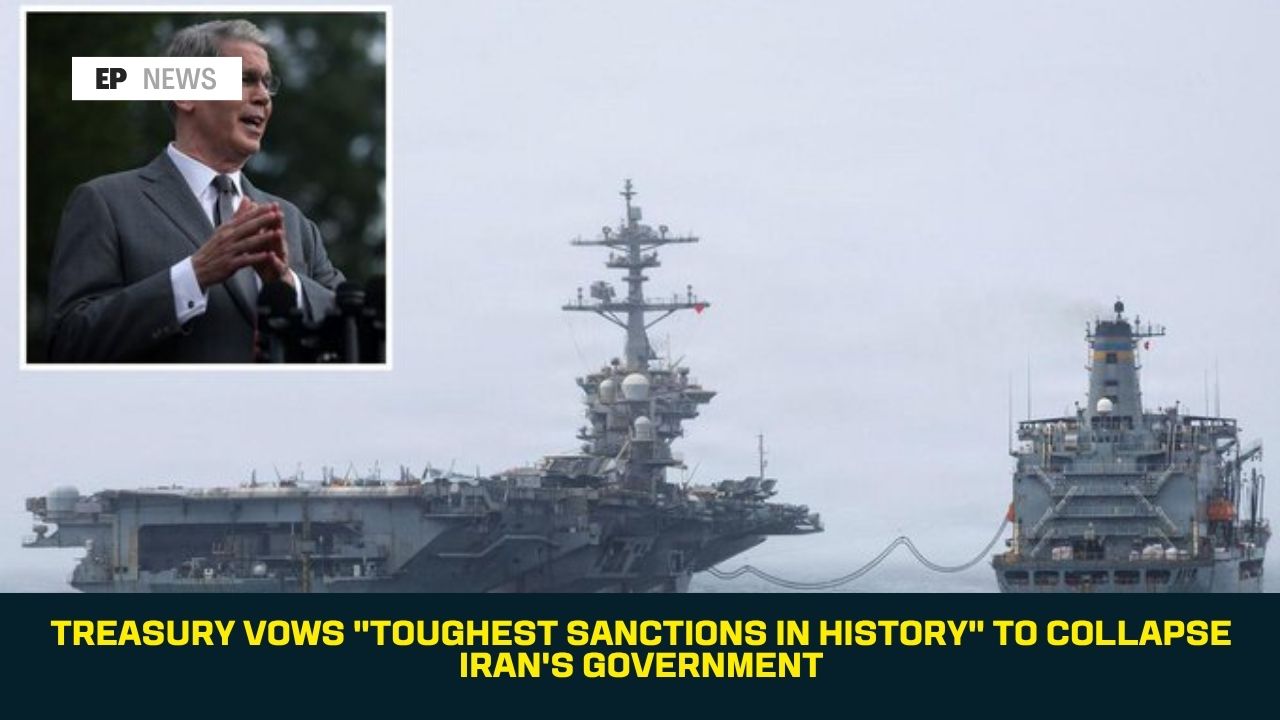
“It is a one-two punch. We have the blockade [on Iran], and we are going to have the toughest sanctions in history,” Bessent told CNBC, referring to the U.S. naval blockade imposed on Iran in April and briefly paused in mid-June before being reinstated. “It is going to work in Iran, and we are going to collapse this regime. It is time for our allies and the rest of the world to make a decision.”
Bessent framed the strategy in explicitly binary terms for other nations. “We are going to all of our allies, and this is going to be the greatest coordinated economic isolation in the history of the world,” he said, according to Democracy Now’s coverage of his remarks. “And we are going to them and saying, ‘You are either with us or against us.'” He warned that any country continuing to transfer money to Iran, buy its oil, or conduct seaborne ship transport on its behalf would face the “full might and force” of the U.S. Treasury and government, according to Al Jazeera.
Trump’s “Economic D-Day”
Bessent’s comments followed a Wednesday night Truth Social post from Trump promising “Economic Warfare and Isolation on an unprecedented scale.” Trump wrote that Iran had failed to take advantage of the opportunity he’d given it to reach a deal, declaring the U.S. would launch the “MOST CRUSHING ECONOMIC OPERATION EVER TAKEN AGAINST ANY COUNTRY,” according to The Epoch Times. Trump added a specific warning for third parties: “ANY country that allows its financial institutions, businesses, airports, or government entities to provide any type of lifeline to Iran will itself face TREMENDOUS Economic Consequences.”
Trump called the coming campaign an “ECONOMIC D-DAY,” according to a Substack account of the announcement, and said all U.S. allies needed to stand with Washington to “isolate, and defeat” the Iranian regime.
Why Officials Say This Reduces the Chance of More Fighting
Bessent explicitly framed the sanctions push as an alternative to renewed direct combat, not a prelude to it. “If we are doing the maximum economic pressure, then that means that likely there will not be a large-scale kinetic restart,” he told CNBC, using “kinetic” as a term for military action — though he added the caveat “that is for now,” according to The National.
Bessent pointed to precedent he believes supports the strategy’s effectiveness. “I see lots of reports that said, ‘oh, well, this has never worked.’ It does work, because we have a combination. It is a one-two punch,” he said, according to the Jerusalem Post. “It worked in Venezuela once we put up the blockade. It is working in Cuba right now, and it is going to work in Iran.”
China’s Rejection and the Oil Question
The sanctions push has already run into resistance from one of Iran’s most significant trading partners. China, which buys more than 80% of Iran’s shipped oil according to 2025 data from analytics firm Kpler, formally rejected the U.S. campaign, declaring it does not accept measures lacking a basis in international law and will not comply.
Bessent avoided directly answering whether the U.S. would target China specifically, saying such conversations were best conducted “in private,” according to Reuters. He did note that China receives roughly 50% of its energy from within the Persian Gulf region, suggesting Beijing has its own incentive to support reopening the Strait of Hormuz and easing the broader energy crisis. Engaging in further economic warfare with China carries real risk for Washington given the country’s role as a major U.S. exporter, including of critical rare-earth minerals.
Oil prices rose to a more than three-week high following the sanctions announcement, a market reaction Bessent said he found puzzling. “I’m not sure why oil has popped up on this,” he told CNBC, adding that if the pressure campaign works as intended, energy markets should eventually benefit from a resolution.
Some Signs of International Support
Not every country has resisted the pressure campaign. The United Arab Emirates announced it was severing all trade and financial ties with Iran, according to The National, a move that came after Iran fired two missiles toward the Emirates earlier in the week. UAE strategic affairs director Afra Al Hameli said the country “remains firmly committed to safeguarding the integrity of the international financial system, in line with international law and the highest global standards.”
Iran’s Response
Iran’s Foreign Ministry condemned the sanctions threat as “illegal and inhumane,” according to Democracy Now. Iranian officials have separately maintained that any resolution to the broader conflict, including reopening the Strait of Hormuz, depends on the U.S. accepting Iran’s own conditions — including a regional ceasefire, sanctions relief, and the unfreezing of Iranian assets — rather than on Washington’s sanctions campaign alone.
The Broader Context
Thursday’s announcement lands nearly six months into the U.S.-Israel war against Iran, which began February 28, and follows the collapse earlier in August of a 60-day negotiating window established under a June memorandum of understanding between the U.S. and Iran. That negotiating period expired without producing a broader peace agreement, prompting Trump’s shift toward the more aggressive economic posture.
The strategy also builds on a long history of U.S. sanctions pressure against Iran. According to NPR reporting from earlier this year, Bessent had already credited the administration’s sanctions campaign with contributing to a collapse in Iran’s economy and runaway inflation, which triggered protests inside the country that Iran’s government met with a violent crackdown reported to have killed at least 7,000 people.
FAQ
When will the new Iran sanctions be formally announced? Monday, August 24, 2026, at a press conference Bessent said he will hold to detail the specific measures.
What does Bessent mean by “one-two punch”? He’s referring to the combination of the existing U.S. naval blockade of Iranian ports, first imposed in April, together with the new sanctions package — arguing the two measures working together will be more effective than either alone.
How has China responded to the sanctions campaign? China has formally rejected the U.S. measures, saying it doesn’t accept actions lacking a basis in international law and won’t comply with the economic isolation campaign.
Does this mean the U.S. plans to avoid further military action against Iran? Bessent suggested maximum economic pressure makes a “large-scale kinetic restart” less likely “for now,” though he stopped short of ruling out future military action entirely.
Has any country agreed to join the sanctions push? The UAE announced it was cutting all trade and financial ties with Iran, a decision that followed Iran firing missiles toward the Emirates earlier in the week.
Conclusion
Thursday’s announcement marks a significant escalation in the economic dimension of the ongoing U.S.-Iran conflict, with the administration explicitly framing sweeping sanctions and international pressure as an alternative path to ending the war rather than a supplement to renewed strikes. With China already rejecting the campaign, oil markets reacting nervously, and the full scope of the sanctions still to be detailed Monday, the coming days will test whether Bessent’s confidence in the strategy — built on comparisons to Venezuela and Cuba — translates into the kind of pressure capable of reshaping Iran’s position at the negotiating table.
Sources: CNBC, Al Jazeera, Reuters (via GCaptain, Business Standard, Kathmandu Post, Red Lake Nation News), The Epoch Times, The Jerusalem Post, The National, Democracy Now!, NPR (reporting dated August 19-21, 2026).