
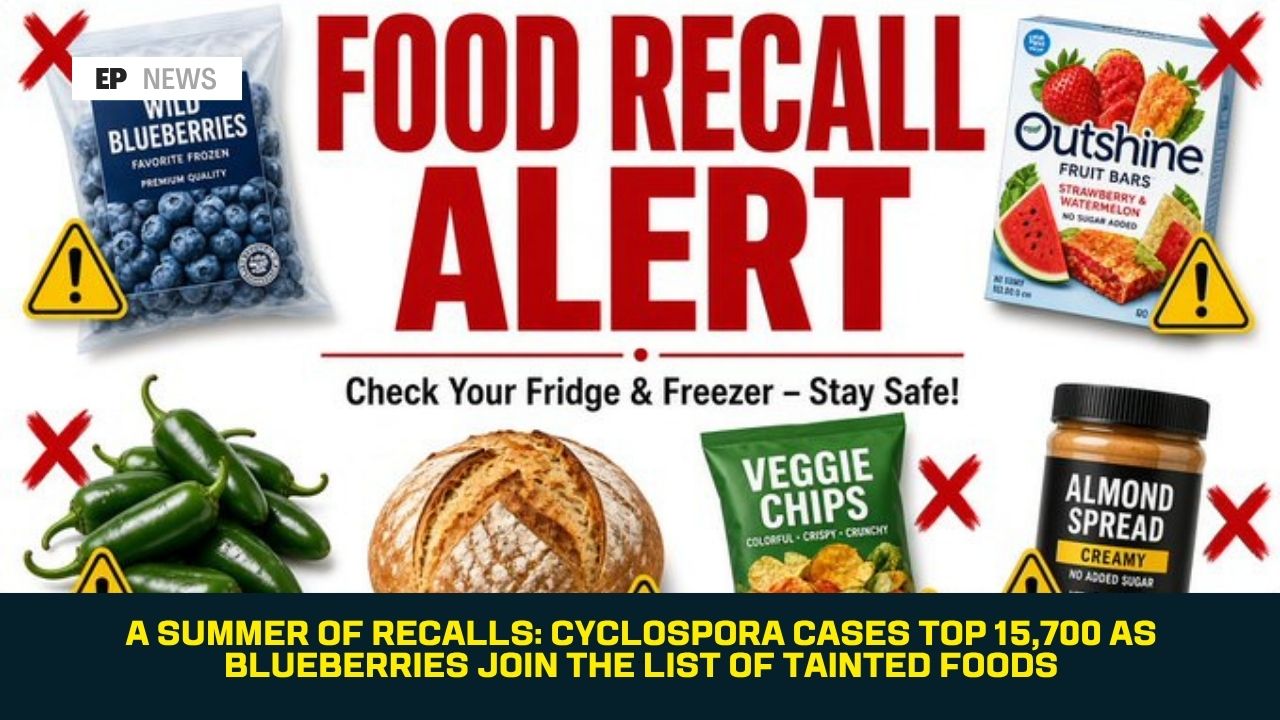
A Summer of Recalls: Cyclospora Cases Top 15,700 as Blueberries Join the List of Tainted Foods
Four separate multistate foodborne illness outbreaks have run concurrently across the United States this summer, and the tally continues to grow: the CDC’s latest figures put confirmed cyclosporiasis cases at 15,716, with nearly 12,000 more under investigation, while a newly identified E. coli outbreak tied to Publix-brand frozen blueberries adds a fourth active thread to a season food safety advocates say has been unusually active.
Cyclospora: The Summer’s Largest Outbreak
The largest of the four outbreaks by far centers on cyclosporiasis, a parasitic illness linked to Taylor Farms de Mexico shredded iceberg lettuce. As of the most recent CDC count, 15,716 laboratory-confirmed cases have been reported across nearly every state, with the agency aware of at least 11,841 additional unconfirmed cases still requiring investigation — putting the outbreak’s total scope potentially above 27,000 people, according to U.S. News & World Report.
Michigan remains the outbreak’s epicenter, reporting 13,909 cases in the most recent weekly count alone. The outbreak has caused 828 hospitalizations and two deaths, according to U.S. News. All recalled iceberg lettuce is now past its expiration date and off store shelves, and the CDC continues investigating whether additional produce sources beyond lettuce may be contributing to the outbreak’s scale, though no additional commodity has been confirmed.
Salmonella and Jalapeños: A Restaurant-Heavy Outbreak
Running alongside the lettuce outbreak is a separate Salmonella Javiana outbreak tied to jalapeño peppers from Sinaloa, Mexico, distributed by Coast Citrus Distributors. According to the FDA’s most recent outbreak page, 431 people across 32 states have been infected, with 57 hospitalizations and no deaths reported.
More than 90% of the 224 people the CDC has interviewed in detail reported eating at Chipotle or QDOBA in June or July, according to U.S. News. Both restaurant chains removed the implicated jalapeños once notified and switched suppliers, and the CDC noted the last recorded illness onset was August 2 — a sign the recalled peppers are likely no longer circulating in the food supply, even as the broader investigation, including additional recalled products like salsa, guacamole, and pico de gallo sold at retailers including Whole Foods, remains active.
Salmonella and Eggs: A Separate, Unrelated Outbreak
A third, entirely distinct outbreak involves Salmonella Enteritidis tied to eggs produced by Midwest Poultry Services in North Manchester, Indiana, and shipped from a Texas facility. According to Food Network’s coverage of the FDA’s Class I reclassification, 98 people across 17 states have been infected between November 2025 and June 2026, with 26 hospitalizations and no deaths.
The eggs, sold under brand names including Kroger, Simple Truth, Brookshire’s, Cal-Maine Sunups, and Country Morning, reached retailers including Kroger and Brookshire Grocery stores across Arkansas, Louisiana, Mississippi, New Mexico, Oklahoma, and Texas. The FDA has stated that Midwest Poultry Services “does not account for all the illnesses in this outbreak,” according to Food Network, meaning the source investigation may not yet be fully resolved even with the recall in place.
E. coli and Blueberries: The Newest Addition
The most recently identified outbreak involves frozen blueberries recalled by Publix under its GreenWise brand. According to Newsweek, Publix recalled all lots of GreenWise Organic Whole Blueberries and Organic Whole Mixed Berries on July 29 after the products were linked to potential contamination with E. coli O145, a strain capable of causing severe stomach cramps, diarrhea, and vomiting. As of July 30, the FDA had reported 12 illnesses in Florida and Georgia, including four hospitalizations.
The recalled berries were shipped to Publix stores across eight states: Alabama, Florida, Georgia, Kentucky, North Carolina, South Carolina, Tennessee, and Virginia, according to CDC outbreak data. A related recall from producer Frutas y Hortalizas del Sur S.A. was issued July 3, ahead of the broader Publix recall later that month.
Why Advocates Are Raising Concerns About the Pattern
The sheer number of overlapping outbreaks running simultaneously this summer has drawn attention from food safety advocates well beyond the specific products involved. According to Newsweek’s broader review of 2026’s recalls, advocates have pointed to the volume of recalls and outbreaks in recent years as evidence of vulnerabilities in the nation’s food safety system, though there’s no clear consensus on a single driving cause — with experts pointing to a mix of increasingly complex global supply chains, large-scale production practices, and questions about regulatory oversight and outbreak-detection capacity.
Newsweek’s review also noted that federal investigators continue actively monitoring several of these outbreaks as of late August, meaning additional recalls or updated case counts remain possible before the year is out.
A Practical Guide: What’s Actually Still a Risk
Despite the scale of this summer’s recalls, health officials have offered some reassurance about what remains genuinely risky today. According to U.S. News, harder-to-clean produce like cilantro, basil, raspberries, and green onions have been linked to past cyclospora outbreaks, but experts say there’s no need to avoid these foods generally — cooking fruits and vegetables remains the only way to guarantee the cyclospora parasite is killed, and all of the specifically recalled lettuce is now expired and off shelves.
For the ongoing outbreaks still considered active — the jalapeño-linked Salmonella cases and the blueberry-linked E. coli cases — consumers should check any recalled products still in their homes against the specific brand names, lot codes, and date ranges listed in each recall notice, since recalls are highly specific and non-matching products from the same general food category remain safe to eat.
FAQ
How many separate foodborne illness outbreaks are currently active? Four: cyclosporiasis linked to iceberg lettuce, Salmonella linked to jalapeños, Salmonella linked to eggs, and E. coli linked to Publix GreenWise frozen blueberries.
Which outbreak is the largest? The cyclosporiasis outbreak, with 15,716 confirmed cases and nearly 12,000 more under investigation as of the latest CDC update.
Has anyone died in these outbreaks? Yes, in the cyclosporiasis outbreak specifically — two deaths have been reported, along with 828 hospitalizations. No deaths have been reported in the Salmonella or E. coli outbreaks.
Are all of the recalled products still on shelves? No. The recalled lettuce is now expired and off shelves, and the jalapeño-linked outbreak’s last recorded illness onset was August 2, suggesting that product is largely out of circulation as well. The egg and blueberry recalls remain more recently active.
Why have there been so many outbreaks at once this summer? Food safety experts haven’t identified a single cause, pointing instead to a mix of factors including complex global supply chains, large-scale food production practices, and ongoing questions about regulatory oversight and detection capacity.
Conclusion
This summer’s convergence of four separate, unrelated foodborne illness investigations — spanning lettuce, jalapeños, eggs, and now blueberries — represents an unusually active stretch for U.S. food safety regulators, even as officials stress that each outbreak has a distinct, identified source rather than reflecting a single systemic failure. With the cyclosporiasis outbreak’s case count still climbing and federal investigators continuing to monitor several threads simultaneously, consumers are best served by checking specific recall notices against what’s actually in their kitchens rather than avoiding entire food categories unnecessarily.
Sources: CDC, FDA, U.S. News & World Report, Newsweek, Food Network (reporting dated August 19-20, 2026).