IndyCar Takes Over the National Mall This Weekend for the First-Ever Freedom 250 Grand Prix
More than 200,000 people are expected to descend on Washington, D.C.’s National Mall this weekend as the Freedom 250 Grand Prix brings professional IndyCar racing to the nation’s capital for the first time ever — a two-day, first-of-its-kind motorsports event built around America’s 250th anniversary celebrations.
What’s Happening and When
The event runs Saturday and Sunday, August 22-23, with the main race — the Freedom 250 Grand Prix itself — held Sunday at 1 p.m. ET, according to CNN. Saturday features practice and qualifying rounds, along with two exhibition races at 3 and 4 p.m. featuring motorsports legends including NASCAR Cup champions Jeff Gordon and Kurt Busch and Indianapolis 500 champions Tony Kanaan and Helio Castroneves, competing in identical 1996-2006 IROC Pontiac Firebirds, according to Spectrum News.
Sunday’s race will run 147 laps around a 1.7-mile, seven-turn street circuit, adding up to a symbolic 250 miles in honor of the nation’s semiquincentennial. Organizers extended the race distance specifically to hit that number. “The street course here was originally 125 laps because we wanted to fit in the TV window, and somebody said: ‘What’s the significance of 125 laps?'” Freedom 250 Grand Prix Chairman Bud Denker said, according to Spectrum News. “I went, ‘Duh.’ Let’s do 1.7 miles divided into 250.” The race will be broadcast live nationally on FOX.
The Course
The circuit runs down Pennsylvania Avenue from Third Street to Ninth Street, doubling back and heading south along Independence Avenue alongside the National Mall before looping back, according to Spectrum News. Turn 1 has the U.S. Capitol’s west façade as its backdrop, and drivers will pass the National Archives, the National Gallery of Art, and the Smithsonian National Air and Space Museum along the route, with pit lane positioned on the Pennsylvania Avenue straightaway between Turns 1 and 2, according to the Jefferson City News-Tribune.
Cars are expected to reach top speeds of up to 190 miles per hour, according to Spectrum News, while CNN reported speeds up to 180 miles per hour — either figure making it one of the faster street circuits on the IndyCar calendar. The race audio can reach roughly 135 decibels, according to CNN, compared to about 88 decibels for a typical motorcycle.
Where the Idea Came From
The race traces back to a January 30, 2026 executive order signed by President Trump, according to Wikipedia’s tracking of the event’s history, which directed the secretaries of the Interior and Transportation to design the course layout within 14 days and expedite all necessary permits. Transportation Secretary Sean Duffy announced the race alongside Trump in the Oval Office that day, declaring “Freedom doesn’t ring, it revs!” according to the Department of Transportation’s official announcement.
The race is being organized in partnership with Freedom 250, a group commissioned by Trump to host various events celebrating the country’s 250th anniversary, including an earlier UFC fight held at the White House and the Great American State Fair on the National Mall, according to the Deseret News. Penske Entertainment Corp., which owns the IndyCar series, is organizing and funding the race itself — a structure similar to how the UFC event was arranged, with Penske and UFC both serving as event sponsors.
Despite sharing its name with the broader Freedom 250 semiquincentennial initiative, event chair Bud Denker clarified to NPR that the race itself isn’t formally affiliated with or funded by that committee. “We’re using the name Freedom 250 Grand Prix, but there’s no affiliation in terms of we’re getting money from the committee or providing them money,” Denker said.
A One-Time Event
Organizers have been explicit that this race won’t become an annual fixture on the National Mall. “This is a one-time-only event, because we’re celebrating the country’s 250th one time,” Denker told NPR. The original 2026 IndyCar Series schedule, released in September 2025, didn’t include a Washington stop at all — the race was added later specifically tied to the anniversary celebrations, according to Wikipedia.
The scale of the temporary construction effort has been substantial for a single weekend event. According to WMAL, organizers completed most of the track construction in just five weeks and expect to have it fully dismantled within roughly three weeks after the race, with more than 1,000 laborers working 12-hour shifts and coordination across roughly 30 different government agencies, according to Penske’s vice president of operations, Jonathan Bailey.
Impact on the City
The race has brought significant disruption to downtown Washington in the lead-up to the weekend. According to NBC4 Washington, road closures and security perimeters have made it difficult for commuters and residents to navigate the area, with officials advising anyone heading downtown to use Metrorail rather than drive. Access to some museums along the race route, including the Air and Space Museum, the Natural History Museum, and the National Museum of the American Indian, will be limited during the event.
Air travel is affected as well: the FAA said flights at Reagan National Airport will be paused for three hours Sunday, tentatively scheduled from 10:15 a.m. to 1:15 p.m., though the agency noted that window could change. Parking restrictions and road closures in some areas are expected to continue as late as September 15, according to NPR, even though most of the physical racetrack structure will be gone by Labor Day.
Trump’s Role in the Event
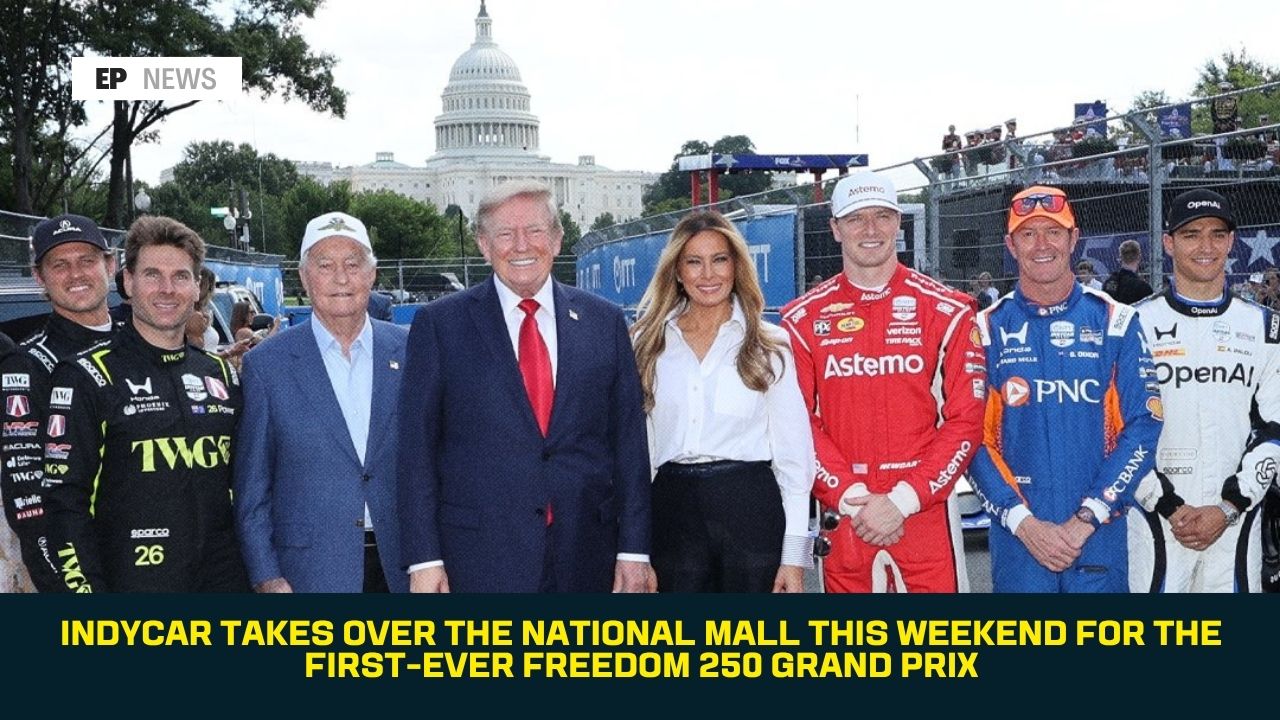
President Trump and First Lady Melania Trump were expected to take a ceremonial lap around the course in “The Beast,” the presidential limousine, ahead of the race, according to The Hill. Trump previously appeared at a Freedom 250 Grand Prix showcase outside the White House in July, and the race fits into what CNN described as Trump’s continued efforts to transform Washington through large-scale public events during his second term.
FAQ
When is the Freedom 250 Grand Prix? Saturday and Sunday, August 22-23, 2026, with the main 250-mile race held Sunday at 1 p.m. ET.
Where can I watch it? Live nationally on FOX on Sunday. General admission to attend in person was free through a ticketed lottery system, though that registration window has closed.
How many laps is the race? 147 laps around a 1.7-mile, seven-turn street circuit, adding up to a symbolic 250 miles.
Will this become an annual event? No. Organizers have said it’s a one-time event tied specifically to the country’s 250th anniversary celebrations.
How is downtown D.C. affected? Extensive road closures and security perimeters are in place around the National Mall, with some restrictions expected to last until September 15. Reagan National Airport flights will be paused for three hours Sunday, and access to several Smithsonian museums along the route will be limited.
Conclusion
The Freedom 250 Grand Prix caps off a summer of large-scale, Trump-backed public events in Washington with what organizers describe as a genuinely unprecedented spectacle — professional open-wheel racing weaving past some of the country’s most recognizable landmarks. Whether or not it returns in any form beyond this year, the race represents a striking, temporary transformation of the National Mall, drawing an expected 200,000 spectators to watch cars hit speeds approaching 190 miles per hour just blocks from the U.S. Capitol.
Sources: CNN, NPR, The Washington Post, Spectrum News, NBC4 Washington, FOX 5 DC, WJLA, WMAL, Jefferson City News-Tribune, Deseret News, The Hill, U.S. Department of Transportation, Wikipedia (reporting dated August 18-21, 2026).