
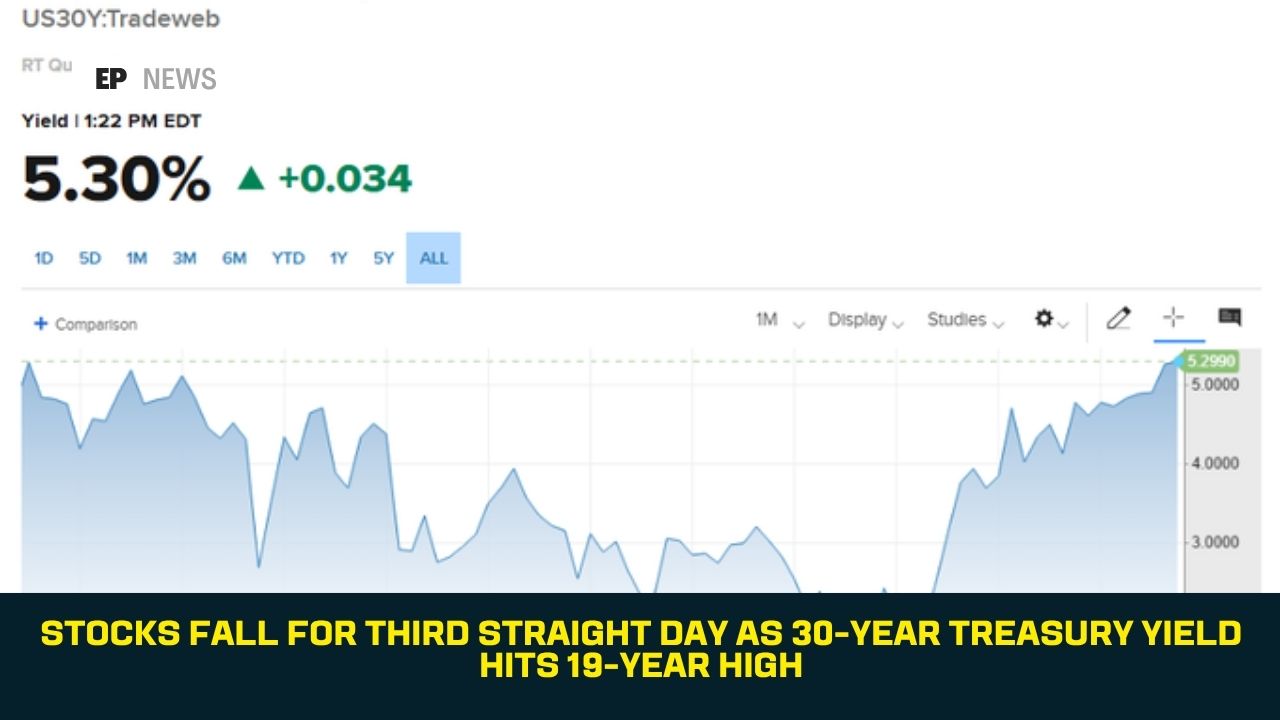
Stocks Fall for Third Straight Day as 30-Year Treasury Yield Hits 19-Year High
Wall Street pulled further from last week’s record high Tuesday, August 18, as a selloff in semiconductor stocks and a surge in long-term Treasury yields to their highest level in nearly two decades combined to push major indexes lower for a third consecutive session.
Tuesday’s Numbers
The S&P 500 fell 0.69% to close at 7,691.76, according to CNBC, marking its third straight losing session since setting an all-time high the previous Thursday. The Nasdaq Composite dropped 1.33% to 26,289.71, weighed down heavily by chip and storage stocks: Western Digital fell 7%, Sandisk dropped 9%, and Marvell Technology and Seagate Technology each fell roughly 8% to 9%. The Dow Jones Industrial Average was comparatively more resilient, shedding 116.38 points, or 0.22%, to close at 53,343.40.
Bloomberg’s broader market summary captured the day’s defining dynamic: “A selloff in chipmakers sent stocks lower, with the market also falling as growing anxiety about inflation and rising government debt kept bond yields elevated.” A closely watched gauge of semiconductor stocks fell 5.5%, according to Bloomberg, marking a sharp reversal for what had been 2026’s best-performing sector.
Why Bond Yields Are Climbing to Multi-Decade Highs
The U.S. 30-year Treasury bond yield hit a fresh 19-year high Tuesday, according to CNBC — and the U.S. wasn’t alone in seeing long-term borrowing costs surge. Japan’s 10-year bond yield reached its highest level in three decades, Germany’s 30-year bond yield hit its highest point since 2011, and the French 30-year government bond yield reached its highest level since 2008, according to CNBC’s markets coverage.
Trading Economics attributed the pressure to a combination of factors: higher borrowing costs offsetting recent support from AI infrastructure spending, inflation risks, and what the outlet described as “surging bond issuance from AI companies” raising different estimates on term premia — the extra yield investors demand for holding longer-dated debt. Despite the scale of the yield surge, CNBC noted the stock market’s reaction was comparatively muted, with Trivariate Research founder and CEO Adam Parker telling CNBC’s “Closing Bell”: “I think, ultimately, the economy is strong enough. I think the earnings and cash flows from these big companies are strong enough that they’ll power through any kind of scare that happens around this.”
Oil Surges as Iran Ceasefire Talks Collapse
Energy markets moved sharply Tuesday after President Trump rejected extending a temporary ceasefire with Iran that had expired Monday, without reaching a broader peace agreement, according to Benzinga. Yahoo Finance reported that oil prices climbed to their highest level in over two weeks after Trump said he intended to inflict more economic pain on Iran and threatened to “bomb” Oman if it interfered with U.S. plans for the Strait of Hormuz. Brent crude traded near $91 per barrel Tuesday, while U.S. benchmark West Texas Intermediate crude rose to $84 per barrel, according to Yahoo Finance.
Trading Economics noted that inflationary concerns were further magnified by the U.S. signaling a prolonged blockade on Iran’s tanker exports — a dynamic directly weighing on AI-related stocks specifically, with Nvidia, Meta, Tesla, and Oracle all dropping as much as 3% on the day, according to Trading Economics.
In response to Trump’s rejected ceasefire extension, Benzinga reported that a senior Iranian official threatened Tehran would shift to a “fully offensive” military posture if diplomatic efforts continued to fail.
Retail Earnings Provided a Rare Bright Spot
Amid the broader selloff, corporate earnings continued to outperform expectations. Home Depot’s stock gained roughly 1% Tuesday after the company beat earnings estimates despite the challenging macro backdrop, according to Trading Economics — part of a retail earnings season Charles Schwab’s market commentary described as impressing broadly, with 87% of companies beating expectations and most sectors outside health care posting double-digit earnings growth, even as investors continued digesting Friday’s surprise 0.6% drop in July retail sales alongside the prior week’s weak jobs report.
What Investors Are Watching Now
The path forward for interest rates remains a key focus heading into the Fed’s next moves. According to Charles Schwab, market pricing now points to roughly a 64% chance of a rate hike by year-end, according to the CME FedWatch Tool — a shift from the market’s earlier expectations for potential rate cuts. Minutes from the Federal Reserve’s last meeting were due later in the week, offering investors additional insight into how divided policymakers remain over the appropriate path forward.
Wolfspeed shares fell 7.6% Tuesday amid investor concerns about persistent negative margins ahead of the semiconductor company’s own August 19 earnings report, according to TheStreet — one of several individual stock stories playing out against the broader macro-driven selloff. Bio-Rad Laboratories tumbled 32.4% amid institutional selling and a technical correction following a sharp prior run-up, while Fabrinet sank 11.3% despite posting stronger-than-expected results, as investors focused instead on weaker margins and a softer near-term profit outlook.
FAQ
How did the major indexes perform Tuesday? The S&P 500 fell 0.69% to 7,691.76, the Nasdaq Composite dropped 1.33% to 26,289.71, and the Dow Jones Industrial Average fell 0.22% to 53,343.40 — marking the S&P 500’s third consecutive losing session.
Why did Treasury yields hit a 19-year high? A combination of inflation concerns, rising government debt issuance, and surging AI-related corporate bond issuance pushed the 30-year Treasury yield to its highest level since roughly 2007, with similar multi-decade highs hit in bond markets in Japan, Germany, and France the same day.
Why did oil prices rise sharply? President Trump rejected extending a temporary ceasefire with Iran that expired Monday and threatened further economic pressure on Iran, including a threat to “bomb” Oman if it interfered with U.S. plans for the Strait of Hormuz, pushing Brent crude toward $91 a barrel.
Which stocks were hit hardest? Semiconductor and storage companies led the declines, including Western Digital (-7%), Sandisk (-9%), Marvell Technology (-8%), and Seagate Technology (-9%), alongside AI-linked names like Nvidia, Meta, Tesla, and Oracle.
What are markets currently pricing in for the Fed’s next move? Roughly a 64% chance of a rate hike by year-end, according to the CME FedWatch Tool, a notable shift given earlier expectations that had favored potential rate cuts.
Conclusion
Tuesday’s selloff reflects how quickly markets can pivot from record-high complacency to renewed caution when geopolitical and rate-related risks converge at once — in this case, a collapsed Iran ceasefire driving oil and inflation fears higher just as global bond yields were already climbing to multi-decade extremes. With strong retail earnings from companies like Home Depot offering some counterbalance, and Fed meeting minutes still to come later in the week, investors are left weighing whether this pullback represents a genuine shift in market sentiment or, as Trivariate’s Adam Parker suggested, just a scare that a still-strong underlying economy and corporate earnings picture can ultimately absorb.
Sources: CNBC, Bloomberg, Yahoo Finance, Trading Economics, TheStreet, Benzinga, Charles Schwab, The Washington Post (reporting dated August 17-18, 2026).