
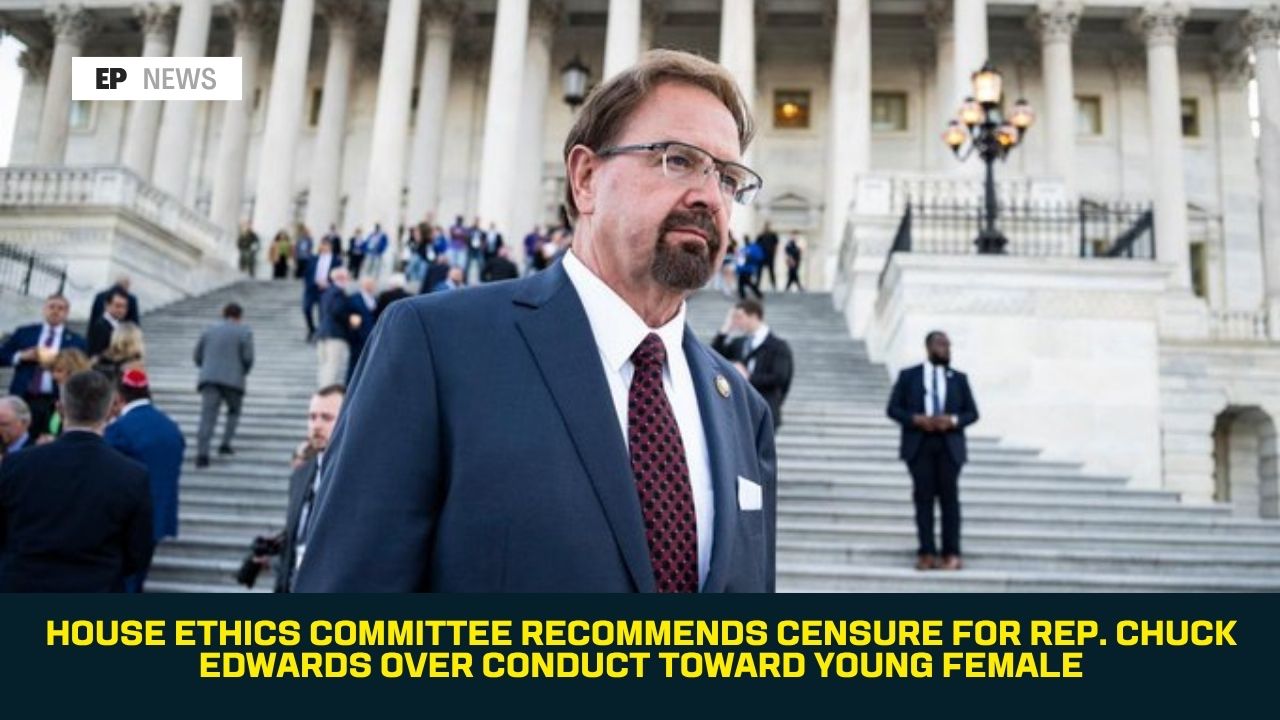
House Ethics Committee Recommends Censure for Rep. Chuck Edwards Over Conduct Toward Young Female Staffers
The House Ethics Committee announced Monday, August 3, that it is recommending the full House censure Rep. Chuck Edwards, R-N.C., following a monthslong bipartisan investigation that found he engaged in “persistent unprofessional and inappropriate conduct” toward two young female staffers. Edwards has denied wrongdoing and disputes the committee’s conclusions.
What the Investigation Found
In a 25-page report released Monday, the bipartisan committee — led by Chairman Michael Guest, R-Miss., and ranking member Mark DeSaulnier, D-Calif. — concluded there was “substantial reason to believe” Edwards violated House rules related to sexual harassment and hostile workplace conduct, according to CBS News. Specifically, the committee found Edwards “violated the House Code of Official Conduct by failing to adhere to the spirit of rules prohibiting sexual harassment of and unwanted advances to House staffers.”
The report detailed a range of alleged behavior toward the two staffers, including giving them what the committee described as “lavish” gifts — among them jewelry totaling more than $1,000, designer purses, guns, shoes, flowers, a laptop, a cell phone, a KitchenAid mixer, and a robotic vacuum, according to Blue Ridge Public Radio. The report also said Edwards invited the staffers to “intimate dinners and vacations” and sent personal texts late in the evening, including messages expressing what the committee called “effusive affection.”
Other alleged conduct outlined in the report, according to The Hill, included extending a work trip to New York City by an extra day to celebrate Edwards’s birthday with additional activities like a helicopter ride and a Broadway show, writing poems for one of the staffers, crying during a slideshow at her going-away party, telling a staffer he left an event early because she’d brought a date, and paying for massages, spa treatments, and a singer for one of the staffers.
What the Committee Did — and Didn’t — Conclude
The committee was explicit about the limits of its findings. According to CBS News, the panel said it found no evidence that Edwards “engaged in sexual activity with or explicitly propositioned any individual under his employ.” However, it did find that Edwards was aware his excessive attention toward the two women had led to rumors and speculation within his office.
The committee also said it found that staffers feared professional consequences if they rejected Edwards’s advances, and expressed particular concern about the broader chilling effect this kind of conduct can have. “The Committee is concerned that the House regrettably lost two staffers because of Representative Edwards’ conduct,” the report stated, according to NBC News. “In this environment, where Members of Congress hold substantial influence, many individuals are reluctant to report misconduct when balancing the fear of reprisal against the potential for accountability.”
According to WLOS, the report also noted that one of the two staffers was promoted to chief of staff despite another staffer in the office having more credentials and experience — a detail cited as part of the broader pattern of favoritism the committee identified.
Notably, the committee did not recommend that Edwards be stripped of his committee assignments, according to Axios — a step sometimes paired with censure recommendations in more severe cases.
Edwards’s Response
Edwards has disputed the committee’s characterization of events. According to NPR, lawyers representing the congressman argued in a rebuttal that the panel had failed to demonstrate the staffers ever expressed discomfort directly to Edwards, and said he had been denied the opportunity to challenge the factual allegations under House rules. The attorneys also said Edwards “sincerely regrets that his behavior created discomfort” for either staffer, even while disputing the committee’s broader findings.
A spokesman for Edwards’s reelection campaign was more pointed in a statement, saying committee staff had “taken it upon themselves to write their own rules based upon an interpretation that is inconsistent with the written rule of law or House rules,” according to NPR. Separately, campaign spokesman Paul Shumaker argued that “the Committee findings completely exonerate Representative Edwards under the House rules governing sexual misconduct or harassment” and said they “contradict the committee’s conclusion” — a characterization at odds with the committee’s own report, which found “substantial reason to believe” Edwards violated House rules.
According to Axios, Edwards did voluntarily produce some of his communications with the staffers to the committee, but the panel said “many relevant messages were omitted and/or seemingly deleted from his phone,” including a photo referenced in the investigation involving 30 pints of ice cream.
What Happens Next
The Ethics Committee itself has no authority to formally punish members — it can only recommend penalties, which the full House must then vote on. Censure requires a simple majority vote in the House. The committee said it intends to bring a privileged resolution for consideration and a vote by the full chamber, according to Axios.
That vote won’t happen immediately. The House is currently on recess and isn’t scheduled to return to Washington until August 31, according to Blue Ridge Public Radio, meaning no formal action on the censure recommendation is expected before then.
The Broader Context
The investigation began in May, after Axios first reported that Edwards had singled out two young staffers for special attention, according to CBS News. Edwards cooperated with the resulting investigation, which included 16 witness interviews — including with Edwards himself — and drew on more than 1,500 pages of evidence, according to NPR.
The report comes amid broader scrutiny of how the Ethics Committee handles allegations of member misconduct, following the earlier resignations of former Reps. Eric Swalwell and Tony Gonzales this year after separate allegations of sexual impropriety, according to CBS News.
Edwards, 65, is a former state lawmaker who unseated Rep. Madison Cawthorn in the 2022 Republican primary and had otherwise kept a relatively low profile in Congress before this investigation, according to NBC News. He currently faces a competitive reelection race against Democrat Jamie Ager in North Carolina’s 11th Congressional District.
FAQ
What did the House Ethics Committee recommend? The committee recommended that the full House formally censure Rep. Chuck Edwards for what it described as “persistent unprofessional and inappropriate conduct” toward two young female staffers, in violation of House rules on sexual harassment and hostile workplace conduct.
Did the committee find Edwards engaged in sexual misconduct? The committee said it found no evidence that Edwards engaged in sexual activity with or explicitly propositioned any staffer, but it did conclude his conduct violated the spirit of House rules against sexual harassment and unwanted advances.
How has Edwards responded? Edwards denies wrongdoing. His attorneys argue the committee failed to show the staffers expressed discomfort directly to him, while stating he regrets that his behavior caused discomfort. A campaign spokesman characterized the report as exonerating him, a characterization that conflicts with the committee’s own conclusions.
When will the House vote on censure? No timeline has been set beyond the House’s return from recess on August 31, 2026. A censure vote requires a simple majority of the full House.
What is censure, and how severe is it? Censure is a formal reprimand and the strongest disciplinary action the Ethics Committee can recommend short of expulsion from Congress. It does not remove a member from office.
Conclusion
The Ethics Committee’s report — the product of a monthslong, bipartisan investigation involving 16 witness interviews and more than 1,500 pages of evidence — presents a detailed and specific account of the conduct at issue, even as it stops short of finding sexual misconduct occurred. With Edwards disputing the findings and a formal House vote not expected until after lawmakers return from recess in late August, the case is likely to remain a point of contention both in Congress and in Edwards’s competitive reelection race back home in North Carolina.
Sources: The Washington Post, CBS News, NBC News, Axios, NPR, The Hill, Blue Ridge Public Radio, WLOS (reporting dated August 3-4, 2026).