
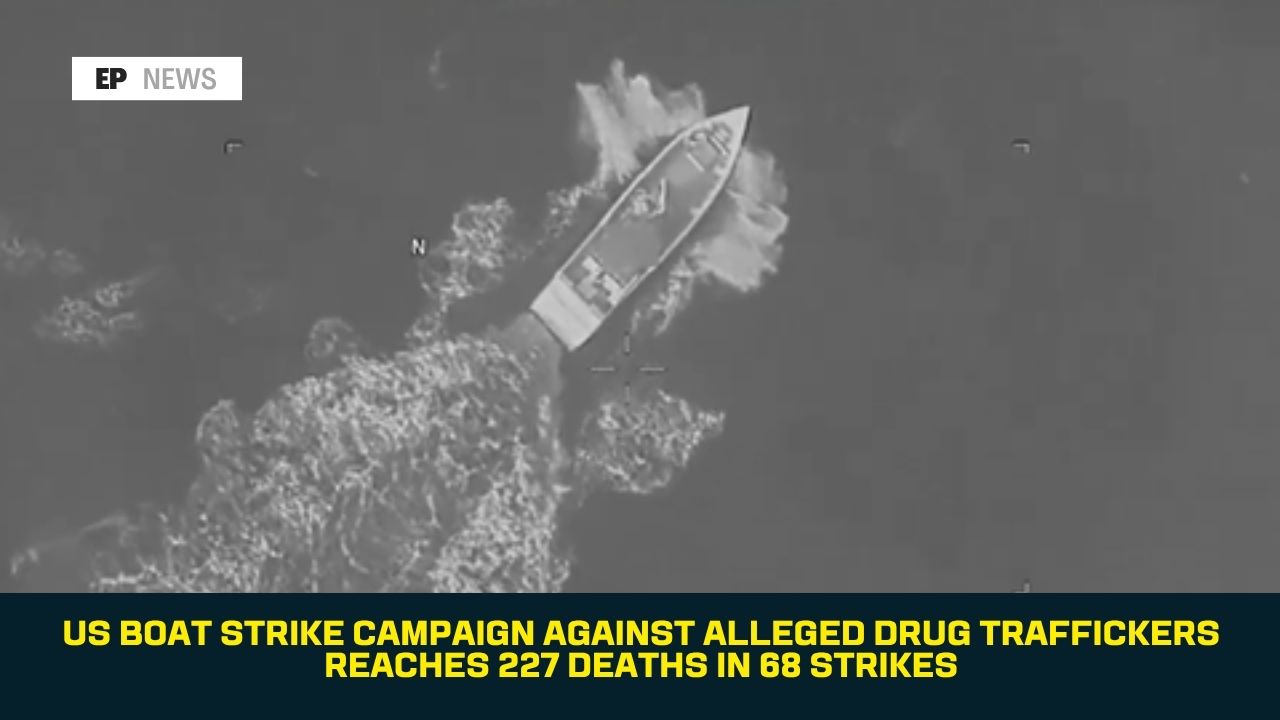
US Boat Strike Campaign Against Alleged Drug Traffickers Reaches 227 Deaths in 68 Strikes
Nearly a year into a military campaign the Trump administration says targets “narco-terrorists,” the U.S. has killed at least 227 people in 68 strikes on suspected drug-smuggling boats in the Caribbean Sea and eastern Pacific Ocean, according to the latest tally confirmed after an August 25 strike that killed four more people. The campaign has drawn sustained bipartisan scrutiny in Congress over whether the killings are legal.
How the Campaign Has Escalated
The U.S. military attacked a boat suspected of smuggling drugs in the Caribbean Sea on August 25, killing four people, according to the Associated Press. U.S. Southern Command said, as it has with most of its strike announcements, that it targeted the alleged traffickers along known smuggling routes — though the military did not provide public evidence that the vessel was actually carrying drugs.
The pace of the campaign has grown substantially since it began. According to CBS News, the August 25 strike came just two days after a separate strike in the eastern Pacific killed two more people, itself notable because it followed a pause of more than two months in the broader campaign. Earlier tallies help illustrate the trajectory: the campaign had reached 28 strikes and at least 104 deaths by early-to-mid autumn, according to NBC News reporting from that period, before climbing to 42 strikes and 147 deaths, then 45 strikes and at least 156 deaths, according to subsequent Fox News reporting — a pace that has continued accelerating to the current total of 68 strikes and 227 deaths.
The Administration’s Justification
Defense officials have consistently framed the strikes as a necessary escalation against organizations responsible for significant harm to Americans. Then-Defense Secretary Pete Hegseth said in comments accompanying an earlier round of strikes, according to Yahoo News: “The Department has spent over TWO DECADES defending other homelands. Now, we’re defending our own. These narco-terrorists have killed more Americans than Al-Qaeda, and they will be treated the same. We will track them, we will network them, and then, we will hunt and kill them.”
President Trump has asserted that the U.S. is engaged in an “armed conflict” with drug cartels, according to NBC News, a legal framing the administration has used to justify treating alleged traffickers as combatants subject to lethal military strikes rather than as criminal suspects entitled to arrest, trial, and due process.
The administration has also worked to expand the campaign’s reach onto land. According to CBS News, Defense Secretary Hegseth said during a visit to Panama that Colombia, Guatemala, and Honduras had agreed to let the U.S. carry out joint military operations against criminal groups on their own soil, though Guatemala publicly denied reaching any such agreement. Ecuador launched similar joint missions with the U.S. in March.
The Controversy Over a “Double-Tap” Strike
The campaign’s legality became a particularly sharp point of bipartisan contention following a September 2 strike that involved what critics have called a “double-tap” — a follow-up strike on survivors of an initial attack. According to Colorado Newsline, a Washington Post report revealed that Hegseth had given verbal orders to kill everyone on the boat during that operation, and Rep. Jason Crow, after reviewing unedited footage of the strike with the House Armed Services Committee, said he saw “no justification for why a second strike needed to be taken” and called it “a violation of the law.”
Not all lawmakers who viewed the same footage reached the same conclusion. Rep. Jeff Crank, a Republican who also sits on the committee, said after watching the video that he had “full faith that they were carried out in accordance with the law,” according to the same report. Senate Intelligence Committee Chairman Tom Cotton similarly defended the follow-up strike to NBC News, arguing survivors “were not incapacitated in any way” and that striking again “was entirely appropriate… to make sure that its cargo was destroyed.”
PBS News described the aftermath as exposing “a new bipartisan divide,” with Republicans generally backing the special operations commander’s decision to strike survivors of the first attack, while Democrats accused the commander of targeting what amounted to a shipwreck.
The Fight Over Releasing Video Evidence
A separate, cross-partisan push has focused specifically on transparency rather than the underlying legality question. According to Fox News, the annual National Defense Authorization Act included a provision requiring the Pentagon to release full, unedited footage of the Caribbean strikes to Congress, in exchange for fully funding Hegseth’s travel budget — a sign that even some Republicans supporting the campaign’s overall legality have pushed for greater public disclosure.
Republican Sens. Lindsey Graham and John Cornyn both publicly encouraged releasing the unedited September footage despite Hegseth’s refusal to make it public. “My default is always for more transparency, because if you don’t release it, then there’s more conspiracy theories,” Cornyn said, according to Fox News. Graham defended the strikes’ underlying legality while separately arguing for release: “Release it, make your own decisions. This is lawful.”
Despite that cross-partisan interest, a specific push by Sen. Adam Schiff to force public release of the September 2 footage was blocked by Senate Republicans, according to Fox News, even as the broader NDAA provision requiring congressional (though not necessarily public) access to the footage moved forward separately.
Legal and Human Rights Criticism
Outside legal and human rights groups have raised more categorical objections to the campaign. The ACLU stated in a formal call for transparency that “since September, the Trump administration has ordered 26 lethal strikes on civilian boats in international waters, killing 99 people and upending countless lives” — a count reflecting an earlier point in the campaign’s escalation — and argued the administration must release its legal justification and the underlying strike orders. “If a president can murder civilians at sea and keep the legal justifications secret, we should all be concerned,” the organization wrote.
Senate Judiciary Committee Democrats made a similar argument in a letter to Chairman Chuck Grassley requesting a public hearing, according to The Hill: “There is not, nor can there be, any justification for state-sanctioned extrajudicial killings. Summary executions have no place in a constitutional democracy operating under the rule of law, no matter how heinous the accusations a government makes against someone.” Grassley rejected the request for a hearing.
FAQ
How many people have died in the boat strike campaign so far? At least 227 people across 68 strikes, as of the most recent confirmed tally following an August 25 strike in the Caribbean.
When did the campaign begin? Early September of the prior year, according to multiple reports tracking the campaign’s origin and escalation.
What is the administration’s legal justification? Officials, including President Trump, have described the campaign as part of an “armed conflict” with designated terrorist organizations trafficking narcotics, treating alleged traffickers as combatants rather than criminal suspects.
Why is the September 2 “double-tap” strike specifically controversial? Reporting indicated Hegseth verbally ordered a follow-up strike on survivors of an initial attack; lawmakers who viewed the unedited footage disagreed sharply along party lines about whether that follow-up strike was legally justified.
Has the unedited footage of these strikes been made public? No. The Pentagon has maintained a policy against releasing full unedited footage publicly, though select congressional committees have viewed some footage, and a bipartisan effort to require broader congressional access was included in the annual defense authorization bill.
Conclusion
Nearly a year into the campaign, the fundamental dispute over the boat strikes remains unresolved: the administration continues expanding both the pace of strikes and their geographic reach into land operations across Latin America, while a genuinely bipartisan, if not unified, coalition in Congress continues pressing for greater transparency and legal accountability. With the death toll climbing past 227 and Senate Judiciary Democrats’ request for a formal hearing already rejected, the central question — whether these strikes constitute lawful military action against combatants or, as critics argue, extrajudicial killings without due process — appears likely to remain contested for as long as the campaign itself continues.
Sources: Associated Press (via U.S. News, ABC4 Utah, WLRN), NBC News, CBS News, Fox News, PBS News, Colorado Newsline, The Hill, ACLU, Yahoo News (reporting dated August 25-26, 2026, and prior campaign coverage).