
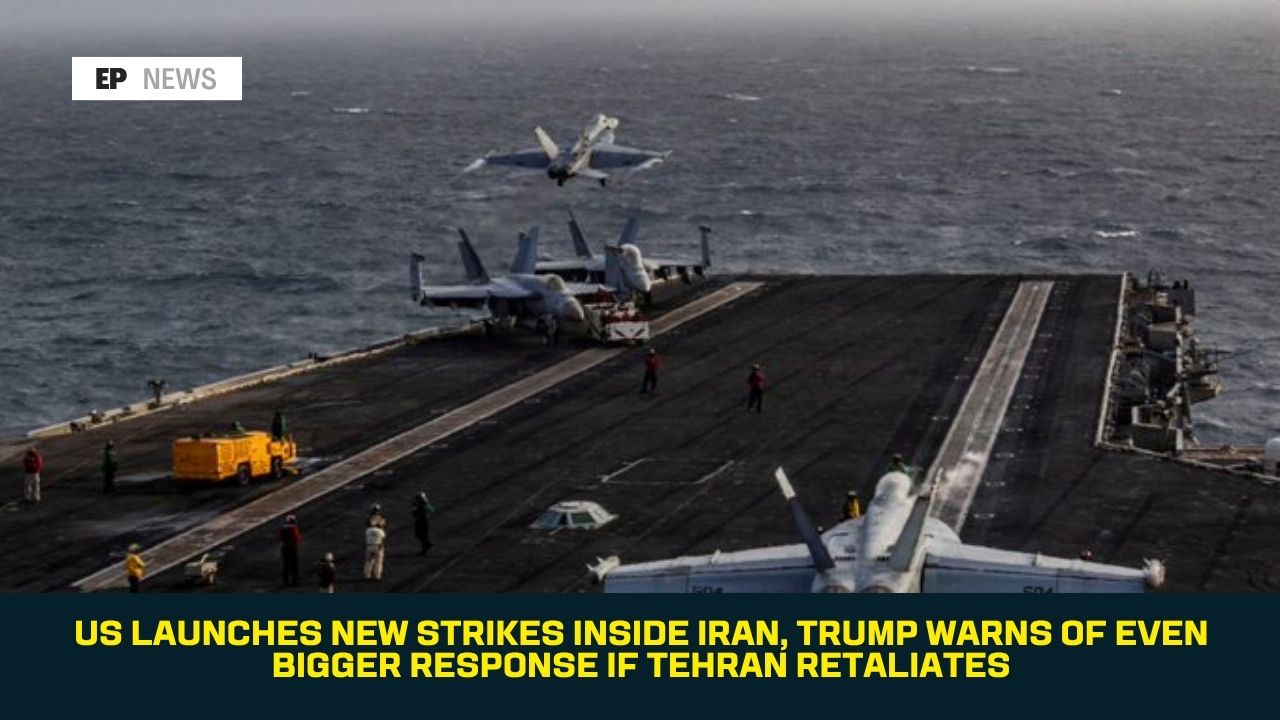
US Launches New Strikes Inside Iran, Trump Warns of Even Bigger Response If Tehran Retaliates
The U.S. military carried out a new, expanded round of strikes against Islamic Revolutionary Guard Corps targets across Iran on Tuesday, September 1, escalating a conflict that had just resumed after weeks of relative calm. President Trump called the strikes “large and powerful” and warned Iran would face an even larger response if it retaliates further.
What CENTCOM Struck
“Today at 12 p.m. ET, U.S. forces began striking Islamic Revolutionary Guard Corps (IRGC) targets in Iran,” Central Command wrote in a post on X, according to CNN. The command said the strikes hit several categories of targets, including “air defense sites, radar systems, maritime assets and facilities, mine laying capabilities, and communications sites,” according to ABC News.
CENTCOM said the strikes were a direct response to “recent attempted attacks by the IRGC against commercial shipping in the Strait of Hormuz and against American service members deployed to the region,” according to CNN. Multiple explosions were reported east of Bandar Abbas and around Qeshm Island in the Strait of Hormuz, according to Iran’s state-run broadcaster IRIB, cited by CNN — both located on the strait’s northern side, one of the world’s most critical energy-shipping chokepoints.
Why This Round of Strikes Came Now
Tuesday’s expanded strikes followed directly from an initial exchange of fire that began over the weekend. According to CNBC, American forces first hit two Iranian rocket launchers on Larak Island on Sunday, August 30, after determining Iran’s Revolutionary Guard was preparing rockets carrying sea mines for launch into the Strait of Hormuz. Iranian state media reported that attack killed two people and wounded several others.
Iran responded to that initial strike by launching missiles toward U.S. military targets in Jordan and the United Arab Emirates, according to CNN — the first exchange of fire between the two countries in more than a month. A U.S. official told ABC News that American forces shot down the Iranian missiles targeting Jordan, and Jordanian Armed Forces said they intercepted 10 missiles, with three landing “in remote areas far from population centers.” No injuries or deaths were reported in Jordan.
Trump’s Warnings
Trump described Tuesday’s strikes as retaliation for both Iran’s attempted sea mine deployment and its missile attack on the U.S. base in Jordan, calling them “large and powerful” in a Truth Social post, according to CNBC. He went further, threatening a significantly larger response if Tehran retaliates again, saying Iran would be hit “at a much harder and higher level” and warning that an even bigger attack was “waiting in the wings.”
Speaking in the Oval Office earlier in the week, Trump had described the overall conflict in surprisingly modest terms despite the escalation. “This is a relatively little war for us. This is not a big war,” he said, according to CBS News, dismissing concerns raised in a Washington Post report that several U.S. military leaders were worried a prolonged Middle East operation was weakening Washington’s ability to respond to threats elsewhere. Asked about further strikes, Trump called Iran “a failed nation” and added, “That doesn’t mean we won’t smack them. We’ll see what happens.”
Iran’s Response and Threats
Iranian military forces said Tuesday’s American strikes “destroyed the technical and repair infrastructure, as well as the enemy fighter deployment sites,” inflicting what they called “heavy damage,” while vowing an increasingly forceful response, according to CNBC. Iran’s Armed Forces Central Headquarters separately said the country would “deliver crushing and devastating blows” against the “American enemy,” according to CNN, citing state broadcaster IRIB.
A senior Iranian source went further in comments to Reuters, cited by CNBC: “For every American attack on Iran, Tehran will respond ‘dozens of times greater.’ No target in the region is beyond Tehran’s reach.” The same source warned that conditions in the Strait of Hormuz would worsen for any vessels violating Iran’s own rules for passage through the waterway.
Impact on Shipping and Oil Markets
The renewed fighting has directly affected both the strait’s shipping capacity and global energy markets. Despite the Trump administration insisting that a southern shipping route near Oman’s coastline remains safe and open, Iran continues to refuse recognizing that lane, instead demanding that commercial vessels coordinate with Iranian authorities to use a northern passage closer to its own shores, according to CBS News. Even with U.S. assurances and American military escorts for some vessels, daily transits through the strait remain at less than half the typical pre-war volume.
Oil prices climbed sharply following the renewed strikes. Brent crude rose above $91 a barrel Monday, up more than 3% from the previous day, according to CBS News, before climbing further to top $94 a barrel Tuesday following CENTCOM’s announcement of the new strikes, according to CNBC.
A Longer Deployment Ahead for US Troops
The renewed escalation is also affecting the length of U.S. troop deployments in the region. According to CBS News, family members of soldiers in one Army division deployed to the Middle East earlier this year have been told their deployments will now extend into 2027, according to a letter obtained by CBS News and confirmed by two U.S. officials.
Ramping Up Munitions Production
Separately, the Pentagon announced Monday that it had reached seven-year procurement contracts with General Dynamics and Lockheed Martin to increase production quantities and speed up delivery schedules for critical subcomponents used in missile defense systems, according to CNBC — specifically the Terminal High Altitude Area Defense (THAAD) system and the Patriot Advanced Capability-3 Missile Segment Enhancement, both systems whose depleted stockpiles have been a persistent point of concern throughout the war.
Regional Security Warnings
The U.S. Embassy in Qatar issued a security alert Tuesday warning of the potential for “unforeseen escalation” and urging Americans in the region to exercise heightened vigilance amid the possibility of flight cancellations, airspace closures, and other travel disruptions, according to CNBC.
FAQ
What did the U.S. strike in Iran on Tuesday? Islamic Revolutionary Guard Corps targets including air defense sites, radar systems, maritime assets and facilities, mine-laying capabilities, and communications sites, according to CENTCOM.
Why did the U.S. carry out these strikes? In response to Iranian attempts to attack commercial shipping in the Strait of Hormuz and attacks against American service members in the region, following an initial exchange of fire over the weekend.
How has Iran responded? Iranian officials say the strikes caused significant damage and have vowed an increasingly forceful response, with one senior Iranian source telling Reuters that Tehran would respond to any American attack “dozens of times greater.”
How have oil prices reacted? Brent crude climbed above $94 a barrel Tuesday, up from around $91 a barrel Monday, as markets responded to the renewed fighting.
Has this affected U.S. troop deployments? Yes. Families of soldiers in one Army division deployed to the Middle East have been told their deployments will now extend into 2027.
Conclusion
Tuesday’s expanded U.S. strikes mark a significant escalation from the weekend’s initial exchange of fire, with Trump explicitly threatening an even larger response should Iran retaliate further — even as he continues to characterize the broader conflict as a “relatively little war.” With oil prices climbing, shipping through the Strait of Hormuz still running at less than half its pre-war capacity, and U.S. troop deployments now extending into 2027, the conflict’s six-month mark appears to be bringing renewed intensity rather than the resolution that recent Iran-Oman negotiations had seemed to offer just weeks earlier.
Sources: CNN, ABC News, CBS News, CNBC, The Washington Post/Reuters (reporting dated August 31-September 1, 2026).