
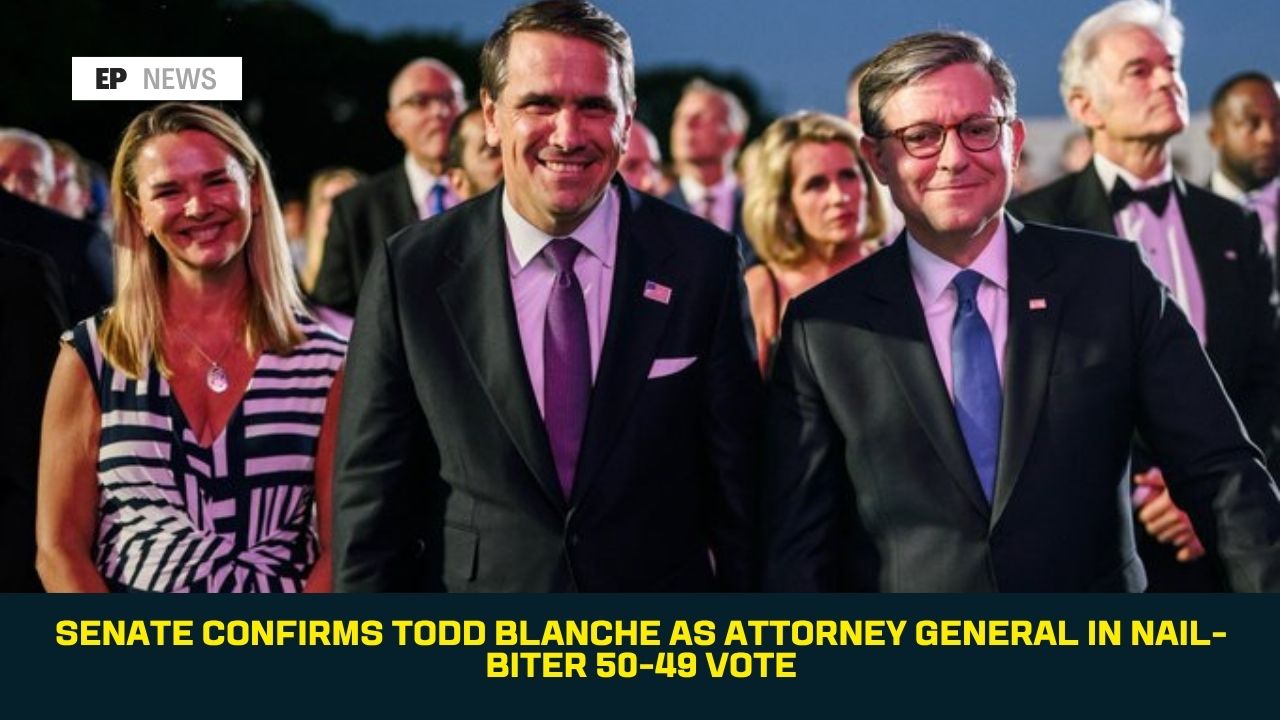
Senate Confirms Todd Blanche as Attorney General in Nail-Biter 50-49 Vote
The Senate narrowly confirmed Todd Blanche as U.S. attorney general in the early hours of Saturday, August 8, by a vote of 50-49 — the culmination of a weeks-long confirmation battle that saw Republican defections, a resolved fund dispute, and a decisive last-minute endorsement that determined the outcome.
How the Final Vote Broke Down
The vote was gaveled down at 4:31 a.m., according to ABC News, with light applause in the chamber marking the end of a process that had grown genuinely uncertain in its final days. All Democrats opposed Blanche’s confirmation, joined by two Republicans: Sens. Susan Collins of Maine and Lisa Murkowski of Alaska. Sen. Mitch McConnell of Kentucky remained absent from the vote due to an ongoing hospitalization-related recovery, according to Roll Call.
With McConnell out and Collins and Murkowski opposed, Blanche’s confirmation ultimately came down to a single senator: Bill Cassidy of Louisiana, who announced his support in a floor speech Friday morning, according to NPR. That decision proved decisive, delivering exactly the 50 votes Blanche needed for confirmation.
Why Collins and Murkowski Voted No
Both Republican holdouts pointed to concerns about the Justice Department’s independence under Blanche’s leadership. Collins had announced her opposition days before the floor vote, citing what she called “several actions that have further eroded the Department’s independence,” including a tax immunity arrangement for the Trump family and the department’s now-terminated “anti-weaponization” fund, according to CBS News.
Murkowski followed with her own opposition Friday, framing her decision around broader institutional concerns rather than any single issue. “The politicization — even weaponization — of the Department did not start” with Blanche, Murkowski said in a statement cited by ABC News, though she said she wasn’t convinced he would “check the worst impulses of this administration.” She added: “I hope Mr. Blanche is able to achieve that, if confirmed, but I simply do not have confidence that will be the case.” Notably, Murkowski also cited concerns tied to the Epstein files as part of her reasoning, according to Roll Call — connecting her opposition to the broader scrutiny Blanche has faced over his handling of matters related to Jeffrey Epstein survivors.
Why Cassidy’s Support Proved Decisive
Cassidy’s path to backing Blanche wasn’t a simple endorsement. In his Friday floor speech, Cassidy explained that he was supporting Blanche in relative terms — because he viewed him as more favorable than potential alternative nominees Trump might choose instead, according to ABC News, rather than as an unqualified vote of confidence in Blanche himself.
That framing echoed concerns Cassidy had raised earlier in the process, when he had questioned publicly whether Blanche could act independently of Trump given his history as the president’s personal defense attorney. Ultimately, those reservations weren’t enough to keep Cassidy from providing the decisive vote.
How the Fund Dispute Was Resolved Along the Way
Blanche’s path to Saturday’s vote had been complicated for weeks by the DOJ’s “anti-weaponization” fund, a roughly $1.8 billion pool tied to the settlement of Trump’s lawsuit over the leak of his tax returns. That dispute reached a resolution earlier in the week when Blanche issued two written orders Sunday night formally addressing the fund and a related audit provision, according to Punchbowl News reporting cited by Raw Story. That written commitment satisfied Sens. John Cornyn and Thom Tillis — who had spent two weeks blocking Blanche’s path to a Judiciary Committee vote — clearing the way for his 12-10 party-line committee advancement on Tuesday.
Tillis used his moment at that Tuesday hearing not just to announce his support but to demand further accountability elsewhere in the department, calling for the firing of a federal prosecutor in North Carolina over the department’s indictment of former FBI Director James Comey. “The 86 47 — some bonehead in North Carolina thinks that that’s a crime,” Tillis said, referring to a photo Comey posted that Blanche’s Justice Department had treated as a prosecutable offense. “Well, they better damn sure have information to back it up, because if all it is is a picture, that person should lose his or her job.”
What Democrats Said in Opposition
Democratic senators used the floor debate to reiterate concerns about Blanche’s independence from Trump. “Todd Blanche claims he was Donald Trump’s personal attorney but is continuing to act as if he’s still Donald Trump’s personal attorney,” Democratic Sen. Alex Padilla of California told NPR. “The American people deserve better.”
Blanche’s Path to This Moment
Blanche joined the second Trump administration as deputy attorney general, a role the Senate confirmed him for by a 52-46 vote in February 2025, according to Senate Judiciary Committee records. He was elevated to acting attorney general in April 2026 after Trump removed Pam Bondi from the role. Before returning to government, Blanche had served as Trump’s personal defense attorney beginning in 2023, representing him against criminal charges tied to hush money payments, the handling of classified documents, and efforts to overturn the 2020 election results.
Under his tenure as acting attorney general, the department pursued what NPR described as Trump’s promised campaign of retribution against perceived political enemies, including the Comey indictment and charges against the Southern Poverty Law Center.
FAQ
What was the final vote to confirm Todd Blanche? 50-49. All Democrats opposed him, along with Republican Sens. Susan Collins and Lisa Murkowski. Sen. Mitch McConnell was absent.
Who provided the decisive vote for confirmation? Sen. Bill Cassidy of Louisiana, who announced his support in a Friday floor speech, saying he viewed Blanche as preferable to potential alternative nominees.
Why did Collins and Murkowski oppose Blanche? Both cited concerns about the Justice Department’s independence under his leadership, including the “anti-weaponization” fund, a tax immunity arrangement for the Trump family, and — in Murkowski’s case — concerns connected to the Epstein files.
How was the dispute over the “anti-weaponization” fund resolved? Blanche issued two written orders on Sunday night formally addressing the fund and a related audit provision, which satisfied Sens. Cornyn and Tillis and cleared his path through the Judiciary Committee.
What role did Blanche previously hold in the Trump administration? He served as deputy attorney general starting in February 2025, then became acting attorney general in April 2026 after Trump removed Pam Bondi from the role.
Conclusion
Saturday’s 50-49 vote brings a definitive close to one of the most closely contested confirmation battles of Trump’s second term — a process that swung from a two-week committee blockade, to a written resolution on the disputed fund, to a fresh crisis when Collins and Murkowski broke ranks, and finally to Cassidy’s decisive last-minute support. With Blanche now permanently confirmed, attention will likely shift to how he leads the Justice Department without the immediate pressure of a pending confirmation vote — and whether the concerns Collins, Murkowski, and even Cassidy raised about the department’s independence prove borne out in the months ahead.
Sources: ABC News, CBS News, NPR, Roll Call, CNBC, Raw Story (reporting dated August 6-8, 2026).