
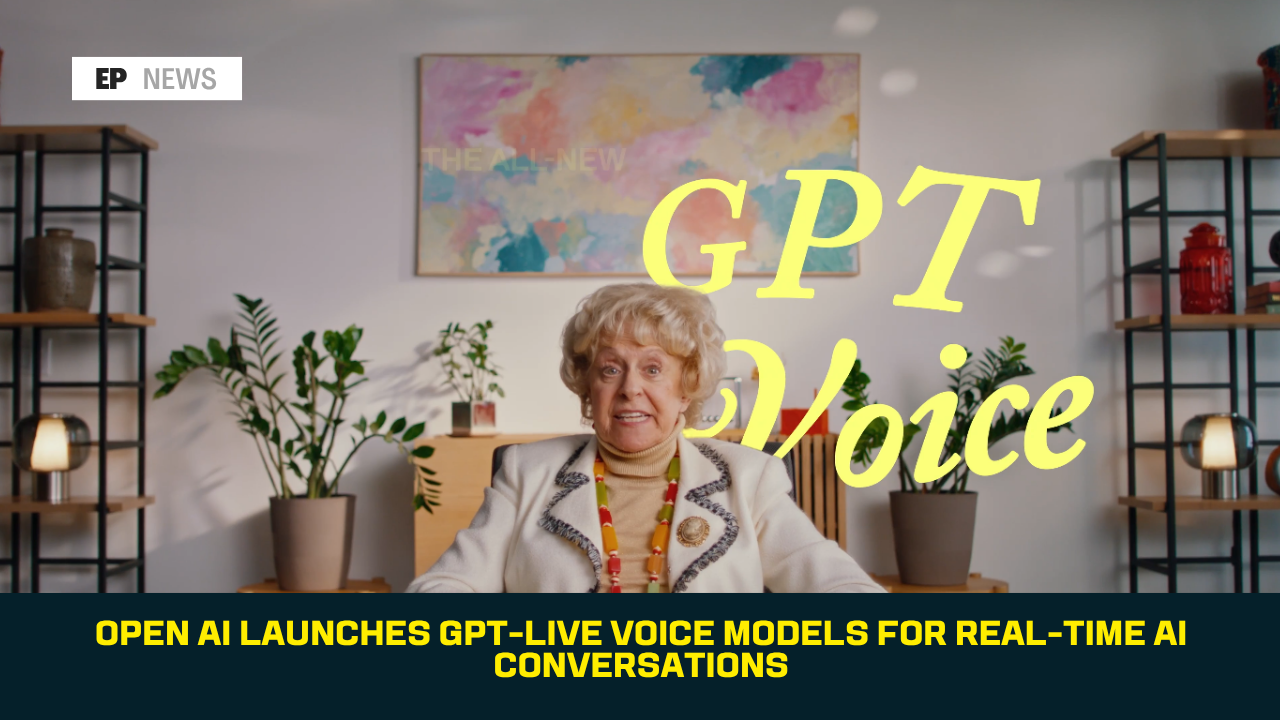
OpenAI Launches GPT-Live Voice Models for Real-Time AI Conversations
OpenAI has unveiled GPT-Live, a new family of voice AI models designed to make conversations with artificial intelligence faster, more natural, and more human-like. Unlike traditional voice assistants that wait for users to finish speaking, GPT-Live can listen and respond almost simultaneously, creating a smoother conversational experience. The launch reflects the growing demand for real-time AI applications across customer service, education, healthcare, and enterprise software.
The announcement represents another major step in the evolution of conversational AI, as companies increasingly seek voice assistants capable of understanding natural speech, interruptions, and changing contexts without noticeable delays.
A New Generation of Voice AI
Traditional AI voice systems typically convert speech into text, process the request, and then generate spoken responses. While effective, that process often introduces delays that make conversations feel less natural.
GPT-Live aims to reduce those delays by enabling more fluid interactions. According to OpenAI, the new models are built to improve:
- Real-time conversation
- Voice recognition accuracy
- Natural speech generation
- Faster response times
- Better context awareness
These improvements are expected to create more engaging user experiences across a wide range of AI-powered applications.
Why This Matters
Voice interaction has become one of the fastest-growing areas of artificial intelligence.
Businesses are increasingly adopting AI voice technology for:
- Customer support
- Virtual assistants
- Smart devices
- Language learning
- Healthcare services
- Business productivity tools
By reducing response times and improving conversational flow, OpenAI hopes GPT-Live will make AI interactions feel closer to speaking with another person.
Competition in the AI Race Intensifies
The launch comes as competition in generative AI continues to accelerate.
Major technology companies including Google, Microsoft, Amazon, Meta, and Anthropic are investing billions of dollars in next-generation AI models and voice technologies. Each company is racing to build more capable assistants that can understand speech, images, video, and complex reasoning.
Industry analysts believe voice AI will become one of the defining technologies of the next decade, powering everything from smartphones and vehicles to enterprise software and robotics.
Opportunities for Developers
Developers are expected to use GPT-Live to build applications such as:
- AI customer support agents
- Real-time language translators
- Interactive tutoring systems
- Voice-controlled productivity tools
- AI-powered meeting assistants
As businesses increasingly integrate AI into everyday workflows, demand for low-latency voice models is expected to grow rapidly.
Market Impact
The introduction of GPT-Live highlights OpenAI’s continued focus on expanding practical AI tools beyond text generation. Analysts say advances in voice technology could help accelerate enterprise adoption of AI by making digital assistants more intuitive and useful in real-world scenarios.
What’s Next?
Technology experts expect OpenAI to continue improving its multimodal AI capabilities, combining voice, text, images, and reasoning into increasingly capable systems.
Future updates may focus on:
- More natural conversations
- Lower latency
- Improved multilingual support
- Better enterprise integration
- Enhanced developer tools
These developments could further expand AI’s role across consumer products and business applications.
Conclusion
OpenAI’s GPT-Live voice models mark another important milestone in conversational artificial intelligence. By enabling near real-time voice interactions, the company is moving closer to AI systems that communicate naturally and respond instantly. As voice technology becomes more sophisticated, GPT-Live could play a significant role in shaping the next generation of AI-powered experiences for businesses and consumers alike.