
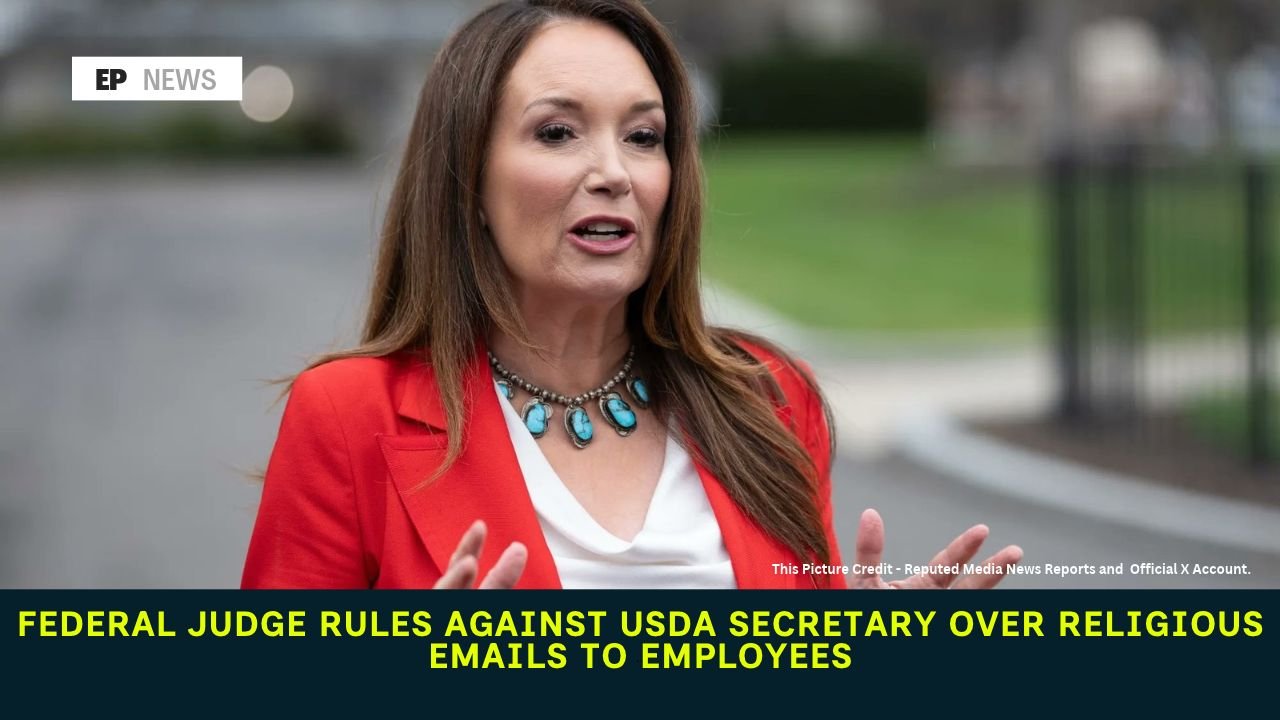
Federal Court Finds Constitutional Problem With USDA Secretary’s Religious Messages
November 19, 2026 | U.S News
A federal judge has ruled that religious messages sent by U.S. Agriculture Secretary Brooke Rollins to approximately 100,000 department employees violated constitutional protections under the First Amendment.
The ruling, issued Thursday, November 19, adds another significant legal development involving the Trump administration and the boundaries between religious expression and government authority.
The case concerns emails that Rollins sent using her official government account on several holidays, including Independence Day, Thanksgiving, Christmas and Easter.
The messages included Christian references and religious imagery.
According to reporting by the Associated Press, U.S. District Judge Trina Thompson in San Francisco concluded that the communications violated the First Amendment’s Establishment Clause.
The judge’s decision focused on the fact that Rollins was not communicating merely as a private individual.
She was sending messages in her official capacity as the head of a federal department to a large workforce under her authority.
The ruling raises important questions about religious expression in government workplaces, the responsibilities of federal agency leaders and the constitutional protections available to public employees.
What Led to the Legal Dispute?
The controversy developed after Rollins sent religious messages to USDA employees through her official email account.
The messages included Christian language and references to religious holidays.
One email sent on Easter contained a message about the resurrection of Jesus Christ and encouraged employees to approach the occasion with hope and religious purpose.
The case was brought by six USDA employees and the National Federation of Federal Employees, a labor organization representing approximately 19,000 workers.
The plaintiffs argued that the communications crossed constitutional boundaries because they came from a senior government official and were distributed through official government channels.
Their concern was not simply that the secretary expressed her personal religious beliefs.
The central issue was whether a federal department leader could use official authority and workplace communication systems to distribute messages that appeared to promote one religion.
Why the First Amendment Matters in Government Workplaces
The First Amendment protects religious freedom in the United States.
It includes protections for individuals who want to practice religion, express their beliefs or choose not to participate in religious activities.
However, the Constitution also places limits on government endorsement of religion.
This distinction is particularly important for public officials.
A government employee may have personal religious beliefs and generally retains the right to express those beliefs appropriately.
But a senior official communicating with thousands of subordinates has responsibilities that are different from those of an ordinary private citizen.
Employees may reasonably interpret messages from an agency secretary as official communications.
They may also feel uncomfortable ignoring or challenging messages sent by the person responsible for leading their department.
That power relationship was central to the court’s reasoning.
The judge found that employees could feel pressure to hide their own beliefs or perceive Christianity as the expected or shared faith within the department.
What the Judge Ordered
The ruling did not establish that Rollins was prohibited from discussing religion in every workplace conversation.
Instead, the court placed limits on how she could communicate religious messages while exercising official authority.
According to the AP report, the judge directed Rollins to avoid proselytizing and follow workplace protections against unwanted religious pressure.
The restrictions include stopping religious communications when a colleague requests that they stop and avoiding conduct that could create a hostile work environment.
The court also emphasized that Rollins could not use her official position to pressure subordinates.
Importantly, the ruling recognized that religious expression can still occur in appropriate workplace situations.
Rollins may discuss her faith with interested colleagues, explain why her beliefs are personally meaningful and politely invite coworkers to religious events.
The distinction is between voluntary personal expression and communications that could be interpreted as government-sponsored religious pressure.
Why the Case Could Matter Beyond the Agriculture Department
The ruling has implications for federal agencies beyond the USDA.
Government departments employ large numbers of people with different religious beliefs, backgrounds and personal values.
Agency leaders must ensure that workplace communications remain professional and that employees are not pressured to adopt the personal beliefs of their supervisors.
This is especially important in large organizations where employees may receive messages from senior officials without having an easy way to respond.
A department secretary has substantial authority.
The use of an official email system can make a personal message appear connected to government policy or institutional expectations.
The decision may encourage federal agencies to review how senior officials communicate about religious subjects.
It could also lead to additional attention on employee protections, internal policies and workplace training.
However, the ruling should not be interpreted as a general ban on religious expression by government employees.
The constitutional issue concerns the government’s role and the use of official authority.
The Broader Debate Over Religious Freedom and Government Authority
Religious freedom remains an important subject in American public life.
The Constitution protects individuals who practice Christianity, Judaism, Islam, Hinduism, Buddhism and other religions, as well as people who do not follow a religion.
Government neutrality is intended to ensure that public institutions do not favor one religious belief over another.
At the same time, public employees do not lose their personal constitutional rights when they enter government service.
The difficult question is determining where private expression ends and official government endorsement begins.
The USDA case illustrates why that distinction matters.
A senior official may believe that sharing religious messages is a positive expression of personal faith.
Employees, however, may interpret the same communication differently because of the official’s authority.
The court’s ruling emphasizes that workplace power relationships must be considered when evaluating religious communications.
What Happens Next?
The ruling establishes legal restrictions on Rollins’s official communications.
Further legal developments could depend on whether the parties seek additional review or clarification.
The USDA may also need to examine its internal communications policies to ensure that similar issues do not arise elsewhere.
For federal employees, the decision reinforces the importance of workplace protections involving religious expression and government neutrality.
For agency leaders, it serves as a reminder that official communication channels carry responsibilities beyond personal expression.
Frequently Asked Questions
1. Who is Brooke Rollins?
Brooke Rollins is the U.S. Secretary of Agriculture.
2. Why did the judge rule against her?
The judge found that religious messages sent to approximately 100,000 USDA employees through her official account violated the First Amendment’s Establishment Clause.
3. Who filed the lawsuit?
Six USDA employees and the National Federation of Federal Employees brought the case.
4. Does the ruling prohibit Rollins from discussing Christianity?
No. The ruling allows appropriate voluntary religious conversations but restricts the use of official authority to pressure employees or promote religious messages.
5. Does the decision apply to every government employee?
The specific court order concerns Rollins and her conduct. Its constitutional reasoning may be relevant to other government workplaces, but it should not be described as a blanket prohibition on religious expression.
Conclusion
The federal court’s decision involving Agriculture Secretary Brooke Rollins highlights the constitutional responsibilities of senior government officials.
The First Amendment protects individual religious expression, but government leaders must also respect the rights of employees who hold different beliefs.
The case demonstrates why official authority, workplace communication and religious freedom must be carefully balanced.
For the USDA, the immediate responsibility is to ensure that future communications respect constitutional protections while allowing employees to maintain their personal beliefs without pressure.
Source: AP News | November 19, 2026.