
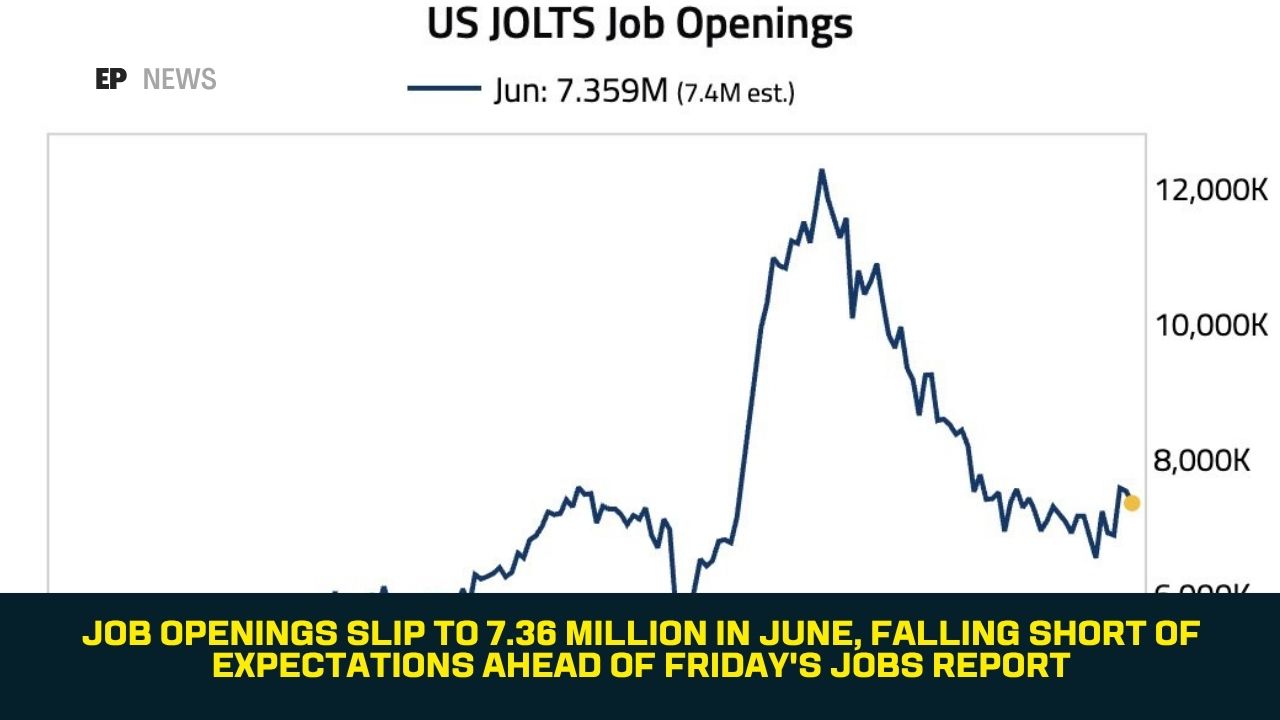
Job Openings Slip to 7.36 Million in June, Falling Short of Expectations Ahead of Friday’s Jobs Report
U.S. job openings edged lower in June, coming in below Wall Street’s expectations and offering the latest signal of a labor market that continues to cool gradually rather than dramatically, according to data released Tuesday, August 4, by the Bureau of Labor Statistics.
What the Report Found
The number of available positions fell to 7.36 million in June, according to the Job Openings and Labor Turnover Survey, commonly known as JOLTS. That figure came in below the Dow Jones consensus estimate of 7.6 million and was down 178,000 from May’s total, which itself was revised downward, according to CNBC.
The job openings rate, measured as a share of the total labor force, edged down to 4.4%. According to CNBC’s reporting, a drop in healthcare-related job openings accounted for much of the overall decline in June. Hires, separations, and quits all moved slightly higher during the month, even as the headline openings figure fell. The ratio of job openings to unemployed workers — a measure the Federal Reserve watches closely as an indicator of labor market balance — held just above 1 to 1.
May’s job openings total was revised down by 57,000 to 7.5 million in the same release, according to the BLS. The number of hires for May was revised upward by 82,000 to 5.3 million, and total separations for the month were revised upward by 159,000 to 5.3 million, driven by upward revisions to both quits and layoffs.
How This Fits the Broader 2026 Labor Market Picture
This year’s job openings data has told a somewhat inconsistent story from month to month. Job openings had actually increased to 7.594 million in May, according to Trading Economics — the highest level since May 2024 and well above market expectations of 7.30 million at the time, a reading that had been described as a sign of labor market resilience despite rising energy costs tied to the Iran conflict. June’s pullback to 7.36 million represents a reversal of that May strength, though the level remains broadly in the same range the labor market has occupied for much of the year.
According to Edward Jones’ market commentary, nonfarm employment had been growing by an average of 92,000 jobs per month through June — an improvement from average monthly employment growth of roughly 10,000 in 2025. The unemployment rate has held around 4.2%, and initial jobless claims have averaged about 211,000 per week this year, suggesting that while hiring has slowed from prior years, outright layoffs have remained relatively limited.
Why This Data Matters for the Fed
JOLTS data carries particular weight with the Federal Reserve because it offers a read on labor demand that goes beyond the more commonly cited monthly jobs report. A labor market with too many open positions chasing too few workers can put upward pressure on wages and, in turn, inflation — a dynamic the Fed has been actively trying to manage following its late-July decision to hold interest rates steady amid unusually public disagreement among its own policymakers.
Ahead of this week’s data, Reuters reported that markets had been pricing in roughly a 64% chance of a rate increase at the Fed’s next meeting in September, according to LSEG data cited in its July 31 preview of the trading week. A cooler-than-expected job openings number, like Tuesday’s release, generally reduces the odds of the Fed feeling pressure to tighten policy further, since it points toward moderating rather than overheating labor demand.
Setting Up Friday’s Jobs Report
Tuesday’s JOLTS release is one of several pieces of labor market data investors are digesting this week, with the more closely watched monthly jobs report for July scheduled for release Friday, August 7. According to Reuters, more than one-quarter of the S&P 500 was scheduled to report earnings during the same week, adding another layer of data for investors to parse alongside the labor market figures. Second-quarter corporate profits, including estimates for companies still left to report, were tracking to rise 29.3% on an adjusted basis from a year earlier, according to LSEG IBES data cited by Reuters — a strong showing that has helped offset some of the uncertainty tied to the more mixed labor market signals.
FAQ
How many job openings were there in June 2026? 7.36 million, according to the Bureau of Labor Statistics’ JOLTS report released August 4 — below the 7.6 million economists had expected and down from a downwardly revised May total.
Why did job openings decline in June? A drop in healthcare-related job openings accounted for much of the overall decline, according to CNBC’s analysis of the BLS data.
What is the ratio of job openings to unemployed workers? It held just above 1 to 1 in June, a level the Federal Reserve watches as an indicator of overall labor market balance.
When is the next major jobs report? The Bureau of Labor Statistics is scheduled to release its July nonfarm payrolls report on Friday, August 7, 2026 — typically the more closely watched of the two monthly labor market releases.
How does this affect the Federal Reserve’s interest rate decisions? Cooler job openings data generally reduces pressure on the Fed to raise rates further, since it suggests labor demand is moderating rather than overheating, which factors into the central bank’s ongoing balance between managing inflation and supporting employment.
Conclusion
June’s dip in job openings adds another data point to a labor market that has been sending mixed but generally moderate signals throughout 2026 — resilient enough to avoid signs of serious weakness, but no longer running as hot as earlier in the cycle. With Friday’s more comprehensive jobs report still to come and the Fed’s September meeting looming, this week’s data will likely factor into how policymakers, and markets, read the overall health of the labor market heading into the fall.
Sources: CNBC, U.S. Bureau of Labor Statistics, Trading Economics, Reuters, Edward Jones (reporting dated August 4, 2026).