
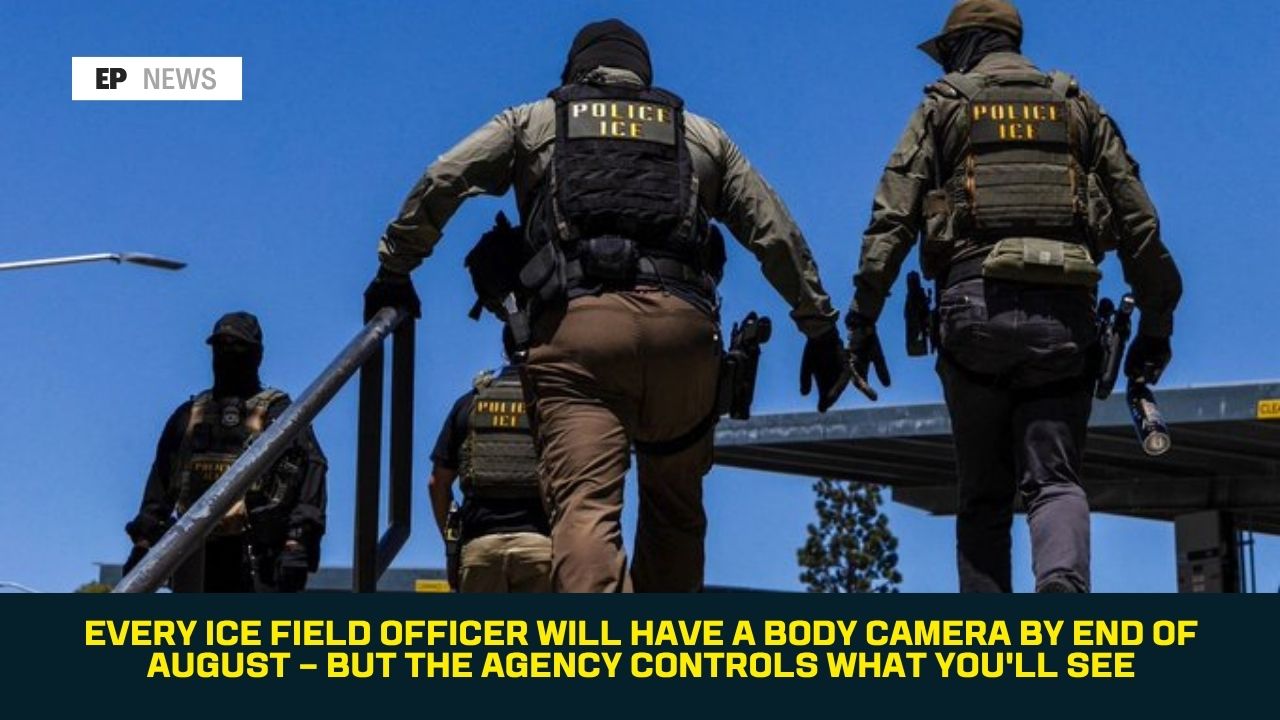
Every ICE Field Officer Will Have a Body Camera by End of August — But the Agency Controls What You’ll See
U.S. Immigration and Customs Enforcement said Saturday, August 8, that it expects every officer and agent in the field to be equipped with a body camera by the end of the month, a rapid expansion the agency says will provide an unprecedented visual record of its immigration enforcement operations. But whether the public actually gets to see that footage remains almost entirely up to ICE itself.
What ICE Announced
The rollout marks a significant acceleration of a body camera program that has moved in fits and starts for years. According to the Associated Press, as reported by CNN and The Washington Post, ICE said Saturday it expects every field officer and agent to have a body camera by the end of August — a timeline other outlets, including Unilad, described as running through the end of September for full activation across the agency.
The program’s roots go back further than this year. A directive requiring ICE officers to wear cameras was originally issued in February 2025, according to Unilad’s reporting, but implementation stalled after funding became entangled in this year’s partial government shutdown. An earlier, narrower phase of the rollout had equipped 1,600 cameras to Homeland Security Investigations and Enforcement and Removal Operations officers specifically in Baltimore, Philadelphia, Washington, D.C., Detroit, and Buffalo, New York, according to a statement at the time from then-ICE Director Patrick Lechleitner, who said the deployment was meant to build “public trust… through transparency and accountability.”
Why the Rollout Is Accelerating Now
The renewed push comes after mounting public pressure following several deadly encounters between ICE agents and civilians this year. According to The Hill and Unilad, senators had formally demanded ICE answers and accelerated body camera deployment following fatal shootings involving agents in Maine and Houston, incidents that intensified scrutiny of the agency’s use-of-force practices and its accountability mechanisms more broadly.
The Catch: Who Controls the Footage
Despite the expanded camera coverage, the agency’s actual policy on releasing that footage to the public has become the central point of controversy. According to CNN’s reporting, ICE’s updated policy gives the agency’s leadership control over what footage is released, based on whether disclosure is judged to serve the agency’s “best interests” — rather than a more standard, presumption-of-release framework common among many police body camera programs.
PBS News’s coverage was more specific about how far that discretion extends: ICE will only release body camera video when doing so is in the agency’s “best interests,” according to the policy language itself. CNN’s earlier coverage detailed that the policy includes provisions allowing ICE leadership to withhold or indefinitely delay footage specifically after serious injuries or deaths in custody — precisely the kind of incidents that generated the public pressure driving this expanded rollout in the first place.
Why Critics See a Built-In Loophole
Unilad’s reporting captured the core objection raised by transparency advocates and outside experts: the ICE director holds the power to sit on footage indefinitely if its release isn’t judged to serve the agency’s own interests, a clause critics say could gut the very transparency the cameras are ostensibly meant to deliver. In other words, the same incidents most likely to generate public scrutiny — serious injuries, deaths in custody, contested use-of-force encounters — are exactly the situations where the policy gives ICE the most latitude to withhold the recorded evidence.
This tension sits awkwardly alongside body camera research more broadly. PBS News noted that body cameras are widely seen as a key tool for police reform, but pointed to ongoing debate over whether they actually increase accountability in practice — a question that hinges heavily on release policies like the one ICE has now formalized, since footage that’s recorded but never released or reviewed independently provides limited public accountability value regardless of how comprehensive the camera coverage becomes.
How ICE Has Defended the Policy
ICE has pushed back on characterizations of the policy as opaque or self-serving. According to KSAT’s coverage, the agency specifically took issue with Associated Press reporting on its body-worn camera release policy, defending its approach amid the public questions about the withholding provisions. The agency’s position, consistent with Lechleitner’s earlier public statements about the program’s goals, frames the cameras themselves — regardless of release policy specifics — as a step toward greater transparency and public trust in the agency’s operations.
FAQ
When will every ICE field officer have a body camera? ICE says it expects full deployment by the end of August 2026, though some reporting describes the timeline extending into September for the cameras to be fully active agency-wide.
Will the public be able to see ICE body camera footage? Not automatically. ICE’s policy gives agency leadership discretion to release footage only when doing so is judged to be in the agency’s “best interests,” including the ability to withhold or indefinitely delay footage after serious injuries or deaths in custody.
Why is ICE expanding body camera use now? The push follows growing public pressure after several deadly encounters between ICE agents and civilians this year, including fatal shootings in Maine and Houston that prompted senators to formally demand answers and faster camera deployment.
When did ICE’s body camera program actually begin? A directive requiring officers to wear cameras was issued in February 2025, with an initial rollout of 1,600 cameras to officers in five cities, before funding issues tied to this year’s government shutdown delayed broader implementation.
Has ICE responded to criticism of its footage-release policy? Yes. The agency has pushed back on reporting characterizing the release policy as restrictive, specifically disputing an Associated Press report on the subject.
Conclusion
The expanded body camera rollout represents a genuine operational shift for ICE, moving toward comprehensive camera coverage across its field operations after years of delayed implementation. But the accountability value of that expanded coverage will ultimately hinge on the agency’s discretionary release policy — a provision that, as written, allows ICE’s own leadership to decide whether footage from the most consequential incidents, including deaths in custody, ever reaches the public at all. With senators already pressing the agency over recent deadly encounters, the gap between “every officer has a camera” and “the public can see what those cameras recorded” is likely to remain a central point of contention as the rollout completes this month.
Sources: Associated Press (via CNN, The Washington Post, PBS News, The Columbian, Boston Globe), The Hill, Unilad, KSAT (reporting dated August 7-9, 2026).