
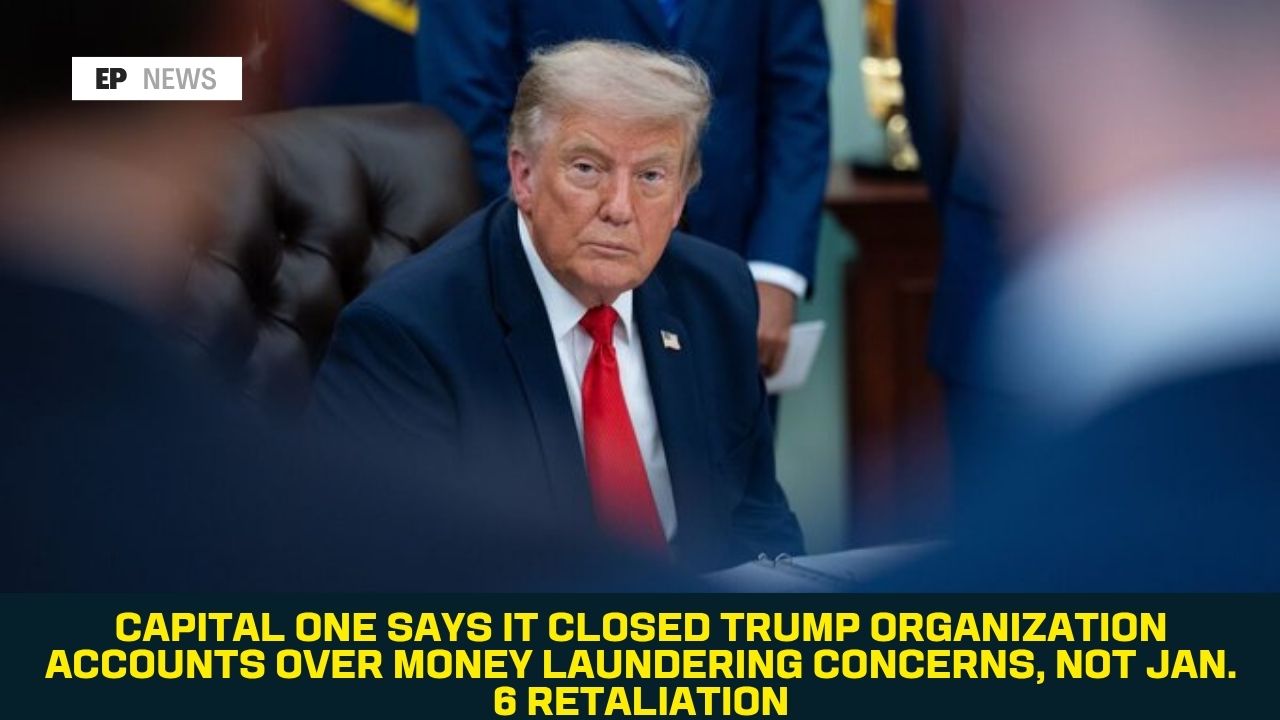
Capital One Says It Closed Trump Organization Accounts Over Money Laundering Concerns, Not Jan. 6 Retaliation
Capital One has asked a federal judge to permanently dismiss a lawsuit brought by the Trump Organization and Eric Trump, disclosing for the first time in a court filing that the bank’s 2021 closure of more than 300 Trump-affiliated accounts stemmed from a months-long internal anti-money-laundering review — not political retaliation over the January 6 Capitol riot, as the Trump companies have alleged.
What the Lawsuit Is About
The dispute traces back to March 2021, when Capital One notified the Trump Organization that it was closing more than 300 bank accounts connected to Donald Trump, his family, and his businesses, according to NPR. The accounts were formally terminated that June. Four years later, after Trump returned to office for a second term, the Trump Organization and Eric Trump sued Capital One in a Florida federal court, alleging the bank closed the accounts because of the political climate following the January 6, 2021 attack on the Capitol.
According to NBC News’s earlier reporting on the original filing, the Trump Organization’s lawsuit claimed Capital One “de-banked” the accounts based on what the company described as the bank’s “unsubstantiated, ‘woke’ beliefs” that it needed to distance itself from Trump’s political views following the riot. The suit sought a declaratory judgment that the closures were improper, along with punitive and other monetary damages for what it described as the “devastating impact” the closures had on the companies’ ability to transact business and access their own funds.
Capital One’s New Defense
In a motion to dismiss filed late Friday, Capital One’s lawyers offered a direct rebuttal, stating that both the bank’s own filings and the Trump businesses’ own allegations “make clear” that Capital One closed the accounts for anti-money-laundering reasons, according to Bloomberg’s reporting via Yahoo Finance. It’s the first time the bank has publicly and formally tied its anti-money-laundering review to the closure of the president’s family business accounts.
Reuters reported, via LiveNOW from Fox, that this marks Capital One’s second attempt to have the case thrown out. The presiding judge, Roy Altman, had already dismissed an earlier version of the lawsuit in March on separate grounds, ruling that a bank’s stated reason for closing an account under an open-ended contract clause generally cannot be second-guessed in court, according to NPR. Capital One has reiterated that same contractual argument in its new filing, pointing out that its account agreements allow it to close any account “at any time, for any or no reason and without notice” — language the Trump companies do not dispute exists in their agreements.
This time, Capital One is asking Judge Altman to dismiss the amended complaint permanently, without giving the plaintiffs another opportunity to refile. The bank is also pushing back on a new claim added to the Trump Organization’s amended complaint in July: that Capital One committed fraud by staying silent about its actual reasoning for closing the accounts at the time.
What Remains Sealed
A significant portion of the case remains hidden from public view. According to Bloomberg, the Trump Organization’s amended complaint, filed last month, includes an entire 10-page section titled “January 6, 2021: The Political Trigger” that is completely redacted under a court-approved sealing order. That redaction currently makes it impossible to see what evidence, if any, the Trump Organization has gathered to support its claim that the account closures were tied to the Capitol riot.
Capital One also asked in its Friday filing that the names of bank employees involved in the account review remain redacted going forward, citing the high-profile nature of the case, according to Bloomberg. A less-redacted version of the complaint may become public once both sides reach agreement on what can be disclosed.
The Broader “Debanking” Fight
This case is one of several legal and political battles the Trump administration and Trump-aligned entities have waged over what they describe as politically motivated account closures. According to Reuters’ reporting, Trump signed an executive order in August 2025 directing federal regulators to crack down on what he and other conservatives call “debanking.” Separately, Trump filed his own lawsuit against JPMorgan Chase in January on similar grounds, according to reporting cited by Stocktwits.
Eric Trump, the president’s son and an executive vice president at the Trump Organization, is a named plaintiff in the Capital One case and has been an outspoken critic of debanking more broadly. Capital One itself has a history of friction with Trump: the bank previously clashed with him during his first term in 2019, according to NPR, though the current lawsuit centers specifically on the 2021 account closures.
FAQ
Why did Capital One close the Trump Organization’s bank accounts? Capital One says in its new court filing that the closures resulted from a months-long internal anti-money-laundering review, not retaliation connected to the January 6 Capitol riot.
How many accounts were closed, and when? More than 300 accounts tied to Donald Trump, his family, and his businesses were closed, with Capital One first notifying the Trump Organization in March 2021 and formally terminating the accounts that June.
Has a judge already ruled on this case? Yes, partially. Judge Roy Altman dismissed an earlier version of the lawsuit in March 2026 on contractual grounds. Capital One is now asking him to dismiss the amended complaint permanently, without allowing another refiling.
What is the “January 6, 2021: The Political Trigger” section of the complaint? It’s a 10-page section of the Trump Organization’s amended complaint that remains entirely redacted under a court-approved sealing order, meaning its contents are not currently public.
Is this the only lawsuit related to “debanking” involving Trump-aligned entities? No. President Trump separately sued JPMorgan Chase in January 2026 on similar debanking allegations, and signed an executive order in August 2025 directing federal regulators to address politically motivated account closures more broadly.
Conclusion
Capital One’s filing marks the first time the bank has publicly and specifically tied its 2021 account closures to an internal money-laundering review rather than responding only in general contractual terms. With a fully redacted section of the complaint still hidden from public view and Judge Altman now weighing a second dismissal request, the case remains a live flashpoint in the broader debanking fight the Trump administration has pursued against several major financial institutions since returning to office.
Sources: NPR, Bloomberg (via Yahoo Finance), Reuters (via LiveNOW from Fox), NBC News, Stocktwits (reporting dated August 1-2, 2026).