
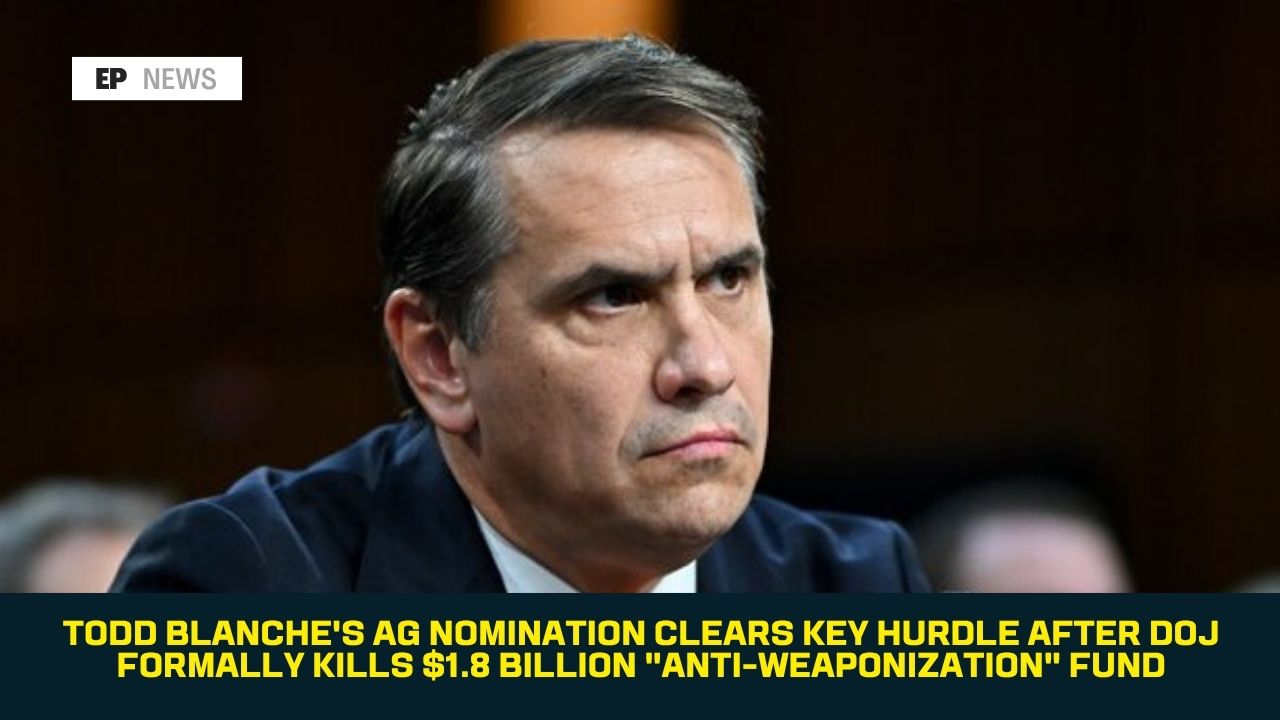
Todd Blanche’s AG Nomination Clears Key Hurdle After DOJ Formally Kills $1.8 Billion “Anti-Weaponization” Fund
The weeks-long standoff over Todd Blanche’s nomination to be U.S. attorney general appears to have reached a resolution after the Justice Department issued a formal order terminating its controversial $1.776 billion “anti-weaponization” fund — just days after President Trump had threatened to push the fund through Congress if the holdout senators blocking Blanche didn’t relent.
The Breakthrough
In a joint statement reported by NBC News, GOP Sens. John Cornyn of Texas and Thom Tillis of North Carolina said they were “pleased that the Department of Justice has issued a formal order terminating the anti-weaponization fund” and that they now “look forward to voting to advance his nomination out of the Senate Judiciary Committee soon.” The Senate Judiciary Committee is scheduled to hold that vote Tuesday, August 4, after twice delaying it in prior weeks due to the standoff.
The resolution marks a formal, written commitment — the specific thing Cornyn and Tillis had been demanding for weeks, after Blanche had previously told Congress verbally that the fund was “dead” without the Justice Department putting that commitment on paper.
What the Fund Was and Why It Became a Flashpoint
The anti-weaponization fund traces back to a lawsuit Trump filed against the IRS and Treasury Department over the 2019 leak of his tax returns. According to NPR, a federal judge dismissed Trump’s original $10 billion lawsuit against the IRS earlier this year, but the case was settled through an agreement that created the $1.776 billion fund, intended to compensate people who claim they were politically targeted by the federal government.
The settlement was notable in its own right: NPR described it as the first known instance of a sitting president reaching such a settlement with the government he leads, and it separately included provisions shielding the Trump family from future IRS audits.
The fund drew criticism in part because its payouts could potentially extend to participants in the January 6, 2021 Capitol riot who claim they were unfairly prosecuted. Multiple federal judges had also raised concerns about the unusual nature of a sitting president suing his own government to help create the fund in the first place, according to Attack of the Fanboy’s reporting on the dispute.
The Justice Department had reportedly abandoned the fund internally in early June, just weeks after announcing it, but officials had declined to formalize that decision in writing — the exact gap Cornyn and Tillis refused to overlook.
The Whiplash That Preceded the Resolution
The path to Tuesday’s expected vote wasn’t straightforward. Trump initially signaled the fund was finished, but then reversed course dramatically over the weekend. In a Truth Social post Saturday, August 1, Trump said that if Cornyn and Tillis — whom he described as “both upset because I wouldn’t Endorse them” — continued blocking Blanche’s confirmation, he would keep Blanche on as acting attorney general indefinitely and “push hard” to pass the anti-weaponization fund into law through Congress instead. “Todd Blanche was a voice of reason!” Trump wrote, adding that the fund “will immediately be back on the table, and I will get it done.”
Tillis, who has announced he won’t seek reelection, pushed back sharply on X, writing that Trump “clearly intends to resurrect the payout pot for punks either by inappropriately establishing another bogus fund or pushing Congress to vote for a bill that the majority of Republicans in the Senate would be against.”
The dispute also drew in additional Republican senators. Sen. John Kennedy of Louisiana, who sits on the Judiciary Committee, told NBC News’ “Meet the Press” on Sunday that he would not give the administration “a blank check” on any legislation to codify the fund, and specifically said January 6 rioters should not be allowed to benefit from it. Kennedy noted that people who believe the federal government wronged them already have a legal path through the existing Federal Tort Claims Act, and said Trump himself had already conceded that legislation would be required to formally establish the fund.
Why the Politics Got Personal
Both Cornyn and Tillis have had rocky relationships with Trump heading into this fight. Cornyn lost his Senate primary earlier this year to Trump-endorsed challenger and current Texas Attorney General Ken Paxton, a defeat CNN noted Trump referenced directly in his Saturday post. Tillis, meanwhile, has been an increasingly vocal Trump critic since announcing he wouldn’t seek reelection, giving him more political latitude to break from the administration on the nomination.
What Happens Next
With the Justice Department’s formal termination order now in place, the Senate Judiciary Committee is positioned to advance Blanche’s nomination out of committee at Tuesday’s scheduled vote, clearing the way for a vote before the full Senate. Blanche has served as acting attorney general since April 2, 2026, and would remain in that role regardless of the outcome, though formal confirmation would remove the time constraints associated with acting status under the Federal Vacancies Reform Act.
FAQ
Has Todd Blanche been confirmed as attorney general? Not yet. The Justice Department’s formal termination of the anti-weaponization fund cleared the key objection from Sens. Cornyn and Tillis, and the Senate Judiciary Committee is scheduled to vote on advancing his nomination Tuesday, August 4.
What was the anti-weaponization fund? A $1.776 billion fund created as part of a settlement of Trump’s lawsuit against the IRS over the 2019 leak of his tax returns, intended to compensate people who claimed they were politically targeted by the federal government — including, potentially, January 6 rioters.
Why did Trump initially threaten to revive the fund? After Cornyn and Tillis refused to support Blanche’s confirmation without written confirmation the fund was dead, Trump said over the weekend that he would instead push Congress to pass legislation formally establishing the fund if the senators didn’t relent.
Which senators opposed Blanche’s confirmation? Republican Sens. John Cornyn of Texas and Thom Tillis of North Carolina led the opposition, with Sen. John Kennedy of Louisiana separately raising concerns about any future legislation on the fund.
Is Todd Blanche currently running the Justice Department? Yes. He has served as acting attorney general since April 2, 2026, and will continue in that capacity regardless of when or whether his permanent confirmation is finalized.
Conclusion
After weeks of public back-and-forth — including a weekend threat from Trump to revive the very fund at the center of the dispute — the Justice Department’s formal termination order appears to have broken the impasse over Blanche’s nomination. With Cornyn and Tillis signaling they’re ready to move forward, Tuesday’s Judiciary Committee vote is likely to finally send Blanche’s nomination to the full Senate, though the episode leaves an open question about how the administration and Congress will handle any future legislative push tied to the fund’s underlying goals.
Sources: NBC News, CNN, NPR, The Hill, Attack of the Fanboy (reporting dated August 1-3, 2026).