
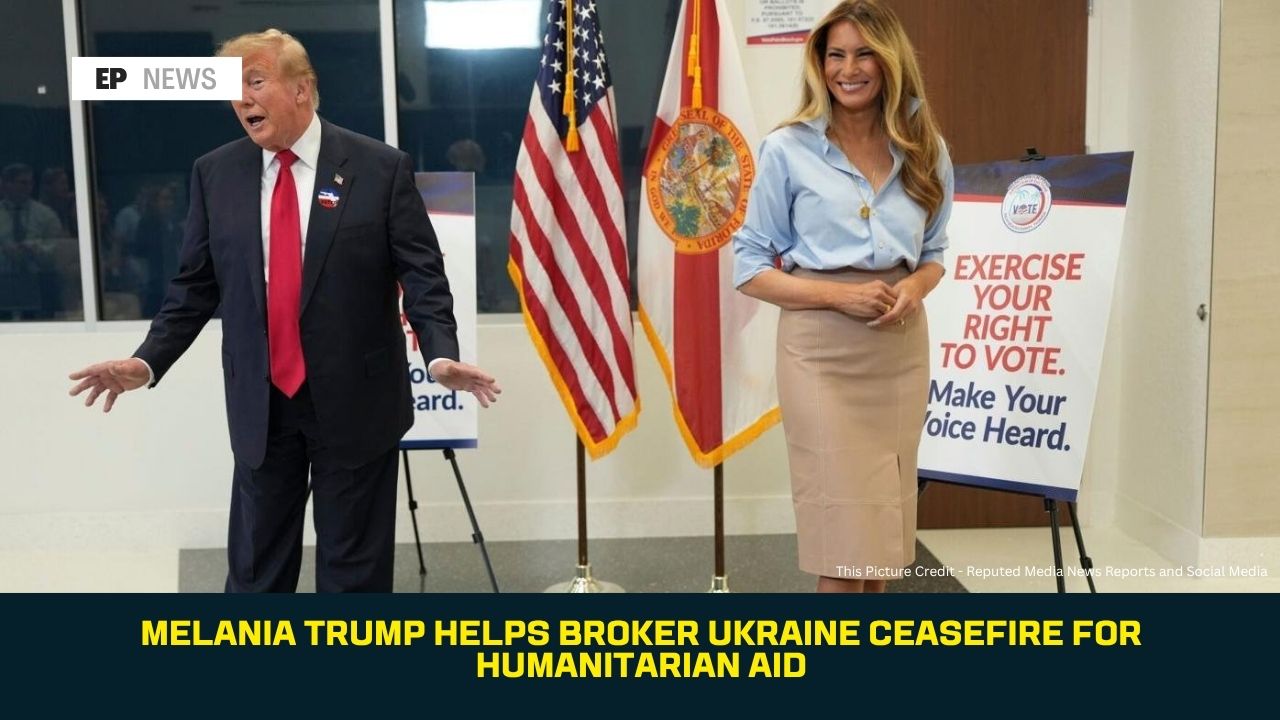
Melania Trump Helps Broker Ukraine Ceasefire Deal to Deliver Aid to Russian-Occupied City
WASHINGTON, October 25, 2026 — U.S. first lady Melania Trump has helped broker a localized ceasefire agreement involving Russia and Ukraine to allow humanitarian assistance to reach the Russian-occupied Ukrainian city of Oleshky and help civilians leave the conflict zone. The temporary pause is expected to begin on October 27, according to the Associated Press.
The agreement is intended to address worsening conditions in Oleshky, a city in Ukraine’s southern Kherson region where residents have faced shortages of essential supplies and disruptions to basic services. Ukrainian, Russian and U.S. negotiators confirmed that an agreement had been reached after weeks of discussions.
The proposed operation is expected to involve three main stages: clearing mines along access routes, delivering humanitarian assistance and evacuating residents who want to leave. Officials have said the aid mission could include food, medicine, hygiene products and other necessities.
However, significant details remain unresolved publicly, including how the ceasefire will be monitored, how the operation will be coordinated on the ground and where evacuated civilians will be taken.
The agreement represents a limited humanitarian initiative rather than a comprehensive settlement of the wider Russia-Ukraine war.
What Is the Melania Trump Ceasefire Agreement?
The agreement concerns Oleshky, a Ukrainian city under Russian occupation in the Kherson region. The arrangement is designed to create a temporary pause in fighting so humanitarian teams can deliver essential supplies and civilians can leave areas affected by the conflict.
According to the Associated Press, Ukrainian, Russian and U.S. representatives confirmed the agreement on Friday, October 23. Melania Trump said on Saturday that the ceasefire was expected to begin on October 27 and expressed hope that the plan would proceed as intended.
The first lady’s involvement began after she learned about the situation in Oleshky during an event connected to the United Nations General Assembly in September, the White House said. She and a representative subsequently worked with Russian and Ukrainian leadership on the proposed arrangement.
The talks reportedly continued for several weeks as the participants worked to develop a mechanism for bringing assistance to civilians.
President Donald Trump also publicly praised his wife’s efforts, according to AP’s reporting.
Although the agreement has drawn attention because of Melania Trump’s role, its success will depend on whether the parties follow through on the operational commitments and allow the humanitarian mission to proceed safely.
Why Oleshky Needs Humanitarian Assistance
Oleshky is located in the partially occupied Kherson region of southern Ukraine, near the Dnipro River. Russian forces captured the city during the opening phase of the full-scale invasion in February 2022.
The city has experienced extensive damage and serious humanitarian challenges during the war. The Associated Press reported that residents have faced prolonged shortages of food and medical supplies, while electricity, heating and running water have been unavailable.
The situation is particularly concerning as colder weather approaches. Without reliable access to basic services, residents may struggle to maintain adequate living conditions, obtain medical treatment or secure enough food and clean water.
Travel in and out of the city is also dangerous. According to AP, roads have been mined and damaged vehicles remain along routes, while the wider area continues to face the risks associated with active hostilities.
These conditions make a humanitarian corridor difficult to organize. Even if the parties agree to pause fighting, aid workers must still be able to reach residents without encountering mines, renewed attacks or other security obstacles.
The proposed ceasefire is intended to provide a limited window in which those challenges can be addressed.
How the Ceasefire and Aid Operation Are Expected to Work
The plan described by officials involves three stages, each dependent on the successful completion of the previous one.
1. Clearing Mines Along Access Routes
Before humanitarian supplies can enter Oleshky, routes into the city must be assessed and cleared of mines, according to Ukrainian human rights ombudsman Dmytro Lubinets, who participated in the negotiations.
This stage is essential because a temporary pause in fighting does not automatically make roads safe. Mines and other explosive hazards can remain dangerous long after combat has moved elsewhere.
Officials have not publicly provided a comprehensive operational map or explained precisely how all routes will be checked. The safety of aid workers and civilians will therefore depend on the arrangements established by the parties involved.
2. Delivering Food, Medicine and Essential Supplies
Once the necessary routes are considered safe, humanitarian assistance is expected to enter the city.
Russia’s human rights ombudswoman, Yana Lantratova, who also took part in the negotiations, said the parties planned to establish residents’ needs and deliver food, medicine, hygiene products and other essential items.
The assistance could be particularly important for people who have remained in Oleshky despite prolonged shortages and the risks created by the conflict.
However, the precise size of the aid convoy, the number of people it could serve and the schedule for distribution have not been fully disclosed publicly.
The operation’s impact will depend on whether supplies reach residents in sufficient quantities and whether the delivery process can continue safely.
3. Evacuating Civilians Who Want to Leave
The third stage is to help residents who wish to leave Oleshky travel out of the conflict zone.
Ukrainian officials have said that people who want to leave should be able to do so safely. Russian officials have also indicated that civilians will be permitted to depart.
One important question remains unanswered: where will the evacuees be taken?
The Associated Press reported that Russian officials had not specified whether people leaving the city would be transported to territory controlled by Russia or Ukraine. Officials also did not provide a detailed public explanation of how the evacuation would be monitored.
Those details matter because civilians need to know where they are going, what assistance will be available after arrival and how they can remain safe throughout the journey.
When Will the Ceasefire Begin?
The ceasefire is expected to begin on Tuesday, October 27, 2026, and last several days, according to officials cited by AP.
The timing has been described differently according to local clocks in Ukraine and Russia. Ukrainian authorities said the pause would begin at 3 a.m. Kyiv time, while Russia’s military leadership announced a 4 a.m. Moscow-time start. The difference reflects the countries’ time zones and Ukraine’s seasonal clock change.
Russian military officials said forces would stop firing in the relevant area and undertake engineering reconnaissance intended to help the humanitarian convoy move safely.
The pause is expected to cover the Kherson region and neighboring areas considered necessary for the operation, according to Lubinets.
Nevertheless, a declared ceasefire does not guarantee that all security risks will disappear. The parties will need to coordinate their actions, maintain communication and prevent incidents that could endanger the aid mission.
The proposed arrangement is temporary and localized. It should not be interpreted as an agreement to end the wider war.
What Role Did Melania Trump Play?
Melania Trump’s involvement is a notable aspect of the agreement because the initiative emerged from direct engagement with officials on both sides of the conflict.
The White House said she became aware of the conditions in Oleshky after hearing about the humanitarian situation during a United Nations-related event in September. She and a representative then worked with Russian and Ukrainian leadership on the terms of the proposed arrangement.
Lubinets credited the first lady’s coordination with helping move the negotiations forward. AP reported that officials from Ukraine, Russia and the United States confirmed the agreement after weeks of discussions.
The initiative also fits with Melania Trump’s public focus on children affected by conflict and efforts involving displaced children. She previously communicated with Russian President Vladimir Putin about children affected by the war.
Even so, the ceasefire’s implementation will require cooperation from the governments, military authorities and humanitarian personnel responsible for activities on the ground. Diplomatic involvement can help establish an agreement, but it cannot by itself guarantee safe passage or successful delivery of aid.
What the Agreement Means for U.S. Foreign Policy
The agreement highlights a humanitarian channel of engagement between Washington, Moscow and Kyiv at a time when relations between the United States and Ukraine remain complicated.
The Trump administration has pursued efforts to revive negotiations aimed at ending the war, while disagreements and uncertainty have continued over military support, sanctions and the broader diplomatic approach.
The Oleshky arrangement is narrower than those larger questions. Its immediate goal is to help civilians in one city rather than resolve territorial disputes or establish a permanent peace agreement.
Still, the initiative could demonstrate whether limited cooperation remains possible even when the wider political relationship is strained.
For Washington, a successful humanitarian operation could provide evidence that targeted negotiations can deliver practical benefits for civilians. If the operation is delayed or fails, it could underline the difficulty of implementing agreements in areas where armed forces remain active.
The outcome will therefore be judged primarily by what happens on the ground: whether fighting pauses, whether assistance reaches residents and whether civilians who want to leave can do so safely.
Major Challenges That Could Affect the Operation
Despite confirmation of the agreement, several practical questions remain.
Security and mine clearance: Roads must be safe enough for aid vehicles and evacuation transport. A ceasefire does not remove mines or other explosive hazards already present.
Coordination between the parties: Russian, Ukrainian and humanitarian personnel must understand where the pause applies and how movements will be communicated. Confusion or a security incident could put civilians at risk.
Monitoring and accountability: Officials have not publicly explained in detail how compliance will be monitored or what procedures would be followed if the ceasefire were violated.
Evacuation destinations: Civilians need clarity about where they will be taken and what support they can expect after leaving.
Duration of the pause: The ceasefire is expected to last several days. Authorities may have to prioritize the most urgent deliveries and evacuations if the window is short.
These uncertainties do not mean the initiative will fail. They do mean that its practical results cannot be assessed fully until the operation begins and additional information becomes available.
What Happens Next?
The immediate focus is the expected start of the ceasefire on October 27. The next developments will show whether the parties can maintain the pause long enough for mine clearance, aid delivery and civilian evacuations.
Further official updates may clarify the size of the humanitarian mission, the routes to be used, the number of people seeking evacuation and the arrangements for monitoring the ceasefire.
For now, the agreement offers a potential opportunity to relieve some of the pressure on civilians who have remained in Oleshky under difficult conditions. Its broader diplomatic significance will depend on whether the limited arrangement is implemented successfully and whether it leads to further humanitarian cooperation.
The agreement does not settle the wider war, and its full impact remains uncertain. The clearest measure of success will be whether people receive essential supplies and those who wish to leave are able to do so safely.
Frequently Asked Questions
1. What is the Melania Trump ceasefire deal?
It is a proposed localized ceasefire involving Russia and Ukraine intended to allow humanitarian assistance to reach Oleshky and help civilians leave the Russian-occupied city.
2. When is the ceasefire expected to start?
Officials have said the pause is expected to begin on Tuesday, October 27, 2026, and last several days.
3. Where is Oleshky located?
Oleshky is in Ukraine’s partially occupied Kherson region in the south of the country, near the Dnipro River.
4. What humanitarian aid is planned?
Officials have described plans to deliver food, medicine, hygiene products and other essential supplies after access routes have been assessed and cleared of mines.
5. Will civilians be evacuated?
The agreement includes plans to evacuate residents who want to leave. However, officials have not publicly specified all destinations or the complete details of the evacuation arrangements.
6. Does this agreement end the Russia-Ukraine war?
No. It is a temporary, localized humanitarian arrangement and is not a comprehensive peace agreement.
7. How did Melania Trump become involved?
The White House said she learned about Oleshky’s humanitarian situation during a United Nations-related event in September and subsequently worked with representatives and leaders from Russia and Ukraine on the proposed arrangement.
8. Has the ceasefire already been implemented?
As of October 25, the ceasefire was expected to begin on October 27. Its implementation and the results of the planned operation remain to be confirmed.
Conclusion
The proposed ceasefire around Oleshky represents a focused attempt to deliver humanitarian assistance and enable civilian evacuations in a part of Ukraine facing severe wartime conditions. Melania Trump’s involvement has brought additional attention to the negotiations, but the success of the initiative will depend on cooperation between the parties and safe access for aid workers.
The coming days will be crucial. If the arrangement is implemented as planned, it could provide residents with essential supplies and a chance to leave the conflict zone. Until the operation begins and its results are verified, the agreement should be viewed as a promising but still developing humanitarian initiative.
Source: Associated Press reporting on the proposed ceasefire and humanitarian operation, published October 25, 2026.