
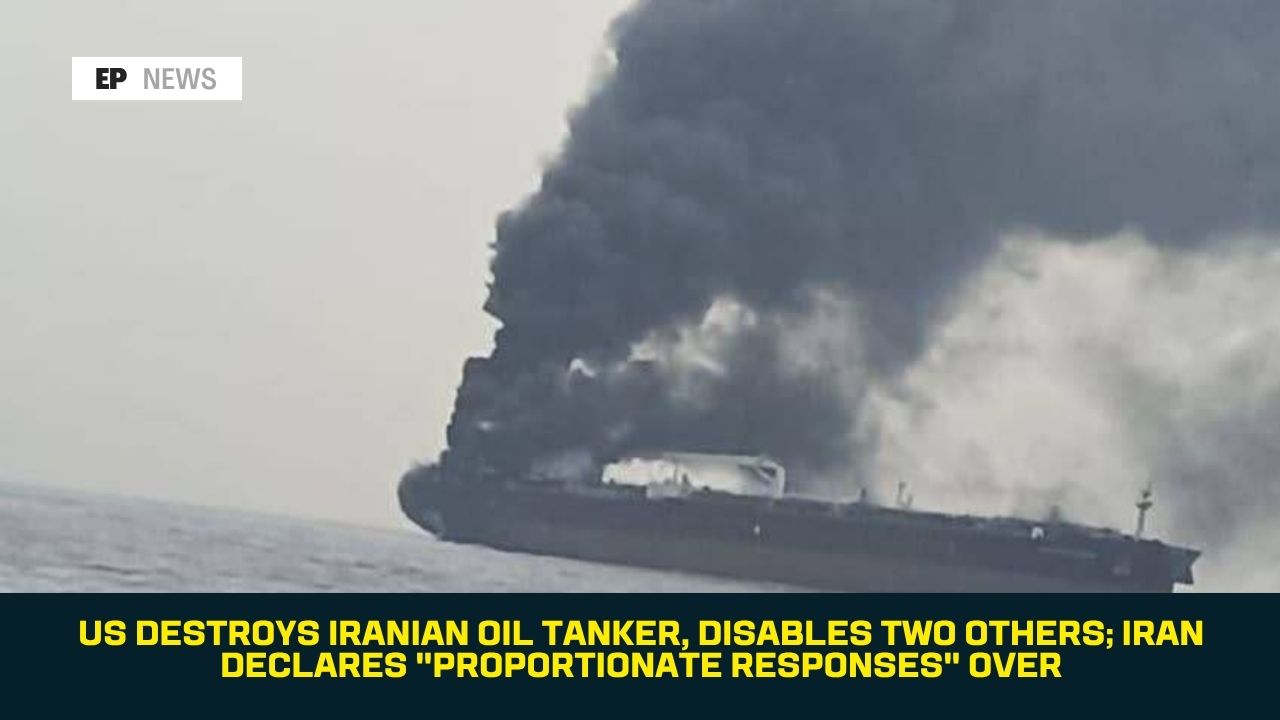
US Destroys Iranian Oil Tanker, Disables Two Others; Iran Declares “Proportionate Responses” Over
U.S. forces struck three Iranian crude oil carriers on Saturday, September 5, destroying one and permanently disabling two others, after Iran’s Revolutionary Guard fired ballistic missiles at a U.S. aircraft carrier and guided-missile destroyer. Iran’s parliament speaker declared Sunday that the “era of proportionate responses” is over, warning of a “faster, heavier, and more painful” retaliation to come.
What Happened Saturday
According to U.S. Central Command, Iran’s Islamic Revolutionary Guard Corps launched ballistic missiles toward two U.S. Navy vessels operating in the region; both a U.S. aircraft carrier and a guided-missile destroyer successfully evaded the attacks, and no American personnel were harmed, according to CNN.
In response, U.S. forces struck three tankers CENTCOM described as part of “a multibillion-dollar shadow network that funds the IRGC and its regional proxies,” according to CNN. The command said it “permanently disabled” the crude oil carriers M/T Downy, off the coast of Kharg Island, and M/T Stark 1, near Jask. A third vessel, an unladen crude tanker called the M/T Kylo, was “completely destroyed” in the Gulf of Oman after being hit multiple times, according to CNN. Al Jazeera reported that CENTCOM’s own video showed the third tanker sinking after extensive bombing.
Admiral Brad Cooper, CENTCOM’s commander, framed the strikes as a deliberate escalation ratio. “Let the message to the IRGC be clear: If you shoot at two of our ships, we will impose an even higher economic cost — taking out three of yours,” Cooper said in a statement, according to the IBTimes UK. “We will not hesitate to defend American forces, and if necessary, destroy Iran’s limited and exposed oil fleet.”
Defense Secretary Pete Hegseth echoed that framing in a post on X, according to CBS News: “It’s simple: if Iran shoots at U.S. ships, we will destroy and sink their oil tankers. All they have to do is not shoot at the Navy.”
Iran’s Response
Iran’s Islamic Revolutionary Guard Corps navy said in a statement Saturday that it had targeted three oil tankers sailing through what it called “an unauthorized route” in the Strait of Hormuz, as well as three additional vessels affiliated with the United States, according to ABC News. Iranian news agencies reported that a tanker near Kharg Island was struck by four projectiles fired by U.S. forces, according to CNN.
Iran’s Foreign Ministry called the U.S. strikes on Iranian ships illegal and a “war crime” that runs counter to the United Nations Charter, according to Al Jazeera.
The Warning From Iran’s Parliament Speaker
Mohammad Bagher Ghalibaf, speaker of Iran’s parliament and the country’s chief negotiator in previous ceasefire talks, delivered a pointed warning Sunday in a speech carried by state media and posted to Telegram. “The Americans must have understood that the era of proportionate responses has come to an end,” Ghalibaf said, according to Al Jazeera. “The rules of the game have changed, and from now on, any transgression against the interests and security of Iran will receive a ‘faster, heavier, and more painful’ response.”
Ghalibaf added that recent Iranian strikes targeting U.S. bases in the Middle East were “only the beginning,” according to ABC News, and separately acknowledged the war’s growing toll on Iran’s economy, according to gCaptain.
Trump’s Characterization of the Conflict
President Trump has continued to downplay the scale of the fighting even as it escalates. “I call it a military conflict,” Trump said, according to CBS News, after Vice President JD Vance said earlier in the week that he wouldn’t describe the situation as a war. Trump insisted the distinction didn’t matter, per ABC News: “I don’t think it matters what you call it. What matters is the fact that we’ve had tremendous success.” He separately described the war as “small potatoes” and said the U.S. has “essentially” taken over Iran.
The Strait of Hormuz Remains Nearly Shut
Shipping through the Strait of Hormuz remains at a fraction of its normal volume. According to gCaptain, citing data from trade analytics firm Kpler, only one commodity vessel crossed the strait on Saturday — a dramatic reduction from the roughly 130 to 140 daily transits the waterway carried before the war began.
Iran is OPEC’s third-largest oil producer and exported 90% of its crude through Kharg Island before the conflict, according to gCaptain. Those flows have already been severely disrupted by the U.S. naval blockade on Iranian oil exports that’s been in place since mid-April.
Regional Spillover
The escalation hasn’t been confined to the Persian Gulf. Israel carried out strikes in southern Lebanon Sunday after Iran-backed Hezbollah launched drones at Israeli soldiers, according to CBS News. Lebanon’s health ministry said the Israeli strikes killed four people, including two women, and wounded 20 others, including three children.
Economic Fallout at Home
The conflict’s economic effects have become increasingly visible domestically. According to Yahoo News/CBS News reporting, U.S. diesel prices have hit record highs amid the ongoing disruption tied to the war, with the timing landing just as Americans prepared for Labor Day travel.
FAQ
How many Iranian tankers did the U.S. strike? Three: the M/T Downy and M/T Stark 1 were permanently disabled, and the M/T Kylo was completely destroyed after being hit multiple times.
Why did the U.S. strike the tankers? In retaliation for ballistic missiles Iran’s Revolutionary Guard fired at a U.S. aircraft carrier and guided-missile destroyer, both of which evaded the attacks without any American casualties.
What did Iran’s parliament speaker say? Mohammad Bagher Ghalibaf declared the “era of proportionate responses” over, warning that any further aggression against Iran would draw a “faster, heavier, and more painful” response, and said recent Iranian strikes on U.S. bases were “only the beginning.”
How much shipping is currently passing through the Strait of Hormuz? Just one commodity vessel crossed the strait on Saturday, according to Kpler data — far below the pre-war daily average of 130 to 140 transits.
Has the conflict spread beyond Iran and the Gulf? Yes. Israel struck targets in southern Lebanon Sunday after Hezbollah launched drones at Israeli soldiers, killing four people according to Lebanon’s health ministry.
Conclusion
Saturday’s tanker strikes and Iran’s subsequent declaration that “proportionate responses” are over mark one of the most serious escalations yet in a war that has now run more than six months, with both sides publicly signaling they’re prepared to widen the conflict’s economic and military dimensions further. With the Strait of Hormuz reduced to a single vessel transit on the day of the strikes and Iranian officials promising heavier retaliation ahead, the coming days will show whether Ghalibaf’s warning translates into a genuine shift in the conflict’s intensity — or becomes another instance in the war’s now-familiar pattern of escalating rhetoric that Trump continues to describe, even amid growing strikes, as “small potatoes.”
Sources: CNN, Al Jazeera, CBS News, ABC News, CNBC, gCaptain, IBTimes UK, PBS News (reporting dated September 5-6, 2026).