
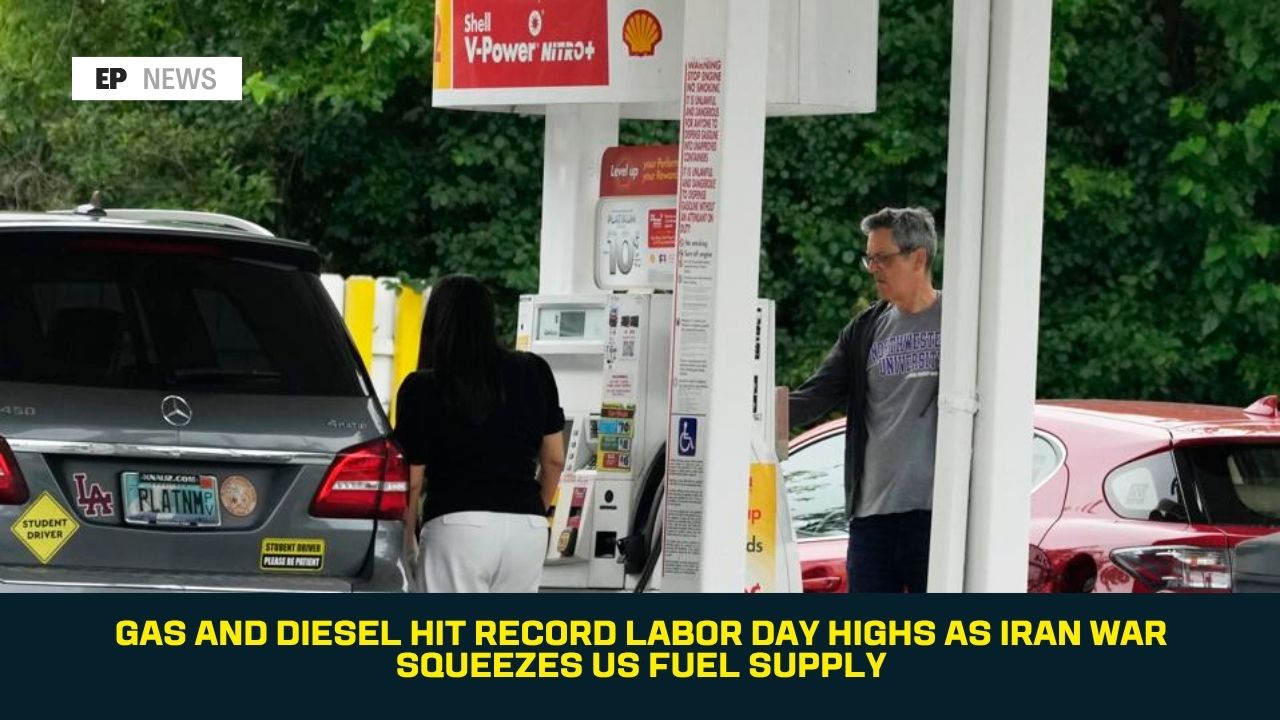
Gas and Diesel Hit Record Labor Day Highs as Iran War Squeezes US Fuel Supply
Fuel prices climbed to their highest levels ever recorded for Labor Day weekend this year, with regular gasoline averaging $4.14 a gallon and diesel hitting an all-time national record of $5.85 a gallon — a spike energy economists attribute largely to the ongoing U.S.-Iran war and its effect on global oil and diesel supply.
The Numbers
The average price of regular gas heading into the holiday weekend was $4.14 a gallon, according to AAA motor club figures cited by the Associated Press, via WRAL — nearly a dollar higher than the same point last year and well above the previous Labor Day weekend record of $3.82, set in 2012. Diesel told an even starker story: it hit a national average of $5.85 a gallon Friday, September 4, an all-time record for the fuel.
For context on how these figures compare historically, the national average for regular gas is still well below the all-time record of $5.02 a gallon set in June 2022 — meaning this is a record specifically for the Labor Day travel period, not for gas prices overall.
Why Experts Are Pointing to the Iran War
Tom Seng, a professor of energy finance at Texas Christian University, offered a direct explanation for the spike. “Everything points to the Iran War and the Strait of Hormuz,” Seng said, according to the AP’s reporting distributed across dozens of local outlets. The connection follows directly from developments in the conflict this weekend: U.S. forces struck three Iranian oil tankers on Saturday, and shipping through the Strait of Hormuz — a route that once carried roughly a fifth of the world’s oil supply — has been reduced to a fraction of its normal volume amid the ongoing naval blockade and hostilities.
Why Diesel Is Being Hit Even Harder Than Gasoline
Diesel’s record-setting price reflects a convergence of pressures beyond the Middle East conflict alone. Seng noted that Ukrainian drone attacks on Russian refineries are separately squeezing global diesel supplies, and Matthew Metzgar, a clinical professor of economics at UNC Charlotte, added that Chinese refiners are also seeing declining output — meaning multiple, largely unrelated disruptions to the global diesel supply chain are compounding at the same moment.
The practical impact of higher diesel prices extends well beyond anyone filling up a truck directly. Trucks and other freight delivery systems rely heavily on diesel, and that increased transportation cost gets passed along to consumers throughout the broader economy — whether at the grocery store or through package delivery services, according to the AP’s reporting.
Why Prices Aren’t Following Their Usual Seasonal Pattern
Gas prices typically decline as the summer driving season winds down and refineries shift to producing a cheaper winter fuel blend. This year, several additional factors are complicating that usual seasonal relief. U.S. refineries are currently operating at 98% capacity, according to Seng, with many facilities working through unusually harsh Texas heat — conditions that leave little slack in the system if a refinery problem or hurricane knocks capacity offline, since there’s minimal spare capacity elsewhere to absorb the loss.
The Administration’s Response
Energy Secretary Chris Wright acknowledged the price increases directly in a Sunday appearance on ABC’s “This Week,” while offering few concrete specifics on timing for relief. “Yes, they’re higher today, but we’re doing everything we can to push them down,” Wright said, according to multiple outlets including Yahoo Finance and KTAR.
Wright pointed to futures markets as a source of optimism for prices eventually falling, telling ABC that current futures pricing suggests markets expect costs to come down in the months ahead, though he stopped short of providing a specific timeline for when American drivers might actually see that relief materialize at the pump.
How Travelers Are Responding
The higher prices have already changed some Americans’ summer travel behavior. Nicole Collins, who was planning to drive from Philadelphia to South Carolina to visit friends over the holiday weekend, told the AP that her family had spent most of the summer staying close to home rather than taking their typical weekend trips, specifically because of how expensive driving has become. “Gas is pretty high right now,” Collins said, speaking outside a gas station in Claymont, Delaware, where regular gas was priced at $4.199 a gallon. “It doesn’t help that we also have a baby, so we also have to pay for that.”
FAQ
How much is gas costing this Labor Day compared to previous years? The national average of $4.14 a gallon is nearly a dollar higher than last year and well above the prior Labor Day record of $3.82, set in 2012.
Is this the highest gas price ever recorded, or just for Labor Day? Just for the Labor Day travel period specifically. The all-time record for regular gas nationally remains $5.02 a gallon, set in June 2022.
Why is diesel hitting a record while gas hasn’t set an all-time record? Diesel is facing compounding pressures beyond the Iran war alone, including Ukrainian drone attacks disrupting Russian refineries and declining output from Chinese refiners, in addition to the Middle East-driven supply constraints affecting both fuels.
What is the Trump administration saying about future prices? Energy Secretary Chris Wright has pointed to futures market pricing as a sign that costs should eventually decline, while acknowledging current prices are higher than a year ago and not offering a specific timeline for relief.
Why aren’t prices following the usual seasonal decline pattern? U.S. refineries are operating at 98% capacity, many in extreme Texas heat, leaving little spare capacity to absorb any additional disruption from equipment problems or hurricanes — on top of the ongoing pressure from the Iran war and global diesel supply issues.
Conclusion
This Labor Day’s record fuel prices offer perhaps the clearest, most direct illustration yet of how the six-month Iran war is reaching into everyday American life, converging with unrelated global refinery and supply pressures to push both gas and diesel to unprecedented levels for this time of year.
With refineries already running near full capacity and no clear timeline from the administration for when relief might arrive, American drivers and the broader economy — given diesel’s outsized role in freight and shipping costs — may be facing elevated fuel costs well beyond this holiday weekend if the underlying conflict and refinery constraints don’t ease.
Sources: The Associated Press (via ABC News, WRAL, KTAR, ClickOrlando, NewsNation, Yahoo Finance, Daily Gazette, KLAS, KRMG), CBS News (reporting dated September 4-7, 2026).