
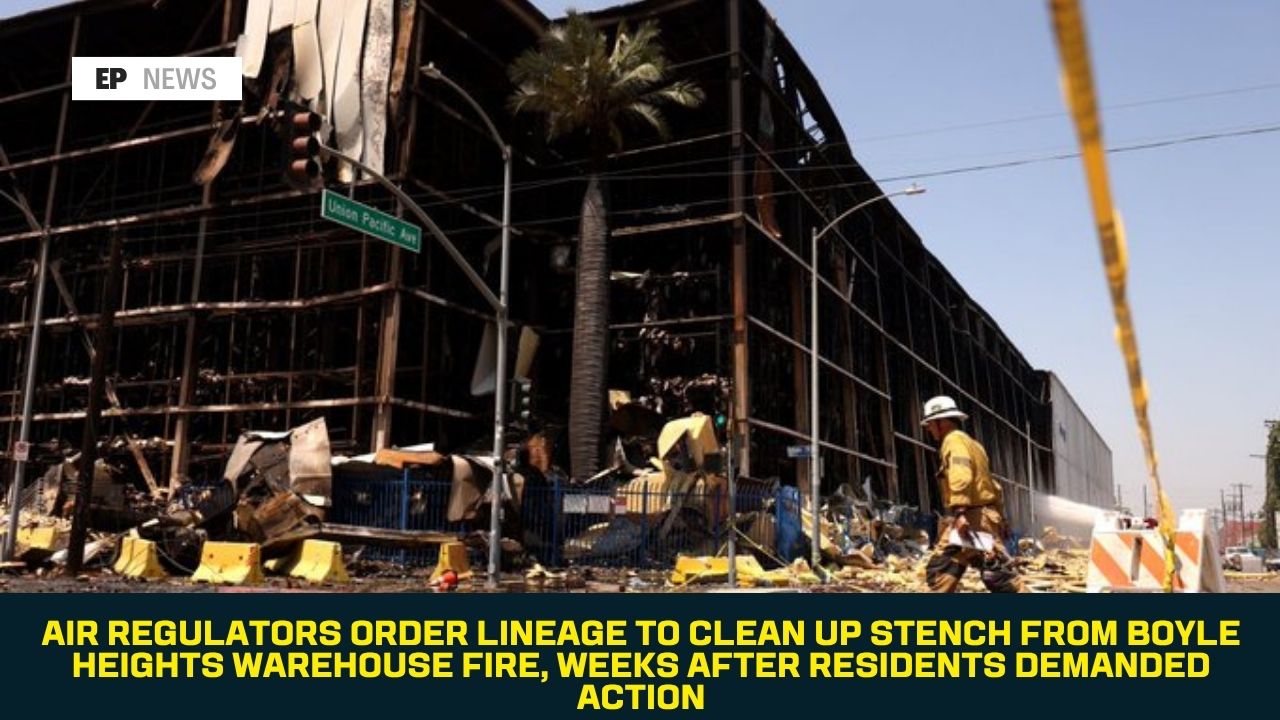
Air Regulators Order Lineage to Clean Up Stench From Boyle Heights Warehouse Fire, Weeks After Residents Demanded Action
Nearly two months after a massive fire tore through a Lineage Logistics cold storage warehouse in Boyle Heights, Los Angeles, air quality regulators have ordered the company to eliminate the lingering stench and pest problems the disaster left behind — a ruling residents say should have come far sooner.
What the New Order Requires
Following two days of hearings, the South Coast Air Quality Management District sided with Boyle Heights residents, ruling that Lineage must do more to address the odor still emanating from the burned warehouse, according to FOX 11 Los Angeles. Under the approved order, Lineage will be legally required to power wash and disinfect the concrete floors in the warehouse’s eastern freezer once all remaining food waste and hazardous materials have been cleared. The company has said it aims to complete bulk food waste removal by the following week.
The order followed a South Coast AQMD hearing held in Diamond Bar, drawing on official testimony, public comments, and documentation from Los Angeles Mayor Karen Bass, City Councilmember Ysabel Jurado, affected residents, and inspection reports from the Los Angeles County Department of Public Health, according to FOX 11.
How the Fire Started — and Why It Kept Burning
The fire began the afternoon of June 17, 2026, at Lineage’s 491,000-square-foot cold storage facility on South Los Palos Street in Boyle Heights, according to Wikipedia’s timeline of the incident. A large black smoke cloud erupted over the warehouse roughly two hours after the fire began, visible across much of the Los Angeles Basin for days afterward. According to CNN, Lineage said it believed the fire originated on the roof while contractors from Altus Power, which operates a solar array leased on the warehouse’s roof, were conducting testing — a conclusion Altus Power disputed.
The fire proved unusually difficult to fully extinguish. It continued burning due to repeated flareups and reignitions beginning June 19, and the Los Angeles Fire Department didn’t declare it fully knocked down until June 24, according to Wikipedia and ABC7 Los Angeles — more than a week after it began. ABC7 described it as a “very complex” fire presenting numerous hazards for firefighters. All building employees were safely evacuated when the fire started, and no injuries were reported, according to CNN.
The Second Disaster: 85 Million Pounds of Rotting Food
Extinguishing the fire didn’t end the crisis for nearby residents — it started a new one. As the facility’s operator, Lineage became responsible for removing an estimated 85 million pounds of food debris from the warehouse, along with broader site cleanup and public nuisance mitigation, according to Wikipedia’s account of the disaster.
That decomposing food created severe, sustained problems for the surrounding community. Los Angeles County Department of Public Health inspectors documented significant violations during a July 15 inspection, citing decaying food residue, wastewater, and both live and dead flies along with fly larvae on sidewalks and streets adjacent to the facility, according to FOX 11. The county subsequently increased potential fines for ongoing public health violations to $2,000 per day. Health officials had already been citing Lineage for unsanitary and nuisance conditions since late July, with fines initially set at $500 per day, according to NBC Los Angeles.
Residents Wanted Mandatory Evacuations — and Didn’t Get Them
Community advocates pushed for a step regulators ultimately declined to take: mandatory evacuation of residents living near the warehouse. According to NBC Los Angeles, Los Angeles County Supervisor Hilda Solis explained that because the warehouse sits within Los Angeles city limits, evacuation decisions fall to the city’s Incident Command structure rather than the county, and that the county’s Department of Public Health issues mandatory evacuation orders “only where there is an imminent risk to life.” As of that reporting, the health department said residents were not being ordered to leave, even as advocacy groups argued that air purifiers and other assistance being offered to residents weren’t sufficient given the scale of the ongoing odor and pest problems.
FOX 11’s more recent reporting found that sentiment largely unchanged weeks later: while Boyle Heights residents welcomed the AQMD’s new cleanup order, many said they have little trust in Lineage and questioned why the required measures weren’t implemented sooner — pointing out that the order arrived seven weeks after the fire and after thousands of complaints from the community.
What Lineage Has Offered So Far
The company has taken some steps to support affected residents independent of the regulatory orders. According to CNN, Lineage contributed $2 million to the California Community Foundation to be distributed to community members impacted by the fire, and said it was working with local officials to provide air purifiers, food, and other resources. The company’s overall cleanup cost estimate has grown substantially: Lineage now projects total cleanup costs will reach between $80 million and $100 million, according to FOX 11.
A Pattern at Lineage Facilities
This wasn’t an isolated incident for the company. According to Yahoo News, a separate fire broke out at a Lineage Logistics cold storage facility in the Tri-Cities area of Washington state, starting in a facility freezer and eventually damaging roughly half the building before being brought under control — with CNN separately noting that Lineage had also experienced a fire at a different Washington state facility in 2024. Investigative reporting from Capital & Main examined the broader pattern, finding that fire and safety risks have mounted as Lineage built what the outlet described as the world’s largest cold storage empire.
FAQ
What did the South Coast AQMD order Lineage to do? Power wash and disinfect the concrete floors in the warehouse’s eastern freezer once all remaining food waste and hazardous materials are removed, addressing the lingering odor problem that’s persisted since the June fire.
When did the original fire happen, and how long did it burn? The fire began June 17, 2026, and wasn’t fully declared extinguished until June 24, due to repeated flareups and reignitions.
Why has the smell persisted so long after the fire was put out? Lineage became responsible for removing an estimated 85 million pounds of food debris from the warehouse after the fire, and decomposing food residue, along with resulting pest issues, continued generating complaints from nearby residents for weeks.
Has anyone been forced to evacuate the area? No mandatory evacuation has been ordered. Los Angeles County officials have said such orders are issued only when there’s an imminent risk to life, and as of recent reporting, residents were not being required to leave, despite advocacy groups’ calls for mandatory evacuation.
How much is the cleanup expected to cost? Lineage estimates total cleanup costs will reach between $80 million and $100 million.
Conclusion
Nearly two months after the fire itself was extinguished, the Boyle Heights community is still living with its aftermath — a public health and quality-of-life crisis that residents say has moved far slower than it should have. With the AQMD’s new order now legally requiring Lineage to eliminate the remaining odor source, the coming weeks will show whether the company’s cleanup timeline finally catches up to a disaster that, for the neighborhood living beside it, never really ended when the flames went out.
Sources: FOX 11 Los Angeles, CNN, ABC7 Los Angeles, NBC Los Angeles, Capital & Main, Yahoo News/AOL, Wikipedia (reporting dated June-August 2026).