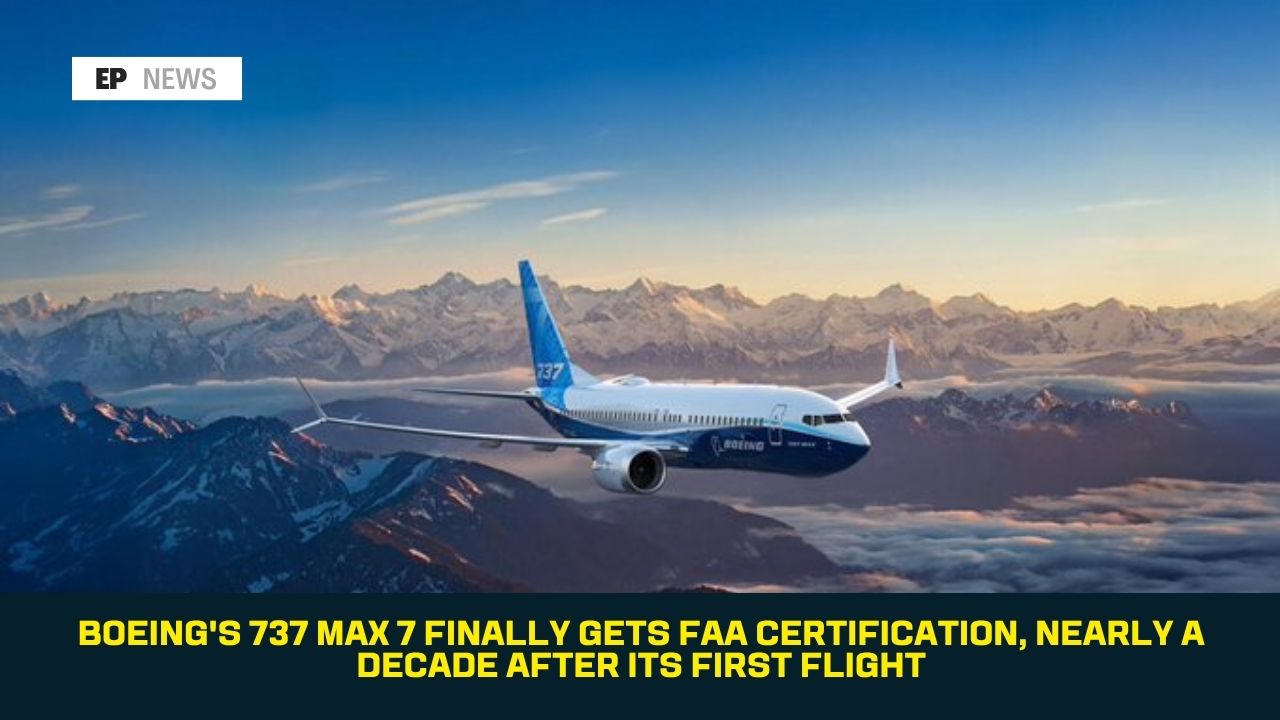
Boeing’s 737 MAX 7 Finally Gets FAA Certification, Nearly a Decade After Its First Flight
The Federal Aviation Administration has granted Boeing an amended type certificate for the 737 MAX 7, clearing the company’s smallest MAX variant for commercial service nearly nine years after the aircraft first took to the skies — a milestone Boeing has been chasing since the plane’s original target entry into service in 2019.
What the FAA Approved
The FAA issued the amended type certificate and an updated Production Limitation Record for the 737 MAX 7 on Monday, August 3, according to the agency’s own statement. In a separate action, the FAA also updated Boeing’s Production Certificate No. 700 to include the new variant, according to Boeing’s own announcement.
The FAA was direct about how extensive the review process had been. “Following almost a decade of extensive review, the FAA has issued an amended type certificate and updated Production Limitation Record for the Boeing 737 MAX-7,” the agency said in its statement. “The approval reflects years of sustained work to resolve complex technical issues and complete a thorough review of the airplane’s design and supporting safety analyses.” The agency said it performed or directly reviewed significant work involving flight controls, system safety assessments, human factors, flight crew alerting, and other “novel, complex, or safety-critical areas,” requiring additional testing, design changes, and analysis where necessary.
Why It Took So Long
Boeing first began flight testing the MAX 7 in 2018, according to AVweb, with the plane originally expected to enter commercial service as early as 2019. The certification process ultimately took far longer, driven by two intersecting factors.
The first was aircraft-specific: engineers discovered a potential issue with the plane’s engine anti-ice system during flight testing, requiring a redesign, according to Boeing’s own account of the certification effort. That same engine anti-ice issue also delayed certification of the larger 737 MAX 10 variant, which first flew in June 2021, according to Aviation Week.
The second factor was broader regulatory scrutiny that reshaped how the FAA approaches Boeing aircraft certifications generally. ABC News and the Associated Press reported that certification of the MAX 7 was delayed as Boeing addressed technical issues alongside heightened regulatory oversight that followed two crashes involving the larger 737 MAX 8, which killed 346 people in 2018 and 2019 — accidents that led the FAA to fundamentally overhaul how it certifies new variants of Boeing aircraft.
What the Certification Process Actually Involved
The scale of the testing effort was substantial. According to Boeing’s own announcement, the certification program included more than 1,000 hours of flight and ground testing, extensive system safety analysis, and human-factors reviews, in addition to the engine anti-ice redesign that addressed the issue identified during flight testing.
Mike Sinnett, a senior Boeing executive involved in the process, characterized the company’s approach to working with regulators throughout the extended review. “Our Boeing team held regular and detailed discussions with the FAA to ensure Boeing understood the requirements and provided transparency of our progress,” Sinnett said, according to Boeing’s statement.
Stephanie Pope, president and CEO of Boeing Commercial Airplanes, framed the approval as validation of the company’s broader recovery efforts. “This important certification validates the rigor of our airplane’s design and recognizes the determination and resilience of our 737 MAX development team,” Pope said, according to KWCH’s coverage of the announcement.
What the MAX 7 Offers
The 737 MAX 7 is positioned as the smallest and longest-range member of Boeing’s MAX family. According to Boeing’s own specifications, the aircraft typically seats 135 to 160 passengers in a two-class configuration and offers a range of up to 3,800 nautical miles — a range Boeing says is specifically suited for operators flying out of high-altitude and hot-climate airports.
Like other members of the MAX family, Boeing says the 737-7 reduces fuel use and CO2 emissions by 20% and cuts its noise footprint by 50% compared to the older-generation aircraft it’s designed to replace. The 737 MAX family’s overall order book stands at more than 7,200 airplanes, of which more than 2,300 had been delivered as of the end of June 2026, according to Boeing.
When Deliveries Will Actually Begin
Certification doesn’t mean immediate deliveries. According to Aviation Week, the approval paves the way for deliveries of the MAX 7 to get underway in early 2027. Southwest Airlines, the aircraft’s launch customer, is preparing for those initial deliveries, with approximately 30 MAX 7 aircraft already assembled and awaiting delivery, according to AVweb.
That delivery timeline lines up with expectations Southwest CEO Bob Jordan had set previously. In comments to Reuters in December, Jordan said he expected the MAX 7 to be certified around August 2026, with Southwest planning to begin flying the aircraft during the first quarter of 2027 — a forecast that has now proven accurate on the certification timing.
What Comes Next for Boeing
With the MAX 7 now certified, Boeing’s attention turns to its remaining uncertified variant. The company is continuing to pursue certification for the larger 737 MAX 10, according to AVweb, though that program has faced the same engine anti-ice redesign hurdle that delayed the MAX 7. FlightGlobal’s reporting noted the MAX 7’s approval caps a “yearslong process” defined by design changes and heightened regulatory oversight — dynamics that are likely to continue shaping the MAX 10’s path toward its own eventual certification.
FAQ
When was the Boeing 737 MAX 7 certified? The FAA granted the amended type certificate on Monday, August 3, 2026.
How long did certification take? The MAX 7 first flew in 2018, meaning the certification process took nearly nine years — well beyond its original planned 2019 entry into service.
Why was certification delayed for so long? Two main factors: a needed redesign of the aircraft’s engine anti-ice system, and broader heightened regulatory scrutiny of Boeing’s certification process following two fatal crashes involving the 737 MAX 8 in 2018 and 2019.
Who is the launch customer for the MAX 7? Southwest Airlines, which already has approximately 30 MAX 7 aircraft assembled and awaiting delivery.
When will airlines actually start flying the MAX 7? Deliveries are expected to begin in early 2027, according to Aviation Week and Southwest’s own public timeline.
How many passengers does the MAX 7 carry? Typically 135 to 160 passengers in a two-class configuration, with a range of up to 3,800 nautical miles.
Conclusion
The MAX 7’s certification closes out one of the longest-running sagas in Boeing’s recent commercial aviation history, arriving nearly a decade after the plane’s first flight and years behind its original schedule. While the approval represents a genuine milestone in Boeing’s broader effort to rebuild credibility with regulators after the MAX 8 crashes, the company’s work isn’t finished — the larger MAX 10 remains stuck behind the same technical hurdle that delayed the MAX 7, meaning Boeing’s path to completing its full MAX family lineup is still not fully resolved.
Sources: Federal Aviation Administration, Boeing, ABC News/Associated Press, AVweb, AirlineGeeks, FlightGlobal, Aviation Week, KWCH (reporting dated August 3-4, 2026).