
Michigan’s Bruising Democratic Senate Primary Tests the Party’s Progressive-vs-Establishment Divide
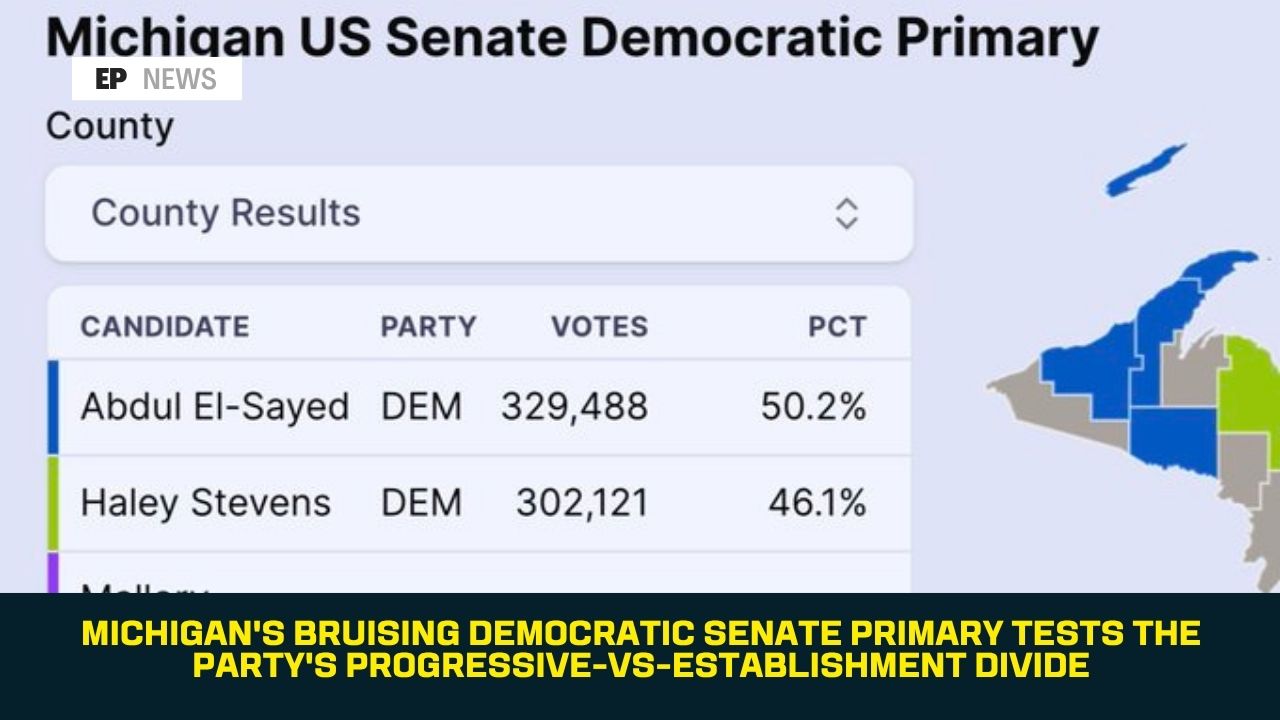
Michigan Democrats went to the polls Tuesday, August 4, in one of the most closely watched and expensive primary fights of the 2026 midterm cycle, choosing between progressive former public health official Abdul El-Sayed and moderate Rep. Haley Stevens for the party’s nomination in a Senate race widely seen as pivotal to control of the chamber. Early returns Tuesday night showed El-Sayed leading, though the race had not been officially called as vote counting continued.
What the Race Was About
The contest emerged after Democratic Sen. Gary Peters announced he would not seek a third term, opening up a Senate seat in a state both parties consider a must-win. According to CNBC, the race quickly became one of the year’s most closely watched, with El-Sayed and Stevens clashing over issues including AI data centers and U.S. foreign policy.
The primary field had originally included a third major candidate, Michigan state Sen. Mallory McMorrow, who attempted to stake out a middle ground between Stevens and El-Sayed before dropping out of the race in July, according to CNBC’s reporting.
Whoever won the Democratic nomination was set to face former Rep. Mike Rogers, the unopposed Republican nominee, in the November general election, according to NBC News.
The Establishment-vs-Progressive Divide
The two Democratic candidates drew support from starkly different wings of the party. Stevens, a member of Congress since 2019, was backed by outgoing Sen. Gary Peters, Michigan Gov. Gretchen Whitmer, former Sen. Debbie Stabenow, and Senate Democratic leader Chuck Schumer, according to Time. Peters campaigned directly for Stevens, telling voters at a Monday event that she had already proven she could flip a Republican-held House seat and was the candidate positioned to keep Michigan’s Senate seat in Democratic hands.
El-Sayed, by contrast, drew support from the party’s progressive wing, including visits and endorsements from Sen. Bernie Sanders and Rep. Alexandria Ocasio-Cortez, according to both Time and The Hill. If elected, El-Sayed would become the country’s first Muslim U.S. senator.
Polling heading into the race showed El-Sayed with a substantial lead. An Emerson College Polling survey released the week before the election showed El-Sayed ahead of Stevens 54% to 39%, according to The Hill, with the gap widening to 57%-41% once undecided voters who leaned toward a candidate were factored in. That same poll found a pronounced generational divide: voters under 50 favored El-Sayed by a 42-point margin, while voters over 60 favored Stevens.
A Contentious, Expensive Fight
The race drew heavy outside spending and became notably contentious in its closing days. According to Time, roughly $60 million in outside money was spent in the race, with much of it aimed at boosting Stevens, who was widely viewed by party strategists as the stronger general-election candidate against Rogers in a swing state Trump carried twice.
El-Sayed’s sharp criticism of Israel’s conduct in Gaza became a particular flashpoint, opening tensions within Michigan’s Jewish community and drawing accusations from detractors that his rhetoric ventured into troubling territory, according to Time’s reporting. Despite that controversy and the outside spending against him, polling suggested his positions had not undercut his support among primary voters, particularly younger ones.
Early Results and What’s Still Uncertain
As of Tuesday night, the Washington Post’s live results tracker showed El-Sayed leading Stevens in early returns, though the Senate primary itself had not yet been formally called, with some populous counties, including Wayne County, still being counted. CNN’s live coverage similarly noted that full results from Wayne County — Michigan’s most populous county and home to Detroit — could take considerable time to finalize.
More than 1.2 million Michigan voters had already cast ballots ahead of Tuesday, either through mail-in absentee voting or in-person early voting over the preceding ten days, according to the Detroit News, citing the Michigan Secretary of State’s office.
Other Michigan Races Decided the Same Night
The Senate primary wasn’t the only closely watched Michigan contest on Tuesday’s ballot. The Washington Post reported that Michigan’s gubernatorial race was called Tuesday night, with Trump-backed Rep. John James winning the Republican nomination to face Democrat Jocelyn Benson, the state’s current secretary of state, in November.
Part of a Broader Midwest Primary Night
Michigan’s primary landed alongside other significant Midwest primary contests the same night. According to NPR, primary elections in Michigan, Wisconsin, and Minnesota were being closely watched as a test case for whether progressive candidates can win in competitive states — and what “electability” really means for Democrats heading into November. Separately, in Missouri’s 1st Congressional District, Rep. Wesley Bell defeated former Rep. Cori Bush’s comeback bid, according to the Washington Post’s live results.
FAQ
Who won the Michigan Democratic Senate primary? As of Tuesday night, the race had not been officially called. Early returns showed Abdul El-Sayed leading Rep. Haley Stevens, consistent with pre-election polling that showed him ahead by double digits, but full results — particularly from Wayne County — were still being counted.
Who will the Democratic nominee face in November? Former Rep. Mike Rogers, who ran unopposed for the Republican nomination.
Why was this primary considered so significant nationally? It was widely viewed as a test case for the direction of the Democratic Party, pitting an establishment-backed moderate against a progressive candidate backed by figures like Bernie Sanders and Alexandria Ocasio-Cortez, in a swing state considered crucial to Senate control.
Who won Michigan’s Republican gubernatorial primary? Trump-backed Rep. John James won the Republican nomination and will face Democrat Jocelyn Benson, the current Michigan secretary of state, in the November general election.
How much outside money was spent on the Michigan Senate primary? Roughly $60 million in outside spending went into the race, according to Time, with much of it directed toward supporting Stevens.
Conclusion
Whatever the final outcome, Michigan’s Democratic Senate primary has already delivered a clear signal about the tensions running through the party heading into the 2026 midterms — an energized progressive base willing to back a candidate like El-Sayed even against tens of millions of dollars in establishment-aligned spending, set against warnings from party veterans that a more moderate nominee gives Democrats a better shot at actually winning the seat in November. With full results still coming in from Michigan’s largest county and the general election matchup against Mike Rogers now set, this primary’s outcome will be closely studied as an early data point for how competitive, swing-state Senate races might play out elsewhere this cycle.
Sources: CNBC, Time, The Hill, NPR, CBS News, The Washington Post, CNN, Detroit News (reporting dated July 30-August 4, 2026).