
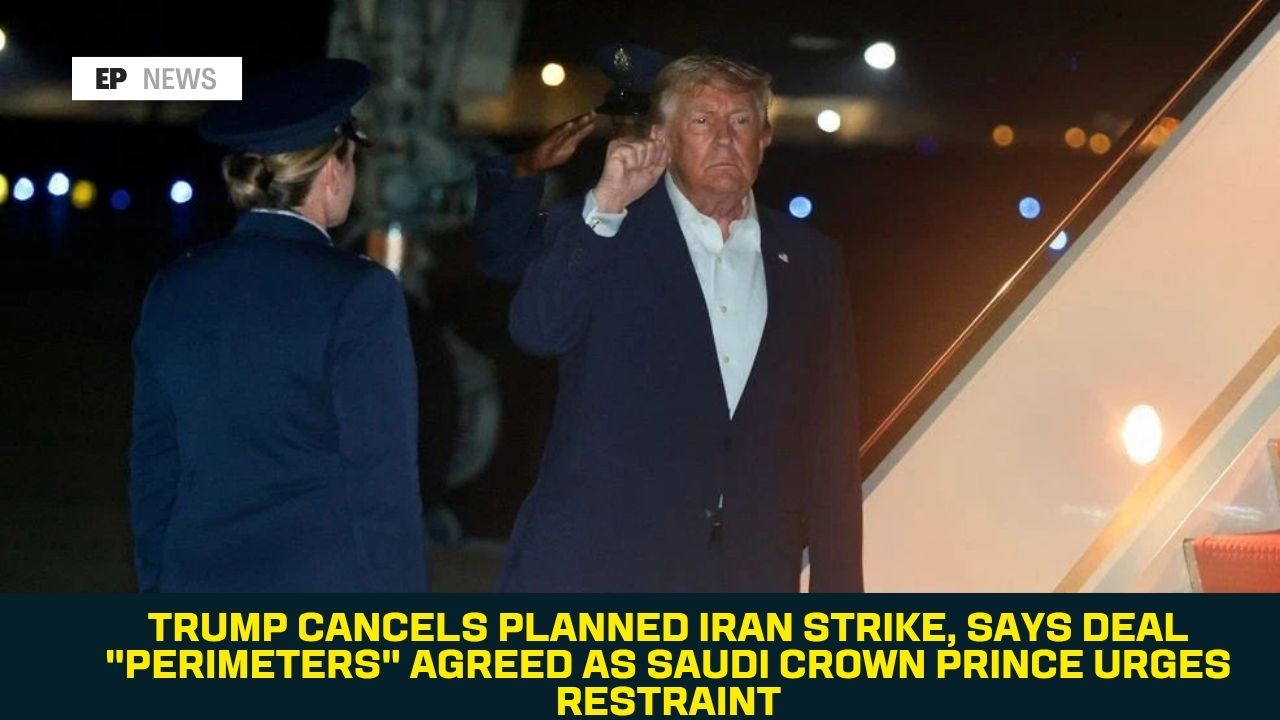
Trump Cancels Planned Iran Strike, Says Deal “Perimeters” Agreed as Saudi Crown Prince Urges Restraint
President Trump announced late Saturday, August 1, that he had called off a planned U.S. military strike on Iran after Tehran and several Middle Eastern nations asked for more time to finalize a broader agreement — one that Trump said would include the full reopening of the Strait of Hormuz and an end to what he called Iran’s nuclear threat.
What Trump Announced
Posting on Truth Social Saturday night, Trump said the United States was “locked and loaded and ready to go” with a level of military force he described as unseen “since World War II.” He said that, despite that posture, Iran and other Middle Eastern countries had just asked the U.S. to hold off any attack because the outlines of a deal had been agreed to.
Trump said the emerging agreement would bring the “Immediate, Complete, and Total” reopening of the Strait of Hormuz, along with an end to Iran’s nuclear threat. He said he agreed to cancel the strike for the benefit of “the WORLD” and for what he called the survival of a prosperous Iran, on the condition that a deal could be reached quickly. He added that Israel had joined the U.S. in committing to try to complete the agreement, and closed his post by telling those involved to “get to work” and get it done.
As of Saturday night, Iran had not issued a public response to Trump’s announcement, according to Al Jazeera.
The Pressure That Led to This Moment
The cancellation didn’t come out of nowhere. According to Axios, Saudi Crown Prince Mohammed bin Salman personally called Trump on Saturday, urging him to cancel the planned strikes and return to negotiations instead — a request Trump cancels Iran strike deal later confirmed through its own sourcing.
The timing was significant given how close the U.S. reportedly was to acting. Multiple sources told CBS News on Friday that the U.S. and Israel were preparing a powerful joint bombing campaign targeting energy infrastructure inside Iran. That came after a rapid sequence of escalating incidents in the days prior: Iran’s state-linked media threatened strikes on oil and gas facilities across Saudi Arabia, the UAE, Qatar, and Israel on July 31, and Iran’s IRGC Navy had claimed responsibility for striking and halting three tankers in the Strait of Hormuz just days earlier. Iranian Foreign Minister Abbas Araghchi had separately warned his Saudi counterpart earlier Saturday that any U.S. or Israeli attack would be met with a “proportionate response.”
Why the Strait of Hormuz Is the Central Issue
The Strait of Hormuz has been the central flashpoint of the broader U.S.-Iran conflict for months. The narrow waterway between Iran and Oman connects the Persian Gulf to the Arabian Sea and, before this year’s conflict, carried roughly a fifth of the world’s oil trade and a similar share of global liquefied natural gas shipments. Iran closed the strait to shipping earlier this year in response to U.S. and Israeli strikes, and has repeatedly targeted commercial vessels attempting to transit it since.
That pattern continued right up through this weekend. The British Navy reported that a tanker was struck and a separate explosion occurred near another vessel in the strait off the coast of Oman on Saturday, though no casualties were reported in either incident. The UK Maritime Trade Organization said the first vessel was hit by an unknown projectile Friday roughly 11 nautical miles northeast of Lima, Oman, damaging its engine room, while a large splash and explosion were reported Saturday near a separate tanker sailing off Khasab.
A Conflict Defined by Reversals
Saturday’s announcement is far from the first time this year that a planned U.S. strike on Iran has been paused at the last minute in exchange for negotiating room. Back in April, Trump similarly agreed to a two-week ceasefire — that time crediting Pakistani Prime Minister Shehbaz Sharif and Field Marshal Asim Munir for the eleventh-hour appeal — contingent on Iran reopening the Strait of Hormuz. That ceasefire came under strain within hours, according to Fox News reporting at the time, as Gulf states reported fresh drone attacks almost immediately afterward.
The broader war traces back to February 28, 2026, when the U.S. and Israel launched coordinated strikes on Iranian military targets. Since then, the conflict has moved through multiple rounds of strikes, retaliation, brief ceasefires, and renewed fighting, with Iran extending attacks to targets in the UAE, Saudi Arabia, Qatar, Kuwait, Bahrain, Iraq, Oman, and Jordan at various points. Just weeks before Saturday’s announcement, Iran struck the Muwaffaq Salti Air Base in Jordan on July 17, killing two U.S. service members and wounding dozens — one of the deadliest single incidents for U.S. forces in the conflict to date.
What’s Still Unconfirmed
It’s important to be clear about what hasn’t happened yet. Trump described this as agreement on the “perimeters” of a deal — not a finalized, signed agreement. Iran had not publicly confirmed the terms as of Saturday night, and previous pauses in this conflict have unraveled within hours or days of being announced. The details of how a nuclear agreement would actually be structured, and what verification mechanisms might apply, have not been made public.
FAQ
Did Trump cancel a strike on Iran? Yes. Trump said Saturday night that he agreed to cancel a planned U.S. military strike after Iran and other Middle Eastern countries requested a pause to finalize a deal.
What would the deal include? According to Trump, the agreement would include the full reopening of the Strait of Hormuz and an end to Iran’s nuclear threat, though specific terms have not been publicly detailed.
Has Iran confirmed the deal? Not publicly, as of Saturday night. Iran had not issued an official response to Trump’s announcement.
Who pushed for the strike to be called off? Saudi Crown Prince Mohammed bin Salman called Trump on Saturday urging him to cancel the planned strikes, according to Axios and CBS News reporting.
When did the current U.S.-Iran conflict begin? The war traces back to February 28, 2026, when the U.S. and Israel conducted coordinated airstrikes on Iranian military targets.
Has a ceasefire like this happened before in this conflict? Yes. Trump announced a similar two-week pause in April 2026 after Pakistani officials intervened, though that ceasefire came under strain within hours as fresh attacks were reported.
Conclusion
Saturday’s announcement is a genuine de-escalation moment in a war that has repeatedly swung between fresh strikes and last-minute pauses since February. But the language Trump used — “perimeters” of a deal, not a finished one — and Iran’s silence so far leave real uncertainty about whether this holds. Given the pattern of this conflict, where previous ceasefires have broken down within hours of being announced, the coming days will show whether this is the beginning of a genuine off-ramp or another temporary lull before renewed fighting.
Sources: Al Jazeera, CBS News, The Boston Globe, Kurdistan24, Axios, Fox News, Iran International (reporting dated August 1-2, 2026).