
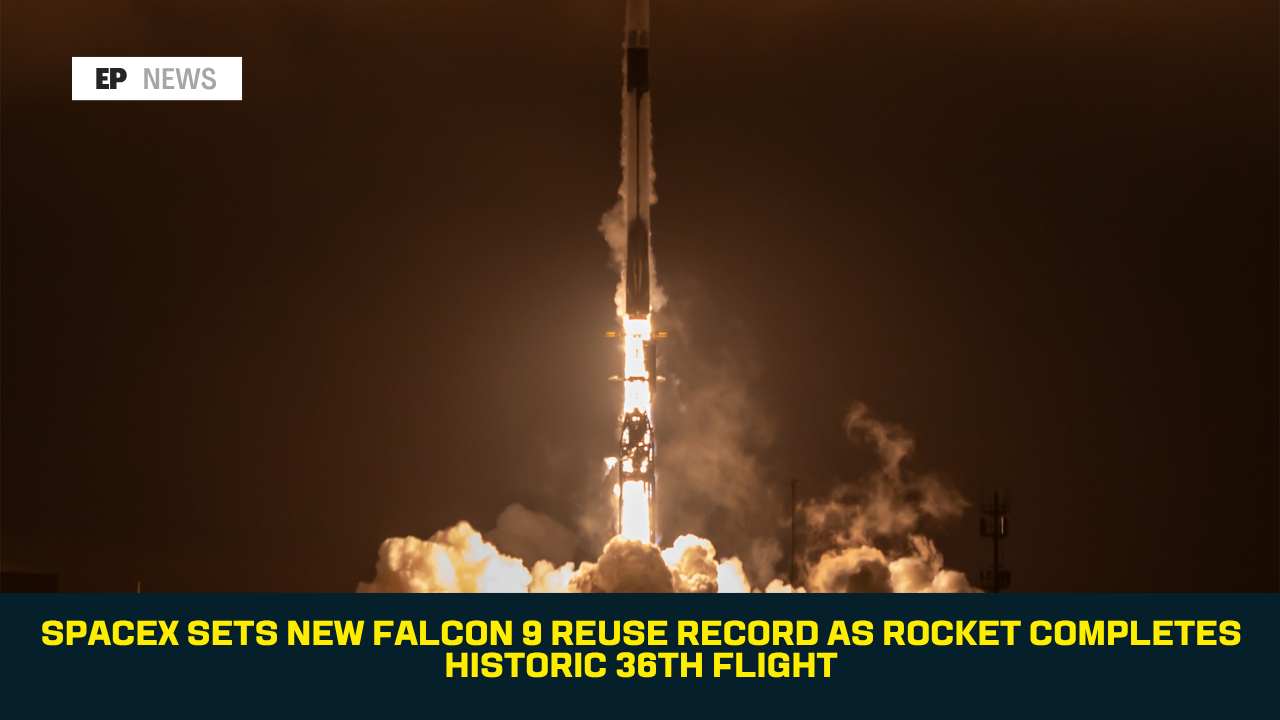
SpaceX Sets New Falcon 9 Reuse Record as Rocket Completes Historic 36th Flight
SpaceX has reached another milestone in commercial spaceflight after one of its Falcon 9 boosters completed a record-breaking 36th mission, further demonstrating the reliability of reusable rocket technology. The launch carried a new batch of Starlink internet satellites into low Earth orbit from Cape Canaveral Space Force Station, Florida.
The achievement strengthens SpaceX’s position as the world’s leading commercial launch provider and highlights how reusable rockets continue to reduce launch costs while increasing the pace of space missions.
Falcon 9 Continues to Break Records
The Falcon 9 first-stage booster used for the mission had already completed 35 successful flights before this launch. With its 36th successful mission, it has set a new company record for rocket reuse.
After liftoff, the booster completed its mission and successfully landed on SpaceX’s autonomous droneship in the Atlantic Ocean, making it available for future launches.
Starlink Network Keeps Growing
The mission deployed another group of Starlink broadband satellites, expanding SpaceX’s global satellite internet network.
Starlink now serves millions of users by providing high-speed internet to:
- Rural communities
- Remote businesses
- Maritime customers
- Airlines
- Emergency response teams
The latest deployment supports SpaceX’s long-term goal of increasing global internet coverage while improving network capacity.
Why Reusable Rockets Matter
Before Falcon 9, most rockets were used only once.
Today, reusable boosters allow SpaceX to:
- Reduce launch costs
- Increase launch frequency
- Minimize manufacturing time
- Support more commercial and government missions
- Expand satellite deployment at a much faster pace
Industry experts say rocket reusability has fundamentally changed the economics of space exploration.
A Busy Year for SpaceX
SpaceX has maintained an exceptionally active launch schedule throughout 2026.
Recent missions have included:
- Starlink satellite launches
- Commercial rideshare missions
- Government payloads
- Scientific satellites
- International customer missions
Earlier this week, the company also successfully launched 81 satellites during its Transporter-17 rideshare mission, one of the largest multi-payload launches of the year.
NASA and Commercial Space Cooperation
SpaceX continues to play a major role in NASA’s commercial space program by supporting cargo missions, astronaut transportation, and future lunar exploration initiatives.
NASA officials have repeatedly highlighted the importance of commercial partnerships in expanding scientific research and lowering mission costs.
What’s Next for SpaceX?
The company is preparing for several major projects in the coming months, including:
- Additional Starlink launches
- Falcon Heavy missions
- Continued testing of Starship
- Commercial astronaut flights
- NASA partnership missions
Investors and space enthusiasts are also watching progress on the next generation of Starship, which is expected to support future Moon and Mars missions.
Conclusion
SpaceX’s record-breaking 36th Falcon 9 flight is another example of how reusable rocket technology is transforming the space industry. By combining rapid launch operations with proven booster recovery, the company continues to set new standards for commercial spaceflight. As SpaceX expands Starlink and prepares for future deep-space missions, reusable rockets remain at the center of its long-term strategy.