
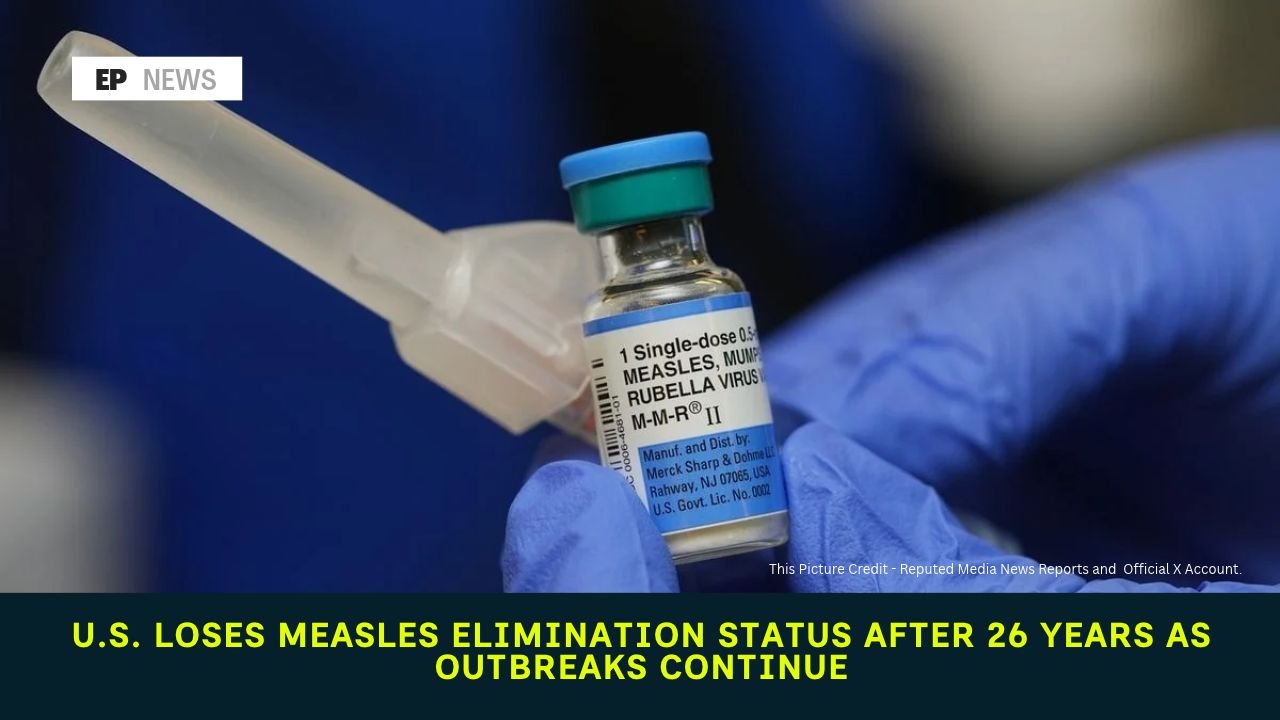
U.S. Loses Measles Elimination Status After 26 Years as Outbreaks Continue
November 18, 2026 | U.S Health News
The United States has officially lost its measles elimination status after more than 26 years, marking a significant setback for one of the country’s major public health achievements.
The Pan American Health Organization (PAHO) announced the decision on November 17, 2026, following a review of measles transmission data from countries across the Americas.
The decision means that measles is once again considered endemic in the United States. In public health terms, endemic transmission means that a disease is circulating continuously within a country rather than appearing only through occasional imported infections or short-lived outbreaks.
The United States first achieved measles elimination status in 2000 after years of vaccination campaigns, disease surveillance and public health efforts.
However, a prolonged outbreak that began in January 2025 continued long enough to meet the international criteria for the re-establishment of endemic transmission.
The development has raised concerns among public health experts because measles is one of the most contagious infectious diseases. It can spread rapidly in communities where vaccination coverage is insufficient.
According to PAHO, the United States is not the only country affected. Mexico and Bolivia have also lost their national measles elimination status following the same review. Canada lost its designation in 2025.
Health officials say the situation can be reversed, but restoring elimination status will require stronger vaccination coverage, effective disease surveillance and rapid responses to new outbreaks.
Why Did the United States Lose Measles Elimination Status?
The main reason was the continued circulation of the same measles virus lineage for at least 12 consecutive months.
PAHO’s Regional Monitoring and Re-Verification Commission reviewed epidemiological and laboratory evidence from the United States and other countries during its meeting from November 10 to November 13, 2026.
The commission concluded that a single chain of measles transmission had continued in the United States for more than one year.
According to the official PAHO assessment, the transmission chain began on January 20, 2025. It continued beyond the 12-month threshold required under the regional elimination framework.
That finding meant the United States could no longer be classified as a country where endemic measles transmission had been eliminated.
The decision was based on scientific and epidemiological criteria, including evidence about the virus’s genetic characteristics and the duration of its circulation.
It was not simply a decision based on the total number of reported cases.
A country can experience imported measles cases and even temporary outbreaks without automatically losing elimination status. The critical issue is whether a continuous chain of domestic transmission persists for 12 months or longer.
In the U.S. case, the commission concluded that the required threshold had been crossed.
PAHO Director Dr. Jarbas Barbosa accepted the commission’s recommendation and communicated the change to the relevant national health authorities.
What Does Losing Measles Elimination Status Actually Mean?
The announcement has caused understandable concern, but it is important to understand what the designation means.
Losing elimination status does not mean measles has suddenly become a new disease in the United States.
It also does not mean every state is experiencing an outbreak or that every American is at immediate risk of infection.
Instead, the designation confirms that measles has been circulating continuously within the country for a prolonged period.
When the United States achieved elimination status in 2000, it meant that continuous domestic transmission had been interrupted.
Individual infections could still occur when someone brought measles into the country from abroad. However, public health authorities were generally able to contain those introductions before they became sustained transmission chains.
The current situation is different.
The same virus lineage has continued circulating for more than a year, showing that the country’s disease-control system has not been able to interrupt that transmission chain.
This is a serious public health setback because sustained transmission creates more opportunities for the virus to reach unvaccinated people, infants and individuals who cannot receive certain vaccines for medical reasons.
However, the status can be regained if the country successfully interrupts endemic transmission and meets the relevant verification requirements.
How Many Measles Cases Have Been Reported in the United States in 2026?
The United States has experienced a substantial measles resurgence during 2026.
According to reporting by The Associated Press and other U.S. news organizations, the country had recorded more than 5,400 confirmed measles cases during 2026 by the time of the PAHO announcement.
The Washington Post reported approximately 5,412 cases and at least 10 deaths during the year.
The Associated Press reported more than 7,000 cases across the two-year period, with 13 deaths overall, including 10 in 2026.
These figures reflect different reporting periods and should not be treated as interchangeable.
The 2026 case total already represents the country’s highest annual measles count since 1991, according to public health reporting.
The scale of the outbreak is particularly significant because measles had become relatively uncommon in the United States after elimination was achieved.
The current increase demonstrates how quickly a highly contagious disease can return when immunity gaps develop in communities.
Case counts can change as state health departments investigate new infections and update their reporting. Readers should therefore consult the latest CDC surveillance information for the most current figures.
How Did the Measles Outbreak Begin?
The prolonged transmission chain identified by PAHO began in the United States on January 20, 2025.
A major outbreak in West Texas became one of the most significant early developments in the resurgence.
The virus subsequently spread into other areas, including communities in Utah, Arizona and additional states.
The outbreak involved transmission in communities where vaccination coverage was not sufficient to prevent sustained spread.
Measles can spread through the air when an infected person breathes, coughs or sneezes. The virus can remain infectious in the air for a period after an infected person has left an enclosed space.
Because of this, a single infectious person can expose multiple susceptible individuals.
The CDC describes measles as one of the most contagious infectious diseases. PAHO has said one infected person can transmit the virus to as many as 18 susceptible individuals.
This helps explain why even a relatively small number of initial cases can lead to much larger outbreaks when vaccination coverage is low.
Public health officials must identify cases quickly, trace contacts, provide vaccination where appropriate and monitor communities where transmission may be continuing.
Why Is Measles So Dangerous?
Measles is a viral disease that commonly causes fever, cough, a runny nose, red or watery eyes and a characteristic rash.
The rash usually begins on the face and spreads across the body.
Some people recover without serious complications, but measles can cause severe illness, particularly among young children and people with weakened immune systems.
Possible complications include:
- Pneumonia.
- Severe dehydration.
- Ear infections.
- Diarrhea.
- Inflammation of the brain, known as encephalitis.
- Long-term neurological complications.
- Death in severe cases.
Measles can also temporarily weaken the immune system, making some people more vulnerable to other infections.
Infants who are too young to receive routine vaccination are particularly vulnerable.
Pregnant people and individuals with certain medical conditions may also face increased risks from infection.
This is why health authorities emphasize prevention and rapid outbreak response rather than waiting until case numbers become very high.
What Role Has Vaccination Played in the Resurgence?
Vaccination gaps are an important factor in the return of sustained measles transmission.
The measles, mumps and rubella vaccine, commonly known as the MMR vaccine, is the primary tool used to prevent measles infections.
The CDC identifies two doses of the MMR vaccine as approximately 97% effective at preventing measles.
However, protection depends not only on individual vaccination but also on maintaining high vaccination coverage across entire communities.
Public health experts generally aim for approximately 95% vaccination coverage with two doses to help prevent measles from spreading.
When coverage falls below that level, the risk of outbreaks increases, particularly in schools, childcare facilities and communities with concentrated vaccination gaps.
The CDC’s November 17 statement identified declining childhood vaccination coverage as an important concern.
According to the agency, MMR vaccination coverage among U.S. kindergarteners fell from 95.2% during the 2019–2020 school year to 92.7% in 2023–2024.
That decline left more children without the recommended level of protection.
The CDC also pointed to disruptions in routine childhood vaccination during the COVID-19 pandemic and declining public trust in healthcare institutions as contributing challenges.
These factors do not mean every unvaccinated person will become infected. However, they increase the number of people who can potentially become part of a transmission chain.
What Is the CDC Doing After the Announcement?
The Centers for Disease Control and Prevention has said it remains committed to stopping measles outbreaks and helping the United States regain elimination status.
In its November 17 joint statement, the CDC and partner organizations outlined several priorities.
These include encouraging MMR vaccination, improving access to vaccines and helping local health departments identify communities with lower protection levels.
The agency also said it had provided approximately $100 million in additional funding since August to support measles prevention and response efforts.
The funding includes:
- $50.2 million through a cooperative agreement focused on vaccine-preventable disease prevention and response.
- $49.8 million through an Epidemiology and Laboratory Capacity cooperative agreement.
The funding is intended to strengthen disease surveillance, laboratory capacity, outbreak investigations and local public health responses.
The CDC also said several states had requested additional technical support through its Epi-Aid program.
These efforts are intended to help state and local authorities identify cases, investigate transmission and respond to outbreaks.
CDC Director Dr. Erica Schwartz said that the elimination designation itself is not what protects Americans; vaccination does.
The agency’s statement also emphasized the importance of rebuilding public trust through transparency and evidence-based information.
Why Did PAHO Also Remove Mexico and Bolivia’s Status?
The United States was not the only country affected by the November 17 announcement.
PAHO confirmed that Mexico and Bolivia had also lost their measles elimination status.
The commission found that the same measles virus lineage had circulated continuously for at least 12 months in all three countries.
According to PAHO, the relevant transmission periods began on:
- January 20, 2025, in the United States.
- February 1, 2025, in Mexico.
- April 16, 2025, in Bolivia.
The three countries were therefore classified as having re-established endemic measles transmission.
Canada had already lost its national elimination status in 2025 after an extended outbreak.
PAHO said the wider region had reported 58,213 confirmed measles cases and 82 deaths as of November 13, 2026.
That figure covers the Americas as a whole, not the United States alone.
The regional situation shows that measles remains a serious public health challenge across North, Central and South America.
Can the United States Regain Measles Elimination Status?
Yes. Losing elimination status is not permanent.
PAHO has explained that countries can regain their status after interrupting endemic transmission and meeting the required verification standards.
The United States will need to demonstrate that the continuous transmission chain has been stopped.
However, simply recording fewer cases for a few weeks or months will not be enough.
The country must demonstrate that endemic transmission has been interrupted for at least 12 consecutive months.
PAHO has also emphasized the importance of improving vaccination coverage, strengthening disease surveillance and ensuring that health authorities can respond quickly when new cases are detected.
The experience of other countries shows that recovery is possible.
Brazil previously lost its measles elimination status after sustained transmission. Following vaccination campaigns and stronger public health measures, the country interrupted endemic transmission and regained its status in November 2024.
The United States will need a coordinated effort involving federal agencies, state health departments, healthcare providers, laboratories and local communities.
Who Is Most at Risk From the Current Measles Situation?
Not every American faces the same level of risk.
People who have received the recommended two doses of MMR vaccine generally have strong protection against measles.
However, certain groups may face a higher risk of serious illness or complications.
These include:
1. Infants and young children
Babies who are too young for routine MMR vaccination may be vulnerable if exposed to the virus.
2. Unvaccinated individuals
People who have not received the recommended doses are more susceptible to infection.
3. People with weakened immune systems
Some individuals cannot receive live vaccines for medical reasons and may depend on community protection.
4. Pregnant people
Measles infection during pregnancy can create additional health risks and requires medical attention.
5. People living in communities with low vaccination coverage
When vaccination rates are low, the virus can spread more easily among susceptible individuals.
People who are unsure about their vaccination history should consult a healthcare professional or their local health department.
Anyone who develops symptoms that could indicate measles should contact a healthcare provider before visiting a clinic or hospital in person, so appropriate precautions can be taken to protect other patients.
What Does This Mean for American Families?
The loss of measles elimination status is primarily a public health warning, but it also has practical implications for families.
Parents may need to check whether their children have received the recommended MMR doses.
Schools and childcare providers may face additional questions about vaccination records and outbreak-related guidance.
Healthcare professionals must remain alert to possible measles cases, particularly when patients have fever and rash after possible exposure.
Local health departments may also need to spend more resources investigating cases, identifying contacts and organizing vaccination activities.
The situation does not mean that families should panic or stop normal daily activities.
Instead, the key message from health authorities is to understand vaccination status, follow local public health guidance and seek medical advice when necessary.
Maintaining high vaccination coverage is important not only for protecting vaccinated people but also for protecting those who cannot be vaccinated.
Conclusion
The United States losing its measles elimination status after more than 26 years is a major public health setback.
PAHO made the decision after determining that the same measles virus lineage had circulated continuously in the country for more than 12 months, beginning in January 2025.
The United States now joins Mexico and Bolivia among the countries that lost their national elimination status in the latest review. Canada had lost its designation in 2025.
The resurgence has been associated with declining vaccination coverage, immunity gaps and sustained transmission in several communities.
The CDC has announced additional funding and public health measures to strengthen vaccination access, surveillance and outbreak response.
The most important point is that the situation can be reversed. The United States can regain elimination status if it successfully interrupts endemic transmission and maintains strong prevention systems.
For American families, checking vaccination records, following trusted medical advice and supporting community protection remain important steps in reducing the risk of measles.
Frequently Asked Questions (FAQs)
1. Has the United States officially lost measles elimination status?
Yes. PAHO announced on November 17, 2026, that the United States had lost its measles elimination status after more than 12 months of continuous transmission.
2. When did the United States first eliminate measles?
The United States achieved measles elimination status in 2000 after sustained public health and vaccination efforts interrupted continuous domestic transmission.
3. Why did the United States lose its measles-free status?
The same measles virus lineage circulated continuously in the country for at least 12 months, meeting the international criteria for re-established endemic transmission.
4. How many measles cases were reported in the United States in 2026?
More than 5,400 confirmed cases had been reported during 2026 by the time of the November 17 announcement, according to contemporary U.S. reporting. Counts can change as health authorities update their data.
5. Which other countries lost measles elimination status in November 2026?
Mexico and Bolivia also lost their national measles elimination status following the PAHO review. Canada had lost its status in 2025.
6. Is measles dangerous?
Yes. Measles is highly contagious and can cause pneumonia, encephalitis, severe dehydration and other serious complications. Some infections can be fatal.
7. Does the MMR vaccine protect against measles?
Yes. The CDC says two doses of MMR vaccine are approximately 97% effective at preventing measles.
8. Can the United States regain measles elimination status?
Yes. The country must interrupt endemic transmission for at least 12 consecutive months and demonstrate that it has the vaccination coverage, surveillance and outbreak-response systems needed to prevent its return.
9. Should vaccinated people be worried?
People who have received the recommended two doses generally have strong protection. Anyone uncertain about their vaccination history should consult a healthcare professional.
10. Does losing elimination status mean measles is spreading in every U.S. state?
No. The designation means continuous transmission has been re-established somewhere within the country. It does not mean every state or community is experiencing an outbreak.
Note: This article reflects information available through November 18, 2026. The loss of elimination status was confirmed by PAHO. Case totals are time-sensitive and may change as CDC and state health departments update their reports.