
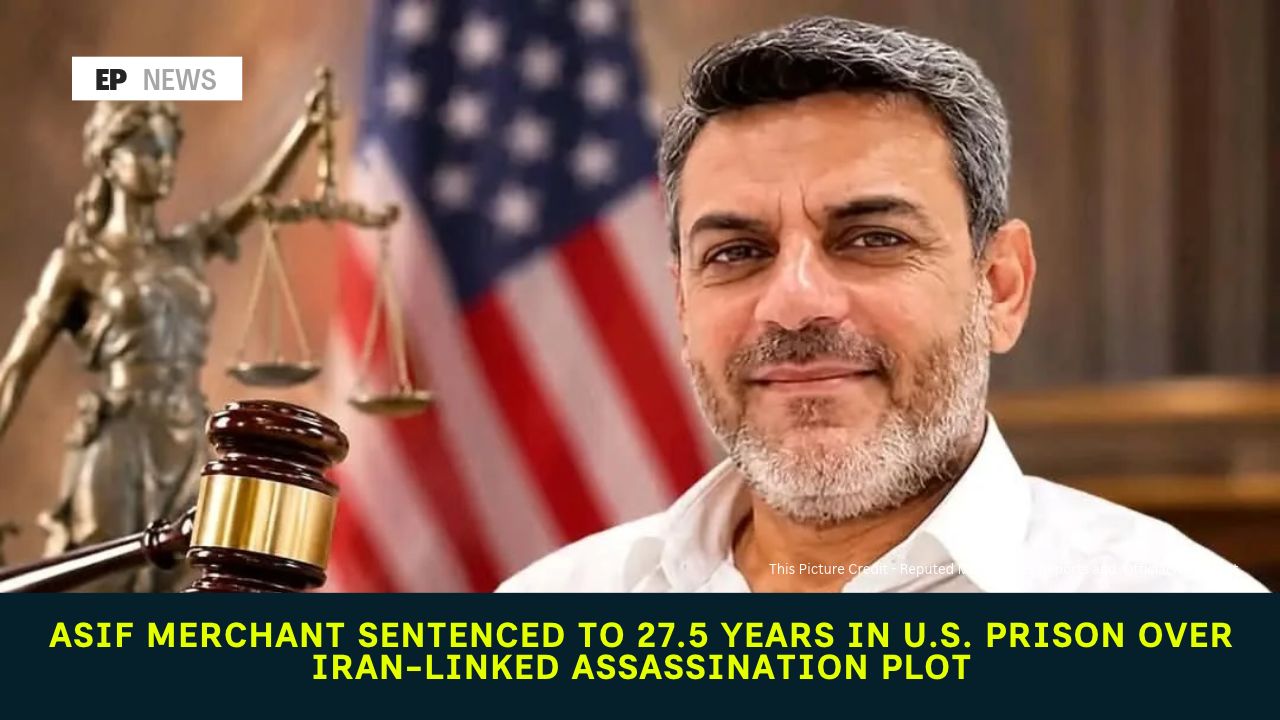
Asif Merchant Sentenced to 27.5 Years in U.S. Prison Over Iran-Linked Assassination Plot
November 18, 2026 | U.S. News
A Pakistani national convicted in a plot to arrange the assassination of a prominent U.S. political figure has been sentenced to 27 years and six months in federal prison, bringing a major criminal case involving national security and alleged Iranian intelligence operations to another significant stage.
Asif Merchant, 48, received the sentence on November 17, 2026, in federal court in Brooklyn, New York. The U.S. Department of Justice announced that he had been sentenced to 330 months in prison for attempting to commit an act of terrorism transcending national boundaries and murder for hire.
Federal prosecutors said Merchant traveled to the United States to organize political assassinations on behalf of Iran’s Islamic Revolutionary Guard Corps (IRGC). According to the Justice Department, he believed President Donald Trump would be the ultimate target, although former President Joe Biden and former United Nations Ambassador Nikki Haley were also discussed as possible targets.
The alleged plan was disrupted before any attack occurred. People Merchant believed were hired killers were actually undercover FBI agents, and an acquaintance had alerted authorities about his activities.
Merchant was convicted by a federal jury in March 2026. During his trial, however, he offered a different explanation for his involvement, testifying that an Iranian intelligence operative had pressured him and threatened his family.
The sentencing highlights the U.S. government’s continuing efforts to prosecute alleged foreign-directed operations targeting American political figures.
Asif Merchant Receives 330-Month Federal Prison Sentence
U.S. District Judge Eric R. Komitee imposed a sentence of 330 months in prison on Merchant during a federal court proceeding in Brooklyn on November 17.
The sentence is equivalent to 27 years and six months.
Merchant had been convicted of two serious federal offenses: attempting to commit an act of terrorism transcending national boundaries and murder for hire.
The Justice Department described him as a trained operative of Iran’s Islamic Revolutionary Guard Corps. Prosecutors said he had traveled to the United States to arrange the killing of American political or government officials.
The sentencing followed a trial in which prosecutors presented evidence from recordings, electronic devices, witness testimony and meetings with undercover FBI agents.
Merchant faced the possibility of life imprisonment following his conviction.
The judge considered the seriousness of the planned violence and Merchant’s explanation that he had acted under pressure from an Iranian handler.
According to the Associated Press, the judge acknowledged that Merchant had some concern for his family but also concluded that he was highly motivated to harm the United States.
Merchant’s defense attorney argued that his participation was reluctant and that the plot was poorly organized. The defense also maintained that Merchant had been operating under pressure and fear for relatives.
The court nevertheless imposed a lengthy prison sentence.
What Was the Alleged Assassination Plot?
According to the Justice Department, the plan involved recruiting people in the United States to kill a political figure or government official.
Prosecutors said the operation was connected to Iran’s IRGC and was motivated by retaliation for the January 2020 U.S. drone strike that killed Iranian military commander Qassem Soleimani.
Soleimani had led the IRGC’s Quds Force, which was responsible for Iran’s overseas military and intelligence operations.
The United States killed Soleimani in Baghdad during Trump’s first presidential administration. Iran subsequently promised retaliation against those responsible for his death.
Federal prosecutors said Merchant was recruited by an Iranian intelligence handler and instructed to identify criminals or members of organized crime who could carry out an assassination.
The proposed attack was reportedly intended to take place at a political rally in the United States.
According to Merchant’s trial testimony, his handler discussed several potential targets, including Trump, Biden and Haley.
The Justice Department said Merchant believed Trump was the ultimate target.
It is important to understand that the case involved a foiled conspiracy, not a completed assassination attempt at a rally. No attack was carried out, and the individuals Merchant believed he had hired were undercover law enforcement officers.
How Did the FBI Discover the Plot?
The investigation developed after Merchant approached an acquaintance in the United States for help with his plans.
According to prosecutors, Merchant initially presented the idea as a business opportunity. During later conversations, he explained that he wanted assistance arranging a killing.
The acquaintance became concerned and contacted the FBI.
Instead of helping Merchant recruit actual assassins, the acquaintance cooperated with investigators and served as an informant.
This allowed federal authorities to monitor Merchant’s communications and gather evidence about the proposed operation.
Merchant subsequently met with people he believed could arrange the assassination.
Those individuals were actually undercover FBI agents.
During meetings in New York, Merchant explained that he was working with people overseas and wanted to hire individuals to kill a politician.
The meetings were monitored as part of the investigation.
According to the Justice Department, Merchant paid $5,000 as an initial payment to the purported hitmen. Prosecutors said the money had been obtained with assistance from relatives overseas.
The payment was part of the evidence presented during the federal trial.
The FBI’s undercover operation prevented the plan from progressing to an actual attack.
Merchant Was Arrested in Texas in July 2024
Merchant was arrested in Richmond, Texas, on July 12, 2024.
According to the Justice Department, he was preparing to leave the United States when authorities took him into custody.
The arrest came after investigators had gathered information about his meetings, communications and proposed payments.
The case was handled by federal authorities in the Eastern District of New York, with assistance from multiple FBI offices and other law enforcement agencies.
Investigators examined Merchant’s laptop, mobile phones and social media accounts.
The Justice Department said evidence from these devices showed his interest in the 2024 presidential election and President Trump.
Among the materials introduced at trial were internet searches relating to campaign rallies and a Google Maps search for the location of a Trump rally in New Jersey.
Prosecutors also presented social media posts that praised Soleimani and expressed hostility toward Trump and the United States.
These materials formed part of the government’s case that Merchant was not simply discussing an imaginary scenario but was actively pursuing an assassination plan.
Why Were Donald Trump, Joe Biden and Nikki Haley Mentioned?
The case attracted national attention because the potential targets included leading American political figures from both major parties.
Donald Trump was a presidential candidate in 2024 and is now the sitting president.
Joe Biden was serving as president during the period when Merchant traveled to the United States.
Nikki Haley was also a prominent Republican presidential candidate during the 2024 election campaign.
According to the Justice Department, Merchant believed Trump was the ultimate target of the operation.
However, his trial testimony indicated that the Iranian handler had also mentioned Biden and Haley as possible targets.
The Justice Department said the plan was intended to target a political figure or government official at a public political event.
The case therefore raised concerns about the security of American political leaders during an election year.
It also demonstrated the risks posed by alleged foreign-directed operations that seek to use criminal networks or intermediaries inside the United States.
No evidence in the case established that an actual attack was carried out against any of the named political figures by Merchant.
Merchant Claimed He Was Acting Under Pressure
One of the most important parts of the trial involved Merchant’s explanation of why he became involved.
Merchant testified that he had been recruited by an Iranian Revolutionary Guard intelligence operative and that he feared for the safety of his relatives.
According to his account, he believed that refusing the handler’s instructions could place his family in danger.
He also suggested that he expected American authorities to discover the operation and that cooperating with them might eventually help his situation.
His defense attorney described his participation as reluctant and argued that the plan was poorly executed.
Prosecutors strongly challenged this explanation.
They pointed to Merchant’s social media activity, his research into Trump campaign events and his meetings with people he believed were hired killers.
The government argued that these actions demonstrated a serious commitment to the assassination plan.
The jury convicted Merchant in March 2026.
During sentencing, the judge reportedly acknowledged that Merchant had some concern for his family but also considered his motivation to harm the United States.
These competing accounts are important to understanding the case. Merchant’s claims about pressure and family threats were part of his defense, while the jury’s conviction established his criminal responsibility under the charges.
What Is Iran’s Islamic Revolutionary Guard Corps?
The Islamic Revolutionary Guard Corps, commonly known as the IRGC, is a major branch of Iran’s armed forces.
It was established after Iran’s 1979 Islamic Revolution and has responsibilities that extend beyond conventional military operations.
The organization plays a significant role in Iran’s domestic security, military structure and regional strategy.
Its Quds Force has been particularly associated with operations and relationships outside Iran.
The U.S. government has designated the IRGC as a foreign terrorist organization.
American officials have repeatedly accused Iranian state-linked groups of conducting or supporting operations against U.S. interests and individuals.
In Merchant’s case, federal prosecutors said the operation was directed by an IRGC intelligence handler.
The Justice Department described Merchant as a trained operative who had received intelligence-related instruction.
The department’s account said Merchant began working with the IRGC around 2022 and met his handler multiple times in Tehran.
According to the prosecution, the handler instructed him to travel to the United States and organize an assassination operation.
Iran has denied seeking to kill U.S. officials. Its government has rejected American accusations involving assassination plots.
The distinction between the Justice Department’s allegations about Iranian involvement and Iran’s official denial should remain clear in reporting on the case.
Why Was the Plot Linked to the Killing of Qassem Soleimani?
Qassem Soleimani was one of the most influential military figures in Iran before his death in January 2020.
He commanded the IRGC’s Quds Force and played a major role in Iran’s regional military strategy.
On January 3, 2020, a U.S. drone strike near Baghdad International Airport killed Soleimani.
The Trump administration defended the operation as necessary to protect American personnel and interests.
Iran strongly condemned the killing and promised retaliation.
The incident significantly increased tensions between Washington and Tehran.
In Merchant’s case, federal prosecutors said the alleged assassination operation was motivated by Iran’s desire to avenge Soleimani’s death.
Merchant also testified about the connection between his instructions and the killing of the Iranian commander.
This background helps explain why the case was treated as a national-security matter rather than an ordinary murder-for-hire investigation.
What Evidence Did Prosecutors Present?
The prosecution relied on several types of evidence during the trial.
These included:
- Testimony from Merchant himself.
- Statements and recordings involving the acquaintance who alerted the FBI.
- Meetings with undercover FBI agents.
- Evidence of the $5,000 payment.
- Searches and other information recovered from electronic devices.
- Social media posts relating to Soleimani, Trump and the United States.
- Evidence concerning Merchant’s contacts with an alleged Iranian handler.
The Justice Department said Merchant admitted at trial that he had joined the IRGC and traveled to the United States to arrange political assassinations.
The recordings and undercover meetings were particularly important because they allowed prosecutors to show how the proposed operation developed.
The government also presented evidence of research into political rallies.
The defense, meanwhile, argued that Merchant’s participation was reluctant and that he was acting under pressure.
The jury ultimately found him guilty of the federal charges.
Could Merchant Appeal the Sentence?
The Associated Press reported that Merchant planned to appeal.
An appeal is a legal process through which a defendant asks a higher court to review certain aspects of a conviction or sentence.
It does not automatically erase the original judgment or mean that the defendant will be released.
Any appeal would need to identify legal grounds for challenging the proceedings or sentence.
The outcome would depend on the arguments presented and the decisions of the appellate court.
As of November 18, 2026, the important confirmed development is that the federal court has imposed a 330-month prison sentence.
Readers should not interpret a planned appeal as a reversal of the conviction.
What Does the Case Mean for U.S. National Security?
The Merchant case has broader implications for American security agencies.
It demonstrates how investigators may need to monitor foreign-linked operations that rely on intermediaries, criminal contacts and undercover networks.
The alleged plan did not involve a conventional military attack. Instead, prosecutors said it depended on recruiting people inside the United States to carry out violence against a political target.
That type of operation creates challenges for law enforcement because the people involved may initially appear to be ordinary contacts or business associates.
The FBI’s use of an informant and undercover agents was central to stopping the plan before an attack occurred.
The case also raises questions about the security of public political events, especially during presidential campaigns.
Political rallies bring candidates into large crowds, often in open venues. Protecting candidates while allowing public access is a major security responsibility.
The investigation showed how intelligence gathering, cooperation from informants and undercover operations can help authorities identify threats before violence takes place.
However, the case should not be treated as proof that every recent security incident involving Iran or other foreign governments is connected. Each investigation requires its own evidence.
Conclusion
Asif Merchant’s 27-year-and-six-month federal prison sentence marks a major development in a case involving an alleged Iran-linked plot to assassinate prominent American political figures.
The Justice Department said Merchant traveled to the United States to organize political killings on behalf of Iran’s Islamic Revolutionary Guard Corps. Prosecutors presented evidence involving undercover FBI agents, a $5,000 payment, electronic searches and discussions about potential targets.
The operation was stopped before any attack occurred, and Merchant was arrested in Texas in July 2024.
His defense argued that he acted under pressure and feared for his relatives, but a federal jury convicted him in March 2026. Judge Eric R. Komitee imposed a 330-month sentence on November 17.
The case is significant for its implications for U.S. national security, political-event protection and the government’s response to alleged foreign-directed operations.
Merchant’s reported intention to appeal means the legal process may continue. However, as of November 18, the conviction and sentence remain in place.
Frequently Asked Questions (FAQs)
1. Who is Asif Merchant?
Asif Merchant is a 48-year-old Pakistani national who was convicted in the United States of murder for hire and attempting to commit an act of terrorism transcending national boundaries.
2. How long was Asif Merchant sentenced to prison?
He was sentenced to 330 months in federal prison, equal to 27 years and six months, on November 17, 2026.
3. What was Asif Merchant accused of planning?
Federal prosecutors said he attempted to arrange the assassination of a U.S. political figure or government official. Potential targets discussed included Donald Trump, Joe Biden and Nikki Haley.
4. Was Donald Trump the main target?
According to the Justice Department, Merchant believed Trump would be the ultimate target. His trial testimony also referred to Biden and Haley as possible targets discussed by his alleged handler.
5. Was the assassination plot successful?
No. The alleged plot was stopped before any attack occurred. The people Merchant believed were hired killers were undercover FBI agents.
6. What role did Iran’s IRGC allegedly play?
Federal prosecutors said Merchant was recruited and trained by an Iranian intelligence operative connected to the IRGC, who instructed him to organize an assassination operation in the United States. Iran has denied seeking to kill U.S. officials.
7. When was Asif Merchant arrested?
Merchant was arrested in Richmond, Texas, on July 12, 2024, as he was preparing to leave the United States.
8. Why did Merchant say he participated in the plot?
Merchant testified that he feared for his relatives and had been pressured by an Iranian intelligence operative. Prosecutors challenged his explanation, and the jury convicted him.
9. Did the FBI prevent the assassination?
The FBI disrupted the alleged plan through an investigation involving an informant and undercover agents. No assassination was carried out.
10. Will Asif Merchant appeal his conviction?
The Associated Press reported that Merchant planned to appeal. Any appeal would be a separate legal process, and the conviction and sentence remain in place unless changed by a court.
Editorial Note: This article is based on information available through November 18, 2026. Claims about Iranian direction are attributed to the U.S. Justice Department and trial evidence. Merchant’s account of pressure and threats to his family is presented as his defense testimony, not as an independently established fact.