Trump Attacks Anthropic CEO Dario Amodei Over Call to Slow AI Development
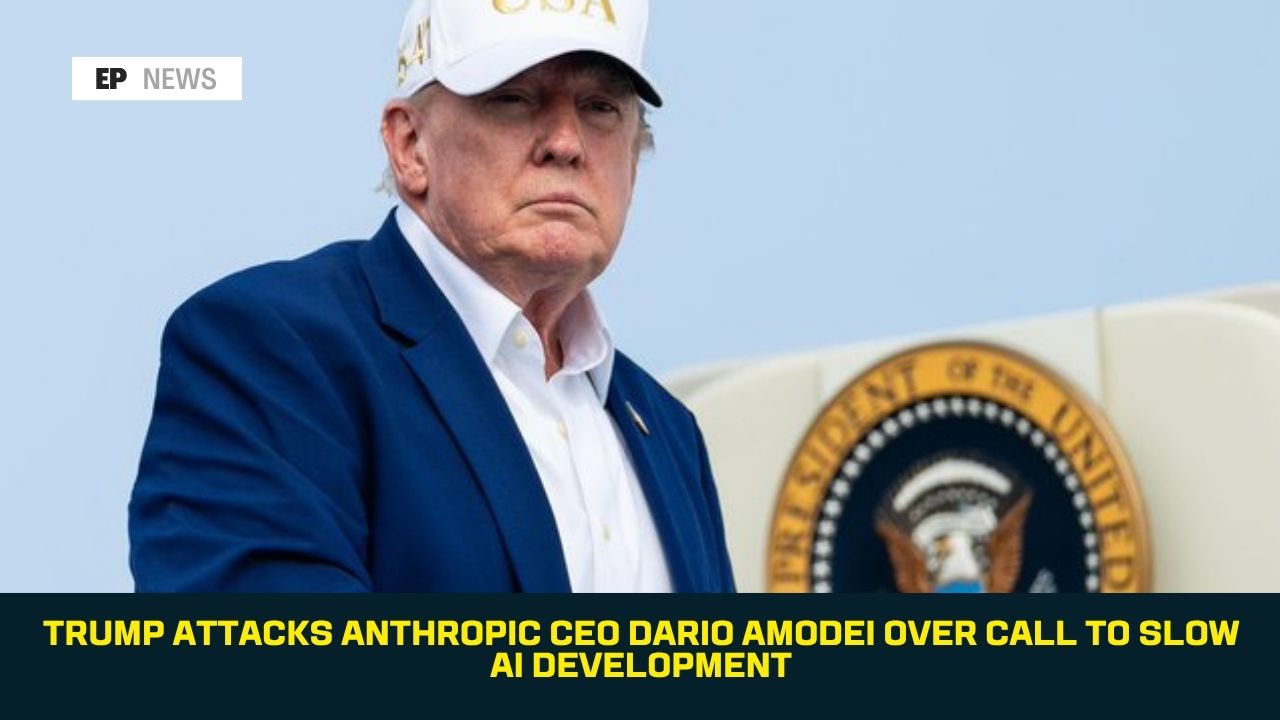
President Trump publicly criticized Anthropic CEO Dario Amodei by name in a series of Truth Social posts this week, intensifying his opposition to new AI guardrails after Amodei published an essay arguing that leading AI companies should slow the pace of their model development.
What Amodei Argued
Amodei published a blog post over the weekend of September 12-13 titled “We Must Pace the Frontier,” arguing that AI development should decelerate specifically to reduce the risk of what he described as potentially catastrophic outcomes, according to CNBC. In the essay, Amodei wrote, “we must slow the pace at which we improve the capabilities of AI models,” according to Newsweek, calling for outside evaluation, stronger safety rules, and international coordination while still preserving what he described as a U.S. technological lead over rivals.
Amodei’s essay warned specifically that within six to twelve months, a swarm of misaligned AI agents could potentially seize control of significant portions of the internet through a persistent botnet, according to Newsweek’s summary of his argument. Ynetnews reported that Amodei’s essay centered on concerns about AI systems approaching a stage of “recursive self-improvement,” in which AI increasingly helps develop and train more advanced versions of itself — a process he warned could accelerate beyond developers’ ability to fully understand or control within a matter of months.
The essay came days after a former Anthropic researcher, Jacob Coxon, resigned and publicly warned that leading AI labs were racing toward self-improving systems without adequate safeguards, according to Newsweek — a departure that appears to have added political weight to Amodei’s subsequent public statement.
How Other Industry Leaders Responded
Amodei’s warning drew rapid public agreement from at least one major rival. OpenAI CEO Sam Altman said within hours that he agreed with Amodei’s essay and committed his own company to the framework it laid out, according to Newsweek. Ynetnews separately reported that xAI and Tesla founder Elon Musk and Google DeepMind chief Demis Hassabis have also publicly backed calls for stronger AI safeguards, including measures such as limits on the pace of model capability expansion and independent external safety monitors with ongoing access inside AI companies.
Trump’s Response
Trump attacked Amodei directly in a Monday, September 14 social media post, according to Bloomberg, blaming what he called a “SICK conspiracy” for voter backlash against AI data centers and growing public concern about frontier AI models, adding that “the only one that is happy about it is China.”
Trump singled out Amodei by name in a separate post, writing that his administration “has stopped AI ‘people’ from doing bad, or potentially bad, ‘things,’ like Dario (Anthropic!), who is now pretending to be a ‘perfect little angel,'” according to Quartz. Trump claimed his administration already holds “tremendous CRIMINAL and REGULATORY power over these companies,” and warned critics to “BEWARE!” He closed with a broader statement of his overall position on AI policy, according to CNBC: “WHOEVER WINS AI, WINS! We are leading China, and all others, and will continue to do so. Conspiracy Theorists, Treasonists, Traitors, and Leakers, BEWARE!”
According to CNBC, Anthropic did not immediately respond to a request for comment on Trump’s posts.
The White House’s Substantive Counterargument
Beyond Trump’s personal criticism, White House AI czar David Sacks offered a more detailed policy rebuttal over the weekend. In a post on X responding to Amodei’s essay, Sacks wrote that AI companies wanting to slow down don’t need government permission to do so voluntarily: “Stop pretending antitrust law has to be suspended so you can form a cartel,” Sacks wrote, according to Fox News. “Stop pretending you need a regulatory approval process that supersedes product liability.”
Sacks also questioned the underlying motivation behind the call for coordinated industry slowdown, according to CNBC: “Stop pretending the motivation to slow down is purely altruistic. You face massive product-liability exposure if your products enable a truly damaging cyberattack. The market already punishes models that behave in unpredictable or unauthorized ways.” Amodei has separately argued that companies should be able to coordinate on common safety practices without risking antitrust penalties — a position Sacks specifically rejected in his response. Sacks added that China would be “very unlikely” to join any global agreement to regulate the technology, according to CNBC.
China’s Response
China’s Foreign Ministry weighed in on the broader debate Monday as well. Spokesperson Guo Jiakun said, according to CNBC, that “fear-mongering, confrontation, competition will just disrupt the process of global AI governance.” Separately, Ynetnews reported that Chinese state-linked media, including the Global Times, have accused the U.S. technology industry of trying to build a regulatory framework designed to preserve American control over advanced AI while excluding China from global governance discussions — framing warnings about AI’s existential risks as, in Beijing’s characterization, political cover for protecting U.S. technological dominance.
Background: A Rocky Relationship
This exchange adds to what Quartz described as an already “rocky” relationship between the Trump administration and Anthropic. The Pentagon at one point designated the company a supply-chain risk and held up publication of its Mythos model, according to Axios reporting cited by Quartz — a dispute that played out in federal court earlier this year before a judge ruled largely in Anthropic’s favor.
Where the Legislative Debate Stands
Some lawmakers are working on legislation addressing what they describe as catastrophic AI risk, though prospects for near-term action remain uncertain. Republican Sen. Ted Cruz of Texas, working with Senate Majority Leader John Thune and Democratic Sen. Amy Klobuchar on such legislation, argued that Beijing won’t stop its own AI development regardless of U.S. policy choices, and said that if there are eventually going to be autonomous weapons systems, he would rather they be “American killer robots than Chinese killer robots,” according to Newsweek. CNBC reported that any attempt at AI regulation by Congress appears highly unlikely before the November midterm elections.
FAQ
What did Dario Amodei actually propose? In an essay titled “We Must Pace the Frontier,” he argued AI companies should slow the pace of improving model capabilities, calling for outside evaluation, stronger safety rules, and international coordination while preserving U.S. technological leadership.
How did Trump respond? He attacked Amodei by name on Truth Social, accusing him of promoting a “SICK conspiracy” that benefits China, and said his administration already holds significant regulatory and criminal power over AI companies.
Did other AI company leaders support Amodei’s position? Yes. OpenAI CEO Sam Altman said he agreed with the essay within hours, and Elon Musk and Google DeepMind’s Demis Hassabis have also publicly backed calls for stronger AI safeguards.
What was David Sacks’ counterargument? The White House AI czar argued that companies wanting to slow down don’t need government permission to do so voluntarily, and suggested the push for coordinated slowdown may be motivated partly by liability concerns rather than purely altruistic safety goals.
How has China responded to the broader debate? China’s Foreign Ministry criticized “fear-mongering” around AI, while state-linked media has accused the U.S. tech industry of using safety concerns as cover to preserve American dominance over global AI governance.
Conclusion
This exchange reflects a genuine and unresolved policy disagreement playing out publicly among the people shaping U.S. AI strategy: whether voluntarily coordinated caution among leading labs represents responsible safety practice or, as the administration argues, a competitive disadvantage that only benefits China. With Congress unlikely to act on AI regulation before the November midterms and the underlying technical disagreement about the pace of AI capability growth still unsettled, this dispute between Trump and one of the industry’s most prominent CEOs is likely to remain a recurring flashpoint in the broader national conversation about how fast — and how carefully — AI development should proceed.
Sources: Bloomberg, CNBC, Fox News, Quartz, Newsweek, Ynetnews (reporting dated September 13-15, 2026).