
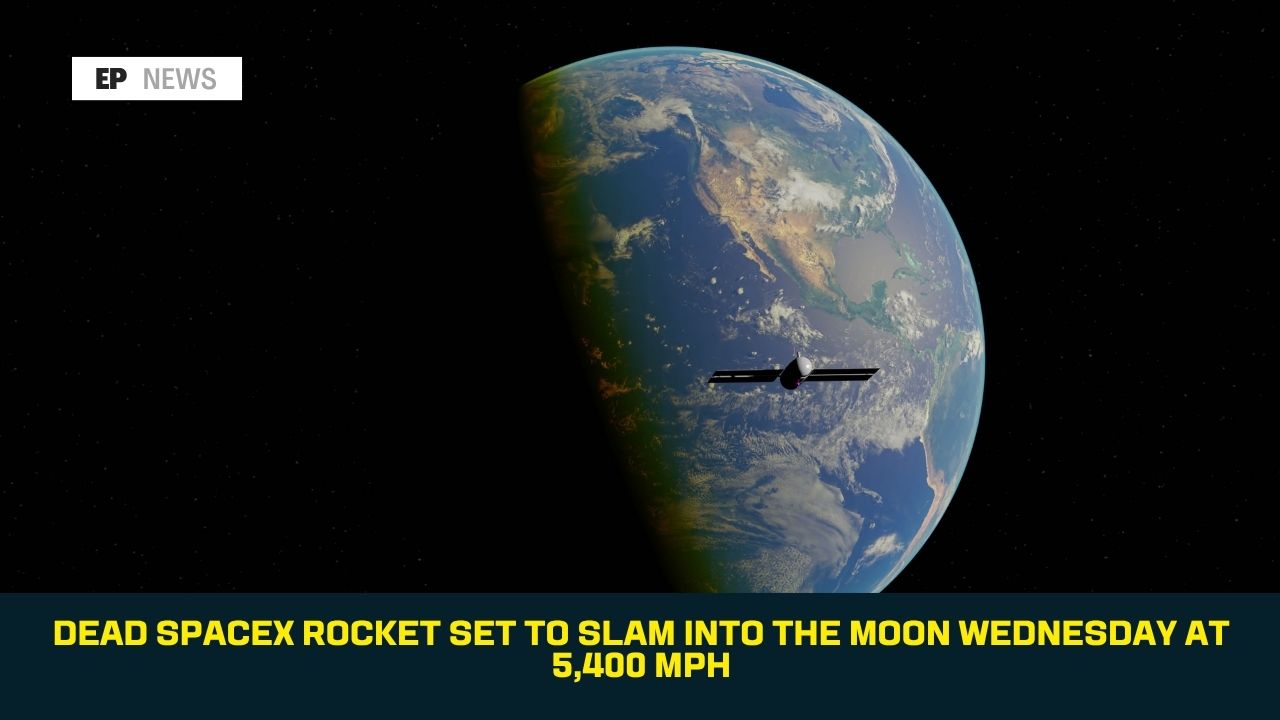
Dead SpaceX Rocket Set to Slam Into the Moon Wednesday at 5,400 MPH
A discarded SpaceX Falcon 9 rocket stage that has been drifting through space for more than 18 months is set to crash into the moon early Wednesday, August 5, giving scientists an unusual opportunity to study a real lunar impact as it happens.
What’s Set to Happen and When
The impact is expected around 06:35 to 06:44 UTC — roughly 2:35 to 2:44 a.m. ET — near the moon’s Einstein crater, according to Forbes. The object involved is the upper stage of a Falcon 9 rocket, a roughly 45-foot, 4,000-kilogram piece of spent hardware that will strike the lunar surface at approximately 5,400 miles per hour, or about seven times the speed of sound, according to Yahoo News.
Forbes reported the impact is expected to carve out a crater roughly 89 feet across and send a substantial plume of debris into space above the lunar surface.
How a Rocket Stage Ended Up on a Collision Course With the Moon
The upper stage originally launched on January 15, 2025, carrying Firefly Aerospace’s Blue Ghost Mission 1 lunar lander toward the moon — a mission that also carried Resilience, a robotic lander built by the Japanese company ispace, according to Space.com. Blue Ghost went on to land successfully and complete its mission, while Resilience crashed during its own landing attempt.
After completing its job delivering the payload, the Falcon 9 upper stage was left in what Yahoo News described as “orbital limbo” — stuck in a chaotic, roughly 26-day elliptical orbit around Earth, without enough fuel to deorbit back to Earth and without enough velocity to escape into deep space entirely.
Julianna Scheiman, director of NASA science and Dragon programs at SpaceX, addressed the situation directly during an August 3 press conference covering the company’s upcoming Crew-13 astronaut launch. She explained that SpaceX had performed a maneuver intended to keep the stage safely positioned according to relevant regulations, rather than attempting a full deorbit — but that maneuver didn’t lock the object into a stable location. Over the following months, she said, “a mixture of solar activity and gravity forces have put it on a path towards the moon.”
Why Scientists Are Actually Excited About This
Rather than treating the impact purely as a piece of space debris gone astray, lunar scientists see it as a rare, valuable opportunity. According to Space.com, the event will let researchers open up what’s known as ejecta-plume science — studying how debris behaves when it’s thrown up during an impact — and calibrate scientific models against a real event, information that matters for planning how future missions deliver hardware to the moon safely.
NASA’s Lunar Reconnaissance Orbiter, or LRO, is positioned to help with that research. Brent Garry, a project scientist for LRO at NASA’s Goddard Space Flight Center, explained that the orbiter will pass over the projected crash site roughly seven days before the impact and again roughly seven days afterward, giving scientists before-and-after imagery to help pin down exactly what changed on the lunar surface.
Will Anyone Be Able to See It?
The impact itself will occur on the moon’s sunlit side and won’t be visible from Earth, even through large telescopes, according to Forbes. However, new research published on the open-access platform arXiv by an international team of scientists suggests the resulting debris plume could briefly become bright enough to spot against the dark sky near the moon’s edge — meaning it might be observable to amateur astronomers using sufficiently sensitive equipment, primarily from parts of North and South America.
Part of a Bigger Space Junk Problem
This won’t be the first time a piece of abandoned rocket hardware has struck the moon, and astronomers who track this kind of debris say interest in these events has been growing. According to independent astronomer Bill Gray, who has previously identified similar objects on lunar collision courses, this marks the second time he’s flagged a piece of space junk heading for impact with the moon, noting that the earlier event drew far more public attention than he initially expected.
The episode also highlights an evolving industry practice around dealing with spent rocket stages. According to Gray’s tracking, at least one more recent Falcon 9 upper stage — launched in November 2025 for the EscaPADE spacecraft — was deliberately placed on a trajectory that will send it into a stable orbit around the sun rather than risking an eventual moon or Earth impact, a technique Gray said SpaceX specifically chose for that mission. That kind of disposal, however, is only feasible for missions that were already headed toward the moon or beyond, limiting how broadly it can be applied to other space debris.
The timing carries added significance given NASA’s own long-term lunar ambitions. With the agency actively planning a future moon base, particularly near the lunar south pole, scientists say incidents like this one serve as a useful, low-risk reminder of the debris-management challenges that will only grow as more missions head to the moon in the coming years.
FAQ
When will the SpaceX rocket stage hit the moon? Wednesday, August 5, 2026, at approximately 06:35 to 06:44 UTC (roughly 2:35 to 2:44 a.m. ET), near the moon’s Einstein crater.
Why is this rocket stage crashing into the moon? It’s the leftover upper stage from a January 2025 SpaceX Falcon 9 launch that carried Firefly Aerospace’s Blue Ghost moon lander. Left without enough fuel to deorbit, the stage drifted for over 18 months until a combination of solar activity and gravitational forces pulled it onto a collision course with the moon.
How fast will it be traveling on impact? Approximately 5,400 miles per hour, or roughly seven times the speed of sound.
Will people on Earth be able to see the impact? The impact itself won’t be visible from Earth, even with large telescopes, since it will occur on the moon’s sunlit side. However, the resulting debris plume might be briefly visible to amateur astronomers with sensitive equipment.
Is this dangerous to anyone? No. Independent astronomers tracking the object say it presents no danger to people, though it does highlight ongoing challenges around managing space debris as more missions head toward the moon.
Conclusion
What might otherwise be dismissed as an unremarkable piece of space junk finally meeting its end is instead giving lunar scientists a genuine, if accidental, research opportunity — a real-world impact event they can study using orbital imagery from before and after the crash. With NASA’s Lunar Reconnaissance Orbiter positioned to capture both sides of the event and new research suggesting the resulting plume might even be visible from Earth, Wednesday’s impact offers a small but useful data point as the space industry grapples with how to responsibly dispose of the growing volume of hardware it leaves in space.
Sources: Space.com, Yahoo News, Forbes, Project Pluto (reporting dated July 31-August 3, 2026).