
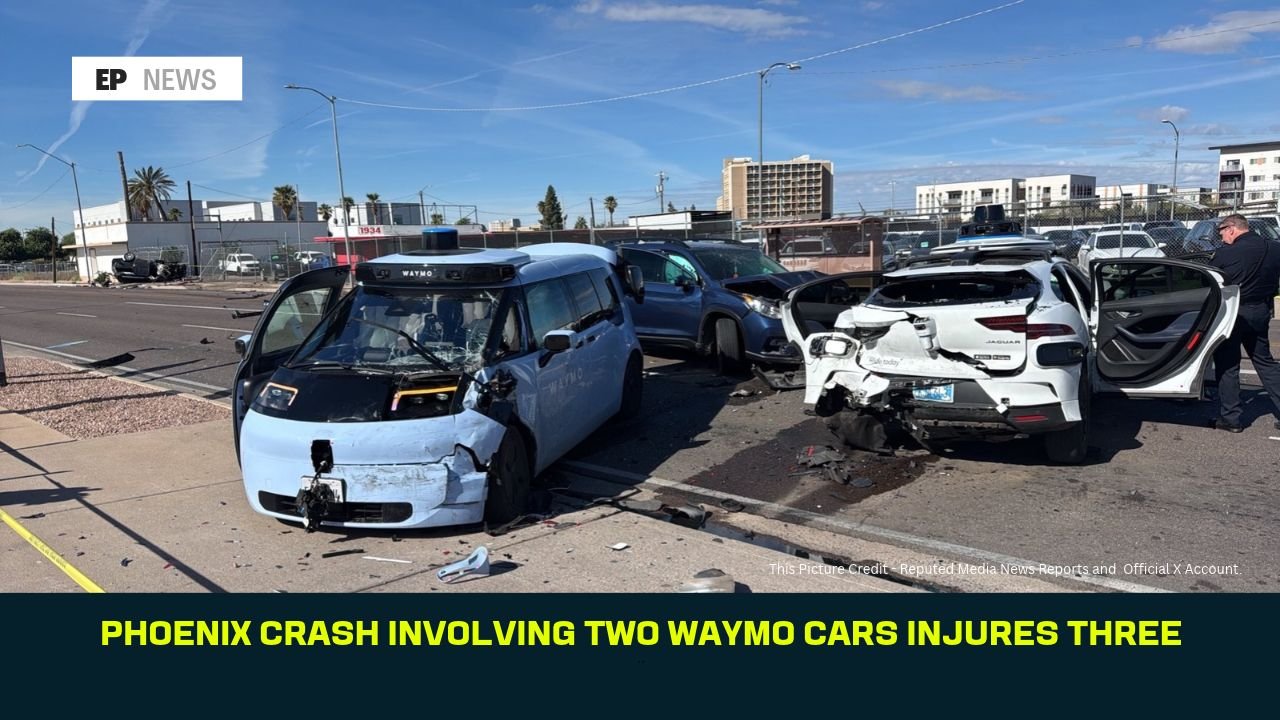
Two Waymo Self-Driving Cars Involved in Four-Vehicle Phoenix Crash, Three Hospitalized
A serious crash in central Phoenix involving two driverless Waymo vehicles has renewed questions about autonomous car safety after police said speed may have contributed to the collision.
A four-vehicle collision involving two Waymo self-driving cars in central Phoenix has drawn attention to the growing presence of autonomous vehicles on American roads. Three people were taken to hospitals following the November 16 crash, including one person who was reported to be in extremely critical condition, according to local authorities.
The incident happened near the intersection of 20th Street and Van Buren Street shortly after 11 a.m. local time. Phoenix police and firefighters responded to the scene after receiving reports of a serious traffic collision.
Police said preliminary information indicated that speed may have been a contributing factor. However, investigators had not publicly established the exact sequence of events or released a final determination about responsibility as of November 17.
The crash involved two vehicles operated by Waymo, the autonomous-driving company owned by Alphabet, along with two other vehicles. The incident has attracted attention because it highlights an important question facing the U.S. transportation industry: how can driverless vehicles safely operate alongside human drivers in unpredictable traffic conditions?
What Happened in the Phoenix Waymo Crash?
The collision occurred in central Phoenix on Monday morning, November 16, near 20th Street and Van Buren Street.
According to reporting by Arizona’s Family, emergency responders arrived shortly after 11 a.m. Phoenix Police Sergeant John Buchanan said the driver of an SUV involved in the collision was transported to a hospital in extremely critical condition.
A person inside a white Waymo sedan was also taken to a hospital. That person’s injuries were described as non-life-threatening.
Two people were reportedly inside a blue Waymo minivan. They did not require hospital treatment, according to the local report.
Firefighters also said a third person was transported to a hospital, although the initial report did not provide that person’s medical condition. Local reporting therefore identified three people who required hospital care.
The crash scene included a fourth vehicle that was found severely damaged and overturned near a business. Skid marks extended west from the intersection toward that vehicle.
Authorities closed Van Buren Street in both directions west of the 20th Street intersection while emergency crews and investigators worked at the scene. The closure was expected to remain in place into the evening.
The incident involved more than a routine traffic disruption. The presence of two autonomous vehicles made the collision particularly relevant to ongoing discussions about the safety and oversight of driverless transportation services.
Police Say Speed May Have Contributed to the Collision
Phoenix police said preliminary information indicated that speed may have played a role in the crash.
However, investigators had not released an official speed estimate for the SUV involved. Sergeant Buchanan said police were still working to determine what happened before the vehicles collided.
This distinction is important. A preliminary indication that speed may have contributed to a crash is not the same as a final investigative finding.
Waymo also provided information about the incident. In a statement reported by FOX 10 Phoenix, the company said one of its vehicles was stationary at a traffic light when it was struck by a truck.
Waymo said the truck was traveling at more than 80 mph in a 35 mph zone. According to the company’s account, the impact pushed the first Waymo vehicle into a neighboring lane, where it collided with a second Waymo vehicle. The first vehicle also struck the car behind it.
That account offers one explanation for how multiple vehicles became involved. However, the speed figure and the sequence described in the statement should be understood as Waymo’s account, not as a final police determination.
The police investigation remains important for establishing the precise circumstances, including vehicle movements, impact sequence and any other factors that may have contributed.
Three People Were Taken to Hospitals
The injuries were among the most serious consequences of the Phoenix collision.
The SUV driver was reported to be in extremely critical condition. One person in a Waymo sedan sustained injuries that were not considered life-threatening. A third person was also taken to a hospital, but the initial reporting did not establish that person’s condition.
The two occupants of the blue Waymo minivan did not need to be transported to a hospital, according to Arizona’s Family.
Authorities had not released a complete public account of every person’s identity or medical status in the reports available by November 17.
It is also important not to assume that everyone inside the vehicles was injured simply because the crash involved multiple cars. The reported medical information distinguishes between those transported for treatment and those who did not require hospital care.
Waymo employees were present at the scene and were assisting investigators. The company said it was working with first responders to support the safety and well-being of its riders.
Why the Crash Is Drawing Attention to Self-Driving Technology
Autonomous vehicles are designed to perform driving tasks using a combination of sensors, software and computer systems. These systems can help a vehicle detect objects, interpret road conditions and respond to traffic situations.
But operating on public roads is complicated. A vehicle must respond not only to traffic signals and road markings but also to the unpredictable behavior of other road users.
A human driver may suddenly accelerate, change lanes, ignore a signal or lose control. A driverless vehicle must be designed to recognize and respond to hazards created by other vehicles, pedestrians, cyclists and changing road conditions.
The Phoenix incident illustrates why autonomous-driving safety cannot be judged only by examining how a self-driving vehicle behaves in normal traffic. Investigators and regulators also need to understand how these vehicles respond when another road user creates a dangerous situation.
If Waymo’s account is supported by the investigation, the collision may involve a chain reaction triggered by a vehicle striking a stationary autonomous car. But the available information does not establish whether the driverless systems responded as expected or whether any technology-related issue contributed.
Those questions require evidence from the vehicles, the crash scene and the official investigation.
What Is Waymo and Where Does It Fit in the U.S. Transportation Industry?
Waymo is an autonomous-driving company owned by Alphabet, Google’s parent company. It operates driverless ride-hailing services in selected U.S. markets.
Unlike a conventional taxi, a fully driverless Waymo vehicle is designed to perform the driving task without a human driver controlling the vehicle during the trip, within the operating conditions for which its system is designed.
The technology relies on multiple sensors and computing systems to interpret the vehicle’s surroundings. These systems are intended to identify other vehicles, pedestrians, road features and traffic conditions.
The expansion of autonomous ride-hailing has created new opportunities for transportation services, but it has also increased public interest in how these vehicles are tested, monitored and regulated.
A single crash does not establish that an entire technology is unsafe. Equally, the presence of advanced sensors does not mean a vehicle is immune to collisions.
The relevant questions are specific: What happened in a particular incident? Was the automated driving system active? Did the vehicle behave as designed? Were there any technical defects? And what can investigators learn to reduce the risk of similar incidents?
The Phoenix crash will need to be assessed on the available evidence rather than assumptions about either the technology or the human driver.
How U.S. Regulators Monitor Autonomous-Vehicle Crashes
In the United States, the National Highway Traffic Safety Administration (NHTSA) monitors certain crashes involving automated driving systems and advanced driver-assistance technologies.
The agency has a Standing General Order requiring identified manufacturers and operators to report qualifying crashes involving vehicles equipped with automated driving systems or certain Level 2 advanced driver-assistance systems.
The reporting system helps federal regulators receive information about real-world incidents. NHTSA can use that information to identify potential safety concerns and determine whether further investigation or enforcement action is necessary.
The rules distinguish between automated driving systems and Level 2 driver-assistance systems. A fully automated driving system is intended to perform the entire driving task within its defined operating conditions. Level 2 systems, by contrast, can assist with steering and speed but still require a human driver to remain fully engaged.
NHTSA’s reporting requirements include crashes in which an automated driving system was in use within 30 seconds before the incident and specified injury or damage conditions were met. The agency’s requirements and reporting data are intended to help it assess safety issues across different manufacturers and technologies.
However, a crash report does not automatically mean that a vehicle has a safety defect. Nor does a reported collision prove that an automated system caused it.
The agency must evaluate the available evidence before deciding whether a formal investigation or other regulatory action is warranted.
What Investigators May Need to Examine
The Phoenix collision involved several vehicles and reportedly included a chain of impacts. Investigators may need to establish how each vehicle was moving immediately before and during the crash.
Evidence from the scene can help establish vehicle positions, impact locations and the direction of travel. Skid marks and physical damage may also help investigators reconstruct the sequence of events.
The Waymo vehicles may provide additional information through their onboard systems and recorded data. Waymo said its employees were assisting investigators and providing video from the vehicles.
Investigators may also examine available traffic-camera or surveillance footage, witness accounts and information from the other vehicles involved.
For the autonomous vehicles, one key question is whether the automated driving system was active at the time of the collision. Another is how the vehicles responded to the initial impact and whether their systems performed as expected.
No public finding available by November 17 established that a Waymo software defect caused the crash. There was also no confirmed announcement of a nationwide Waymo service suspension connected to this particular incident in the reports reviewed for this article.
Until investigators release more information, conclusions about the cause would be premature.
Could the Phoenix Crash Affect Public Confidence in Driverless Cars?
Public confidence is a major factor in the future of autonomous transportation.
Companies developing self-driving vehicles often emphasize their potential to reduce certain types of human error and improve transportation efficiency. Supporters argue that automated systems may eventually help address problems such as distracted driving, impaired driving and inconsistent human reactions.
But public acceptance depends on more than technological promises. People want to know how these vehicles behave in real traffic, how companies respond after collisions and whether regulators can identify and address safety problems.
A serious crash involving driverless vehicles can therefore become a wider public discussion, even when preliminary information suggests that another vehicle may have initiated the collision.
For passengers, pedestrians and other motorists, the central concern is straightforward: whether every vehicle on the road, regardless of who or what controls it, can operate safely around other people.
The Phoenix incident may provide useful evidence for that discussion once the investigation is complete.
It is too early to say whether the collision will lead to changes in Waymo’s operations, additional regulatory scrutiny or any new safety requirements. Those outcomes would depend on the findings and any subsequent decisions by the company or government authorities.
What Happens Next?
The immediate priority is the investigation into the four-vehicle collision and the medical recovery of those who were injured.
Phoenix police will need to establish the sequence of events and determine what factors contributed to the crash. Information from the vehicles, video footage and other evidence may help clarify the circumstances.
Waymo has said it is cooperating with first responders. The company has also emphasized that rider and road-user safety is its priority.
Federal reporting rules may also be relevant if the incident meets NHTSA’s criteria for a report involving an automated driving system. Any such reporting should not be confused with a finding that the technology was responsible.
As of November 17, the cause had not been officially established. The reported speed of the SUV came from Waymo’s statement, while police had said speed may have contributed but had not provided an exact estimate.
Further details may become available as authorities complete their work.
Frequently Asked Questions (FAQs)
1. What happened in the Phoenix Waymo crash on November 16, 2026?
Two Waymo autonomous vehicles were involved in a four-vehicle collision near 20th Street and Van Buren Street in central Phoenix. Three people were taken to hospitals, according to local reporting.
2. How many people were injured in the crash?
Three people were transported to hospitals. The SUV driver was reported to be in extremely critical condition, while one person in a Waymo sedan had injuries described as non-life-threatening. The initial report did not establish the condition of the third hospitalized person.
3. Did the Waymo cars crash into each other?
Waymo said one of its vehicles was struck by a truck and pushed into a neighboring lane, where it collided with a second Waymo vehicle. The company also said the first vehicle struck another car. Investigators had not released a final reconstruction of the collision by November 17.
4. Was speeding responsible for the Phoenix collision?
Police said speed may have been a contributing factor but had not provided an official speed estimate. Waymo separately stated that the truck was traveling at more than 80 mph in a 35 mph zone. That figure was the company’s account and should not be treated as a final police finding.
5. Did Waymo suspend its driverless service after the crash?
The reports reviewed for this article did not confirm a company-wide suspension of Waymo’s driverless service following this particular incident.
6. Is the Phoenix crash proof that self-driving cars are unsafe?
No. One collision cannot establish the overall safety or danger of an entire technology. Investigators need to determine the exact cause, vehicle movements and whether any system malfunction occurred before broader conclusions can be made.
7. Which U.S. agency monitors autonomous-vehicle crashes?
The National Highway Traffic Safety Administration monitors qualifying crashes involving automated driving systems and certain advanced driver-assistance technologies. It can use reported information to assess potential safety concerns and determine whether further action is needed.
Conclusion
The November 16 collision in central Phoenix has placed two Waymo self-driving vehicles at the center of a serious traffic investigation. Three people were taken to hospitals, and one person was reported to be in extremely critical condition.
Police said speed may have contributed to the crash, while Waymo provided its own account of how the initial impact led to multiple collisions. The exact sequence and cause had not been officially established as of November 17.
The incident is a reminder that autonomous vehicles operate in a shared road environment where the actions of every driver can affect everyone else. The investigation’s findings will be important not only for the people involved but also for the wider discussion about driverless transportation and road safety in the United States.
Note : This is a developing story. This article may be updated when Phoenix police or relevant transportation authorities release verified new information.