
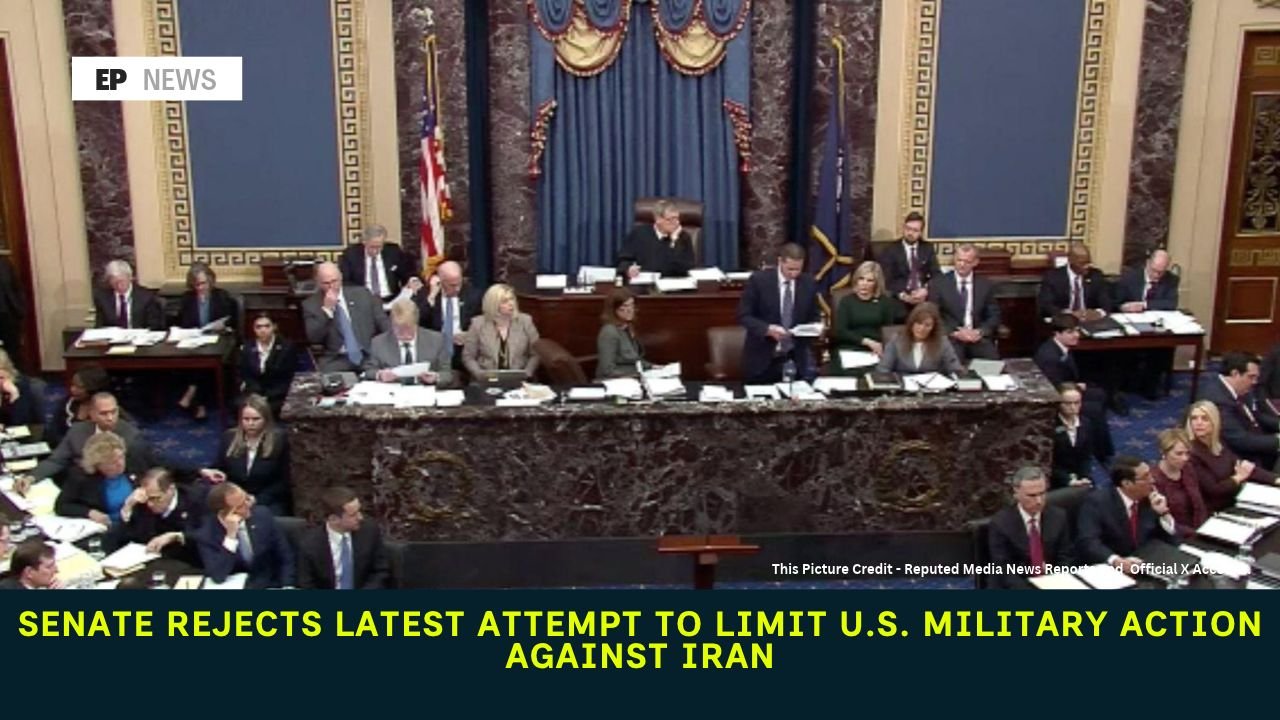
Senate Rejects Latest Attempt to Limit U.S. Military Action Against Iran
November 19, 2026 | U.S News
The United States Senate has rejected another Democratic effort to end American military involvement in Iran, highlighting continuing political divisions in Washington over the conflict, congressional authority and the financial consequences of military operations.
Senators voted 48-51 on Thursday, November 19, against a resolution seeking to halt the U.S. military action. The vote marked the first major Senate decision on the conflict since Republicans experienced significant losses in the November midterm elections.
The resolution was led by Democratic lawmakers who have repeatedly attempted to use congressional war powers to challenge the administration’s military policy.
Although the proposal was largely symbolic and would not have gone directly to President Donald Trump for his signature, its rejection carries political significance.
The debate has become increasingly important as Americans face higher fuel prices and lawmakers continue to disagree about the objectives, costs and duration of the conflict.
According to the Associated Press, three Republican senators, Susan Collins, Lisa Murkowski and Rand Paul, supported the Democratic proposal. Democratic Senator John Fetterman of Pennsylvania voted with Republicans against it.
The final result demonstrates that opposition to the war has not yet produced enough bipartisan support in the Senate to force a change in military policy.
How the Senate Vote Unfolded
The 48-51 result followed months of disagreement between Democrats and Republicans over the administration’s approach to Iran.
Democratic Senator Tim Kaine of Virginia has been among the leading voices calling for Congress to exercise greater authority over the conflict.
Kaine argued that Americans are increasingly frustrated with the military situation and its economic consequences.
He also pointed to higher gasoline and diesel prices, which have added pressure to households and businesses.
Republicans, meanwhile, have argued that repeated votes on the conflict distract from the military mission and could weaken the country’s position.
Republican Senator Tim Sheehy of Montana argued before the vote that the United States should complete its mission and protect American interests and allies.
The disagreement reflects two different approaches to the conflict.
Democrats have emphasized congressional oversight, public opinion and the economic consequences of military involvement.
Republicans supporting the administration’s policy have focused on national security objectives and the need to maintain pressure on Iran.
Why the Iran War Has Become a Major Political Issue
The conflict has become an important subject in American domestic politics.
According to an Associated Press voter survey involving more than 100,000 voters, approximately six in ten respondents believed that the United States made the wrong decision in taking military action against Iran.
The findings have added political pressure on lawmakers, particularly those representing communities concerned about fuel prices and the broader cost of living.
For many households, the conflict is not simply a foreign policy issue.
Military developments can influence international oil supplies, shipping costs, insurance expenses and energy markets.
When global energy supplies become uncertain, crude oil prices can rise. Higher oil prices can eventually affect gasoline, diesel, transportation and production expenses.
However, fuel prices are influenced by multiple factors, and the war should not automatically be considered the only explanation for every price increase.
For American families already managing housing, food and transportation expenses, additional energy costs can make monthly budgets more difficult.
What the War Powers Act Means for Congress
The Senate vote also raises important constitutional questions.
The U.S. Constitution divides military authority between Congress and the president.
Congress has the authority to declare war, while the president serves as commander in chief of the armed forces.
The War Powers Resolution, commonly known as the War Powers Act, was introduced after the Vietnam War to establish limits and reporting requirements concerning presidential military action.
The legislation generally requires the president to notify Congress when U.S. forces enter hostilities and establishes time limits for continued military involvement without congressional authorization.
The law is intended to prevent prolonged military operations without appropriate congressional involvement.
However, disagreements frequently arise over how the law should be interpreted and whether particular military operations require additional congressional approval.
The latest Senate resolution represents another attempt by lawmakers to use that framework to influence the administration’s military decisions.
What the Vote Means for President Trump
The Senate’s rejection allows the administration to avoid an immediate congressional rebuke through this particular resolution.
Nevertheless, the result does not eliminate political pressure.
The November midterm elections have changed the political environment, and the administration faces increasing scrutiny over several issues, including the economy, energy prices and foreign policy.
Democratic lawmakers may continue introducing similar resolutions.
The repeated votes could also become part of broader congressional oversight efforts.
Republicans who supported the administration’s approach must balance their national security arguments with concerns about public opinion and rising household expenses.
How the Conflict Could Affect American Consumers
Energy prices are one of the most direct ways international conflict can affect American households.
Higher fuel prices can increase the cost of commuting, transporting goods and operating businesses.
Companies that depend heavily on transportation may eventually pass some additional expenses to customers.
Airlines, logistics companies, delivery services and manufacturers can also face increased operating costs.
If higher energy prices continue, the pressure could extend beyond gasoline stations.
Consumers may experience higher prices for certain goods and services as businesses adjust to increased transportation and production expenses.
However, the actual impact will depend on the duration of the conflict, global oil production, shipping conditions and domestic energy supply.
What Happens Next?
The Senate vote does not end congressional debate over Iran.
Lawmakers may continue using hearings, legislation and additional resolutions to challenge or support the administration’s policy.
The administration will also face questions about military objectives, financial costs and the conditions under which American involvement could end.
The next important developments will include changes in military operations, energy market movements and congressional oversight.
Frequently Asked Questions
1. Did the U.S. Senate vote to end the Iran war?
No. The Senate rejected the latest Democratic resolution by a vote of 48-51 on November 19, 2026.
2. Who led the resolution?
Democratic Senator Tim Kaine of Virginia has been a leading advocate of congressional efforts to limit military involvement.
3. Which Republicans supported the resolution?
Susan Collins, Lisa Murkowski and Rand Paul voted in favor.
4. Why are lawmakers concerned about the war?
Concerns include military authority, national security, public opinion, fuel prices and the financial costs of the conflict.
5. Does the Senate vote automatically authorize the war?
No. The vote rejected a specific resolution. It should not be interpreted as a new declaration of war or a comprehensive determination of presidential authority.
Conclusion
The Senate’s 48-51 vote demonstrates that the debate over American military involvement in Iran remains deeply divided.
Although Democrats failed to secure enough support to advance their resolution, the political and economic questions surrounding the conflict remain unresolved.
For American households, the most immediate concern may be the potential effect of continued instability on energy prices and the cost of living.
For Washington, the challenge will be balancing national security priorities with congressional oversight and growing public expectations for accountability.
The coming weeks could prove important in determining how the administration approaches the conflict and how lawmakers respond to its economic and political consequences.
Note: This article explains the November 19 Senate vote and does not claim that the resolution passed. Based on AP reporting.
Source: Associated Press | November 19, 2026.