NTSB Confirms Broken Engine Fan Blade Caused Passenger to Be Partially Sucked Out of Ryanair Window
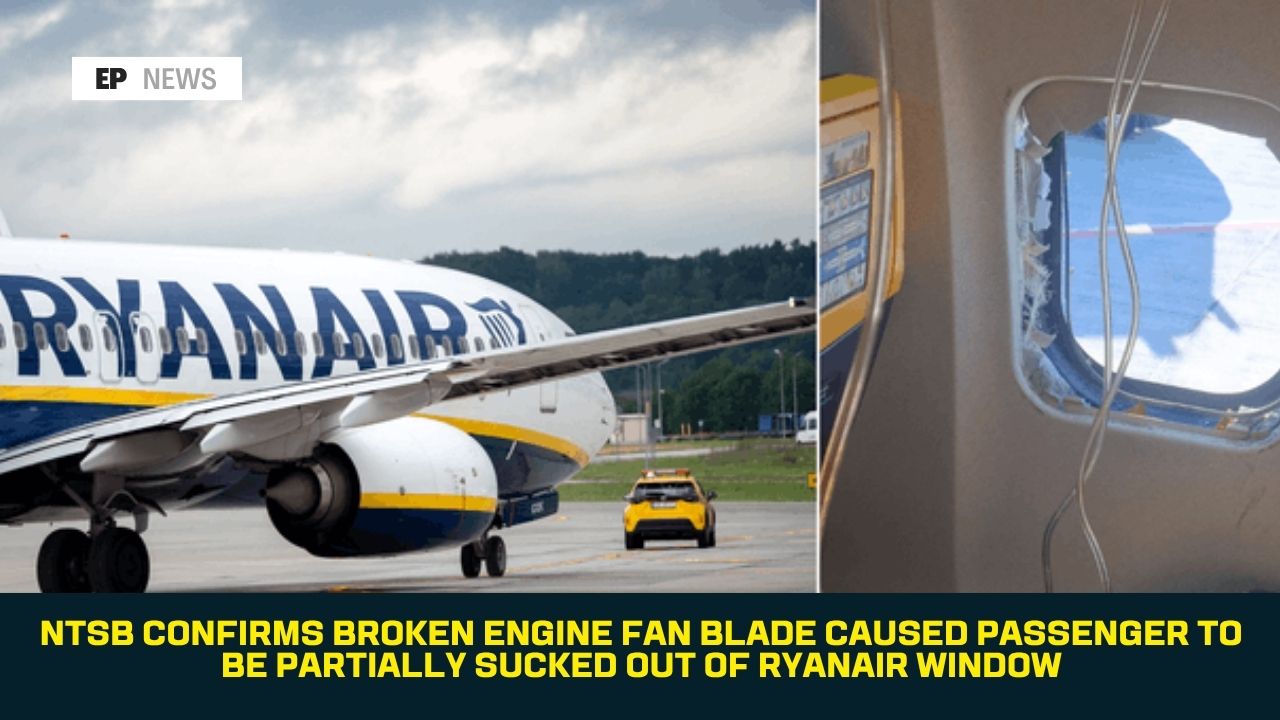
The National Transportation Safety Board released a preliminary report Thursday, August 13, confirming that a broken engine fan blade caused a cabin window to shatter aboard a Ryanair flight last month, resulting in a 61-year-old passenger being partially pulled outside the aircraft before fellow passengers pulled him back to safety.
What Happened
The incident occurred July 10 aboard Ryanair Flight 1879, a Boeing 737-800 en route from Thessaloniki, Greece, to Memmingen, Germany. According to CNN, the aircraft was flying at roughly 16,000 feet, less than 10 minutes after takeoff, when a fan blade in the No. 2 engine broke free and struck the side of the passenger cabin, shattering a window.
The NTSB’s preliminary report found that engine fragments breached the fuselage, causing the cabin to depressurize, according to CBS News. Pieces of the shattered window were found scattered across several rows of the aircraft. The passenger seated near the damaged window, later identified as 61-year-old Ljubisa Karovic in seat 11F, had his head and shoulders pulled out through the broken window, according to his wife, who spoke to Reuters as cited by CNN. She and a flight attendant pulled him back into the cabin.
Karovic suffered neck and shoulder injuries along with friction burns, according to ABC7. He later described the experience to The Guardian: “I don’t remember much and my head and neck still hurt but I am still alive.” The flight crew declared an emergency and returned the aircraft to Thessaloniki for an emergency landing.
What Investigators Found Inside the Engine
The NTSB’s investigation, which it is leading at the request of Greece’s Hellenic Air and Rail Safety Investigation Authority under international rules, found signs of metal fatigue at the base of the fan blade that broke off, according to CBS News. Three loose fan blade fragments were recovered from the engine, along with punctures in the inlet cowl.
Investigators also discovered bird remains, including feathers, deep inside the failed engine, according to CBS News. It remains unclear whether those remains came from the July 10 incident specifically or from an earlier event; the recovered material was sent to the Smithsonian Institution’s Feather Identification Lab in Washington, D.C., for further examination.
Maintenance records reviewed by investigators showed the fan blades on the right engine had undergone ultrasonic inspections in May 2026 and November 2025, with no damage found at the time, according to CBC News. However, flight crews had reported four suspected bird strikes involving that same engine over the preceding year, with bird remains found after two of those earlier suspected strikes, according to the NTSB.
Unanswered Questions Going Forward
Jeff Guzzetti, a former NTSB and FAA investigator who reviewed the preliminary report, told the Associated Press that the required maintenance on the engine appeared to have been performed on schedule. Even so, he said investigators will likely need to examine how those prior inspections were actually conducted, and whether the earlier suspected bird strikes may have contributed to damage that went undetected. “We know what happened and even to some extent why it happened, but there’s still unanswered questions that the NTSB will get at,” Guzzetti said, according to CBC News.
The Dispute Over Ryanair’s Public Comments
The report’s release comes amid separate friction between the NTSB and Ryanair’s leadership over public statements made during the active investigation. According to CNN, Ryanair CEO Michael O’Leary told investors during a July earnings call that the investigation was focused on foreign object damage to the engine rather than the plane’s age or maintenance history, and pushed back on media characterizations of the incident: “Some of the more salacious reports that one passenger was halfway out the window, head out the window. Nobody was out any window.”
NTSB Chairwoman Jennifer Homendy formally reprimanded O’Leary for those comments in a letter, stating that accredited representatives and their technical advisers are prohibited from commenting on the potential cause of an event or otherwise conveying investigative information while an NTSB investigation remains open, according to CNN. The agency said its investigators had not ruled anything out at the time O’Leary made his public remarks, and that he was not authorized to discuss the investigation’s findings.
Ryanair said Thursday it would not comment further until the NTSB investigation is complete, according to Local10.
Precedent From a Similar Past Incident
This isn’t the first time an engine failure from this manufacturer has led to a cabin breach. According to ABC7, there have been at least two previous incidents in which parts of an engine made by CFM International, the maker of the engine involved in the Ryanair flight, failed and breached a plane’s cabin. In one of those earlier cases, in 2018, a woman was killed aboard a Southwest Airlines flight after being partially pulled through a shattered window during a similar engine failure.
FAQ
What caused the Ryanair window to shatter? A fan blade in the aircraft’s No. 2 engine broke off due to metal fatigue, and engine fragments struck and breached the cabin, shattering a window.
Who was injured, and how badly? A 61-year-old passenger, Ljubisa Karovic, had his head and shoulders pulled through the shattered window before his wife and a flight attendant pulled him back inside. He suffered neck and shoulder injuries and friction burns.
Did the plane have a history of bird strikes on that engine? Yes. Flight crews had reported four suspected bird strikes involving the same engine over the prior year, with bird remains found after two of those incidents.
Why did the NTSB reprimand Ryanair’s CEO? Michael O’Leary made public comments during a July earnings call characterizing the investigation’s likely cause and disputing media reports, while the NTSB investigation remained open — comments the agency said he wasn’t authorized to make.
Is the investigation finished? No. This is a preliminary report. The NTSB said several questions remain, including how earlier engine inspections were conducted and whether previous suspected bird strikes contributed to undetected damage.
Conclusion
The NTSB’s preliminary findings confirm the core mechanical sequence behind one of this year’s more alarming aviation incidents — a fatigued fan blade, a shattered window, and a passenger’s harrowing near-ejection from the aircraft — while leaving open the more consequential question of how that fatigue went undetected despite recent inspections. With the investigation still active and tension already surfacing between the NTSB and Ryanair’s own public statements about the case, the final report’s conclusions on inspection protocols and potential contributing factors are likely to draw continued scrutiny from both aviation regulators and the flying public.
Sources: CBS News, CNN, CBC News, ABC7/ABC11, US News & World Report, Local10 (reporting dated August 13, 2026).