
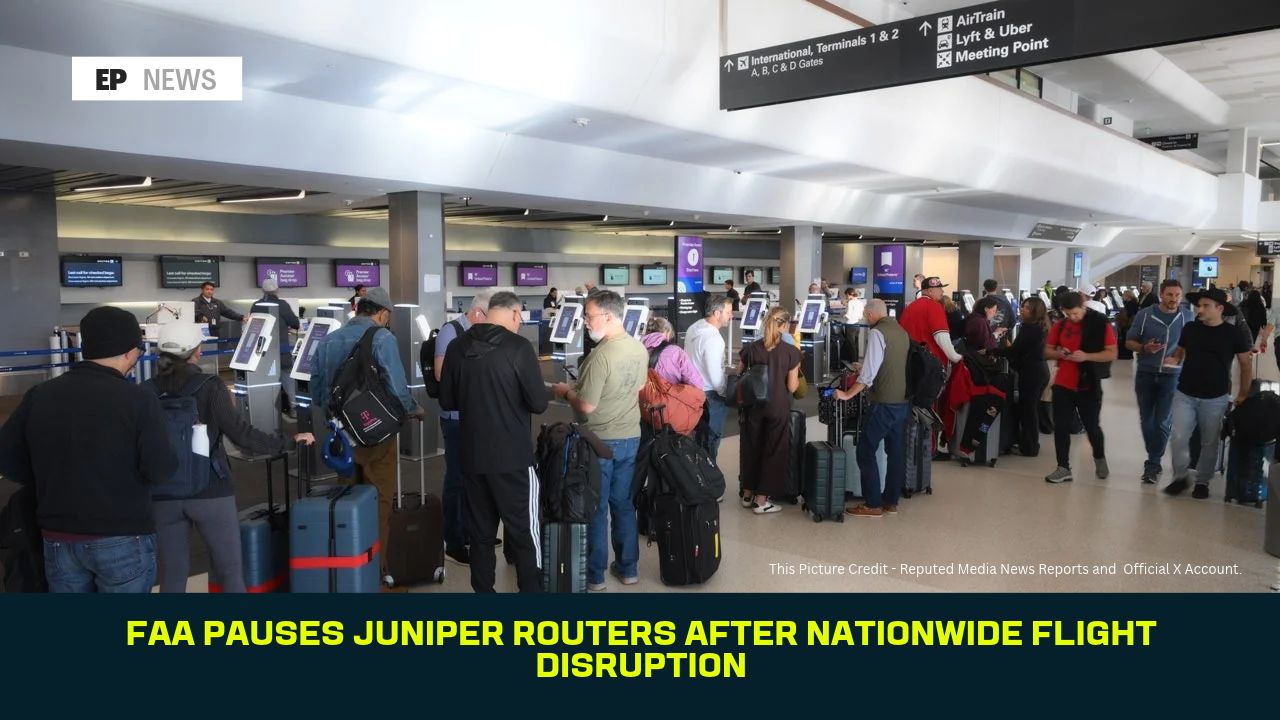
FAA Pauses Juniper Router Installations After Nationwide Flight Ground Stop
November 18, 2026 | U.S News
The Federal Aviation Administration has suspended new Juniper router installations and disabled the functionality of existing devices after a technical failure disrupted U.S. air traffic. The Trump administration is also seeking $50.1 billion from Congress to modernize America’s aviation infrastructure.
The Federal Aviation Administration (FAA) has paused the installation of new Juniper telecommunications routers following a nationwide flight disruption that affected air travel across the United States on November 13.
The decision came as federal investigators continued examining a technical problem involving the agency’s communications network. The failure disrupted communications and radar feeds at multiple air traffic control centers, forcing the FAA to issue a nationwide ground stop.
The disruption lasted nearly five hours and resulted in more than 18,000 flight cancellations, according to Reuters. Hundreds of thousands of travelers experienced delays and changes to their travel plans.
On November 17, the FAA confirmed that it had stopped installing additional Juniper routers while the investigation continued. The agency also disabled the functionality of existing routers connected to the affected upgrade program as a precaution.
The technical problem has created fresh questions about the safety of the country’s aging air traffic control infrastructure and the way the government is modernizing its communications systems.
At the same time, Transportation Secretary Sean Duffy has asked Congress to approve a $50.1 billion investment in aviation infrastructure. However, several lawmakers, including Republicans, have questioned whether the entire amount is necessary and whether all parts of the proposal directly address air traffic safety.
As of November 18, investigators had reproduced the technical failure but had not established its definitive root cause.
What Happened During the November 13 Nationwide Flight Disruption?
The incident occurred on Friday, November 13, when a technical problem affected the FAA’s air traffic communications network.
According to federal officials, the disruption was connected to work involving the replacement of older copper telecommunications lines with modern fiber-optic connections.
The modernization project includes installing new networking equipment to help the FAA transition from its older communications infrastructure to a more modern digital system.
One of the installations involved a Juniper router at an FAA communications facility in El Dorado, Arkansas.
Transportation Secretary Sean Duffy said the installation led to an unusually high volume of connection attempts entering a government communications network. The FAA described the resulting traffic as excessive data that destabilized aircraft communications and radar feeds.
The agency said the data was arriving at a rate of approximately 1,000 connection attempts every four to five seconds.
The resulting instability affected 17 of the country’s 22 en route air traffic control centers, according to officials.
These centers help manage aircraft flying at higher altitudes across the United States. They are essential to coordinating aircraft movements, maintaining safe separation and supporting the flow of air traffic between airports.
Because communications and radar feeds were affected, the FAA took the precautionary step of issuing a nationwide ground stop.
A ground stop means aircraft are temporarily prevented from departing affected airports or operating under the restrictions specified by air traffic authorities. It does not mean that every aircraft already flying must immediately land.
The disruption created widespread problems for airlines and passengers, particularly as airports worked to manage delayed departures, cancellations and aircraft repositioning.
FAA Suspends New Juniper Router Installations
The FAA’s decision to pause the router installations is one of the most important developments following the incident.
On November 17, the agency confirmed that it had stopped deploying additional Juniper routers while investigators examined the technical failure.
The FAA also disabled the functionality of existing Juniper routers involved in the upgrade program as a precaution.
According to the Associated Press, the agency returned to using older Cisco routers that had been operating in the network for approximately 25 years.
The decision is intended to help maintain the communications network while officials investigate what happened.
However, the pause does not mean that the entire FAA modernization project has been cancelled. The agency still faces the challenge of replacing aging telecommunications infrastructure, and the transition from copper to fiber remains an important part of that effort.
The immediate concern is whether the new equipment and its installation procedures can be shown to operate reliably before additional devices are deployed.
The FAA has not announced a confirmed date for restarting the suspended Juniper installations.
Why Are Juniper Routers Being Investigated?
Juniper routers are part of the telecommunications equipment being introduced as the FAA upgrades its network.
The devices involved in this project have a different role from the ordinary Wi-Fi routers commonly used in homes and offices.
According to the FAA’s explanation reported by AP, the equipment helps connect older analog parts of the air traffic communications network with newer digital infrastructure during the modernization process.
This transition is important because telecommunications providers are moving away from older copper-based services and toward fiber-optic networks.
The FAA needs to update its connections to maintain reliable communications as older infrastructure becomes increasingly difficult to support.
However, the November 13 incident raised questions about how the new equipment interacts with older systems.
The problem is particularly important because a failure in a communications network used by air traffic controllers can have consequences far beyond a normal internet or office-network outage.
Air traffic controllers depend on reliable communication and radar information to monitor aircraft and coordinate safe movements.
If those systems become unstable, the FAA may need to restrict flights until normal operations can be maintained.
How Many Routers Have Been Installed?
Information provided to lawmakers by FAA contractor L3Harris indicates that the wider modernization project involves converting 3,648 routers to Juniper devices.
According to the information cited by 13 Democratic senators, approximately 400 devices had been installed, and 69 were operational at the time of their November 16 letter.
That means a significant portion of the planned equipment conversion had not yet been completed when the FAA paused additional installations.
The figures also show why lawmakers are demanding stronger testing and oversight before the project expands.
If the same equipment is planned for thousands of locations, officials need to establish that the technology, installation procedures and backup arrangements can work reliably under real operating conditions.
The FAA and its contractor will need to determine whether the November 13 incident resulted from the router itself, its configuration, the installation process, interaction with older equipment or another network-related issue.
The number of installations completed does not, by itself, establish that the entire project is unsafe. Equally, successful installations elsewhere do not eliminate the need to understand the failure that caused the nationwide disruption.
What Did Transportation Secretary Sean Duffy Say?
Transportation Secretary Sean Duffy has said that investigators have been able to reproduce the technical problem but have not yet identified its underlying cause.
During discussions with lawmakers on November 17, Duffy said that 68 earlier installations involving the same routers had worked successfully before the latest problem.
He also said the two routers under examination were being tested at an L3Harris laboratory in Florida.
According to Reuters, Duffy described the Arkansas installation as producing an overload of approximately 1,000 connection attempts every four to five seconds.
The secretary has emphasized that the FAA needs a modern and more reliable air traffic control system.
The Trump administration argues that aging infrastructure has created long-standing problems and that additional investment is necessary to replace outdated equipment.
However, the investigation has not yet established whether the failure was caused by a defective device, a configuration issue, an installation error or a combination of factors.
That distinction matters because the corrective action will depend on the actual cause.
If the problem involved installation or configuration, the FAA may need stronger testing and procedures. If it involved equipment design or compatibility, additional technical changes may be necessary.
Until the investigation identifies the root cause, it would be premature to assign final responsibility to a particular company or device.
What Is L3Harris’ Role in the FAA Modernization Project?
L3Harris Technologies is the federal contractor involved in the FAA telecommunications modernization work.
The company has been working on the transition from older copper connections to fiber-optic infrastructure and the installation of new networking equipment.
The Arkansas installation associated with the November 13 disruption was part of that wider project.
L3Harris has said it is cooperating with the official investigation.
The company is also involved in testing the affected equipment at its Florida laboratory.
Hewlett Packard Enterprise (HPE), which owns Juniper Networks, has separately said that the device appeared to be operating according to the configuration provided by the installer.
That statement is important because it highlights a difference between identifying the equipment involved and establishing why the system failed.
The fact that a particular router was present during the incident does not automatically prove that the device itself was defective.
Investigators must examine the configuration, installation process, surrounding network equipment and available technical records before reaching a conclusion.
Neither the contractor nor the equipment manufacturer should be described as having been found legally responsible for the disruption based on the information available on November 18.
Why Are Senators Demanding More Testing?
The router pause followed growing pressure from lawmakers concerned about the reliability of the FAA’s modernization project.
On November 16, 13 Democratic members of the Senate Committee on Commerce, Science and Transportation, led by Senator Maria Cantwell, sent a letter to Transportation Secretary Sean Duffy and FAA Administrator Bryan Bedford.
The senators called for an immediate pause in additional Juniper router deployments until the agency could establish that the equipment was safe and reliable.
They also demanded a clear explanation of why existing safeguards failed to prevent the nationwide disruption.
The lawmakers identified several measures they want the FAA to demonstrate before installations resume.
These include:
- Improved operational testing: The equipment should undergo more extensive testing under realistic operating conditions.
- Independent validation: Testing should provide independent evidence that the systems are ready for deployment.
- Verified failover capability: Backup systems should be tested to ensure they can support operations when the primary network experiences a failure.
- Rollback procedures: The FAA should have a reliable process for returning to the previous system if an installation creates problems.
- Congressional briefing: Lawmakers want information about the corrective measures before the installation program resumes.
The senators argued that identifying the equipment involved does not explain the root cause of the failure.
Their central concern is that the FAA should not continue a large-scale technology rollout until the agency understands what went wrong and can demonstrate that similar disruptions can be prevented.
The FAA’s subsequent pause in new installations addressed one of their immediate requests.
Trump Administration Requests $50.1 Billion for Aviation Modernization
Alongside the router investigation, the Trump administration has launched a major funding effort aimed at modernizing America’s aviation infrastructure.
On November 17, Transportation Secretary Sean Duffy, FAA Administrator Bryan Bedford and White House budget director Russ Vought sent a letter to congressional appropriators requesting $50.1 billion.
The administration says the money would help build a more modern air traffic control system and address long-standing infrastructure problems.
According to the Department of Transportation, the requested funding is divided into five major categories.
| Funding area | Requested amount |
|---|---|
| Air traffic control modernization | $10.1 billion |
| Airport infrastructure improvements | $10 billion |
| Modernization of aging airport terminals | $10 billion |
| Five consolidated air route traffic control centers | $10 billion |
| Construction or improvement of up to 140 control towers | $10 billion |
| Total | $50.1 billion |
The $10.1 billion air traffic control modernization allocation includes improvements to digital systems, controller safety-separation tools and telecommunications infrastructure.
The proposal also includes plans to build five consolidated Air Route Traffic Control Centers to replace the existing network of 22 centers.
The Department of Transportation says the last of the existing centers was built in 1969.
The administration also wants funding to build or improve up to 140 air traffic control towers.
However, the $50.1 billion request is not limited to replacing the routers connected to the recent disruption. A large portion would support airport facilities, terminals and broader infrastructure projects.
Congress must decide whether to approve the full request, modify it or provide funding in stages.
Why Are Some Republicans Questioning the $50 Billion Request?
The administration’s funding request has faced questions from lawmakers in both political parties.
Several Republicans have indicated that they support improving aviation safety but do not necessarily agree that the entire $50.1 billion package should be approved.
Senator Ted Cruz, chairman of the Senate Committee on Commerce, Science and Transportation, said he did not expect the full amount to be funded and questioned whether some of the requested spending was directly related to safety.
Senator John Kennedy of Louisiana also expressed opposition to approving the full $50 billion request, while indicating support for funding improvements to the copper-to-fiber transition.
Senator Rick Scott of Florida argued that airlines should pay for some of the infrastructure improvements rather than placing the entire financial burden on federal taxpayers.
The disagreement is partly about priorities.
Lawmakers may agree that the air traffic control system needs modernization but still disagree about how much money is necessary, which projects should receive priority and who should pay.
The debate is also connected to earlier congressional funding.
Congress previously approved $12.5 billion for FAA modernization through legislation signed during the Trump administration.
Some lawmakers have questioned why additional money is needed before the administration provides a complete explanation of how the earlier funding is being used.
The Trump administration argues that the existing allocation is already committed to ongoing projects and that additional resources are needed to complete a broader modernization program.
How Much Did the Nationwide Flight Disruption Cost Airlines?
The November 13 ground stop also created a significant financial impact for major U.S. airlines.
According to the Associated Press, financial research firm Bernstein estimated that the disruption and the recovery work over the following weekend cost the four largest U.S. airlines a combined $345 million.
The estimate covered American Airlines, Delta Air Lines, United Airlines and Southwest Airlines.
The financial impact included cancelled flights, operational disruption, passenger refunds, travel credits and rebooking expenses.
When flights are cancelled on a large scale, airlines must also manage aircraft and crew schedules that can remain disrupted after the original technical problem has been resolved.
For passengers, the consequences can include missed connections, additional hotel expenses, changed travel plans and longer waits at airports.
The estimated $345 million figure is an analyst estimate rather than a final audited accounting of the total economic damage.
The full financial impact may also extend beyond airlines to airports, hotels, businesses and travelers who experienced additional expenses.
Could Another Nationwide Ground Stop Happen?
The FAA has taken precautionary steps to reduce the risk associated with the Juniper routers while the investigation continues.
The agency has paused additional installations and disabled the functionality of existing devices connected to the affected upgrade program.
It is relying on older Cisco routers to maintain network operations while the technical issue is examined.
However, these measures do not guarantee that no future disruption can occur.
The broader air traffic control network contains many interconnected systems, and its reliability depends on communications equipment, software, radar infrastructure, backup arrangements and operational procedures.
The investigation’s findings will be important for determining whether the problem was isolated to particular installations or revealed a wider weakness in the modernization process.
For travelers, the most important issue is whether the FAA can maintain reliable air traffic operations while replacing aging equipment.
The agency will need to balance the urgency of modernization with the requirement that new systems are thoroughly tested before being introduced into critical aviation operations.
What Happens Next?
The immediate next step is for the FAA, Transportation Department and contractor to complete their technical investigation.
The agency will need to identify the precise cause of the data overload and determine why the existing safeguards did not prevent the disruption from spreading across multiple control centers.
Testing at the L3Harris laboratory in Florida may provide additional information about the affected equipment and network configuration.
Congress is also expected to continue examining the FAA’s response and the administration’s request for $50.1 billion.
Lawmakers may seek additional information about the earlier $12.5 billion allocation, the status of modernization projects and the specific improvements needed to prevent future failures.
The FAA has not announced a confirmed date for restarting Juniper router installations.
As of November 18, the agency had not publicly established the definitive root cause of the November 13 disruption.
The future of the modernization program will depend on the investigation, technical testing and decisions made by federal officials and Congress.
Frequently Asked Questions (FAQs)
1. Why did the FAA pause Juniper router installations?
The FAA paused new installations after a technical problem involving a Juniper router at an Arkansas facility was linked to a nationwide flight ground stop on November 13. The agency is investigating the failure before allowing additional installations.
2. How many flights were affected by the November 13 FAA disruption?
Reuters reported that the nationwide ground stop led to more than 18,000 flight cancellations and disrupted the travel plans of hundreds of thousands of passengers.
3. What caused the nationwide flight ground stop?
Officials linked the disruption to excessive data entering the FAA communications network during a copper-to-fiber modernization project. The precise root cause had not been established as of November 18, 2026.
4. What is the FAA’s Juniper router project?
The project involves replacing older network equipment and connections as the FAA upgrades its telecommunications infrastructure. The wider conversion plan involves 3,648 routers, according to information provided by contractor L3Harris to senators.
5. How much money is the Trump administration requesting for FAA modernization?
The administration is requesting $50.1 billion from Congress. The proposed funding covers air traffic control technology, airport infrastructure, terminals, control centers and air traffic control towers.
6. Why are lawmakers questioning the $50.1 billion request?
Some lawmakers believe the full amount may be unnecessary or that parts of the proposal are not directly connected to the immediate safety problem. They have also requested more information about previously approved modernization funding.
7. Is the FAA still using older routers?
Yes. According to AP reporting, the FAA is relying on older Cisco routers while it investigates the Juniper-related problem and keeps the network operating.
8. Has the FAA identified the exact cause of the outage?
No definitive root cause had been publicly established by November 18. Officials said they had reproduced the failure but were still investigating why it happened.
9. Will the FAA restart Juniper router installations?
The agency had not announced a confirmed restart date. Additional installations remain paused while testing and the investigation continue.
Conclusion
The FAA’s decision to pause Juniper router installations marks an important development in the investigation of the November 13 nationwide flight disruption.
The incident exposed the risks involved in modernizing a complex aviation network while older equipment remains essential to daily operations. More than 18,000 flight cancellations and hundreds of thousands of affected travelers demonstrate how serious a communications failure can become.
The Trump administration is seeking $50.1 billion to improve America’s aviation infrastructure, but lawmakers want clearer explanations about the recent failure and the use of previously approved funding.
The central challenge is now to modernize the air traffic control system without compromising operational safety. The FAA must identify the root cause, verify the reliability of replacement equipment and demonstrate that backup systems can protect air travel from similar disruptions.
For millions of Americans who depend on commercial flights, the outcome of this investigation could have important implications for the reliability of the nation’s aviation network.
This article is based on information available as of November 18, 2026. It may be updated when the FAA, Department of Transportation or Congress releases further verified information.