
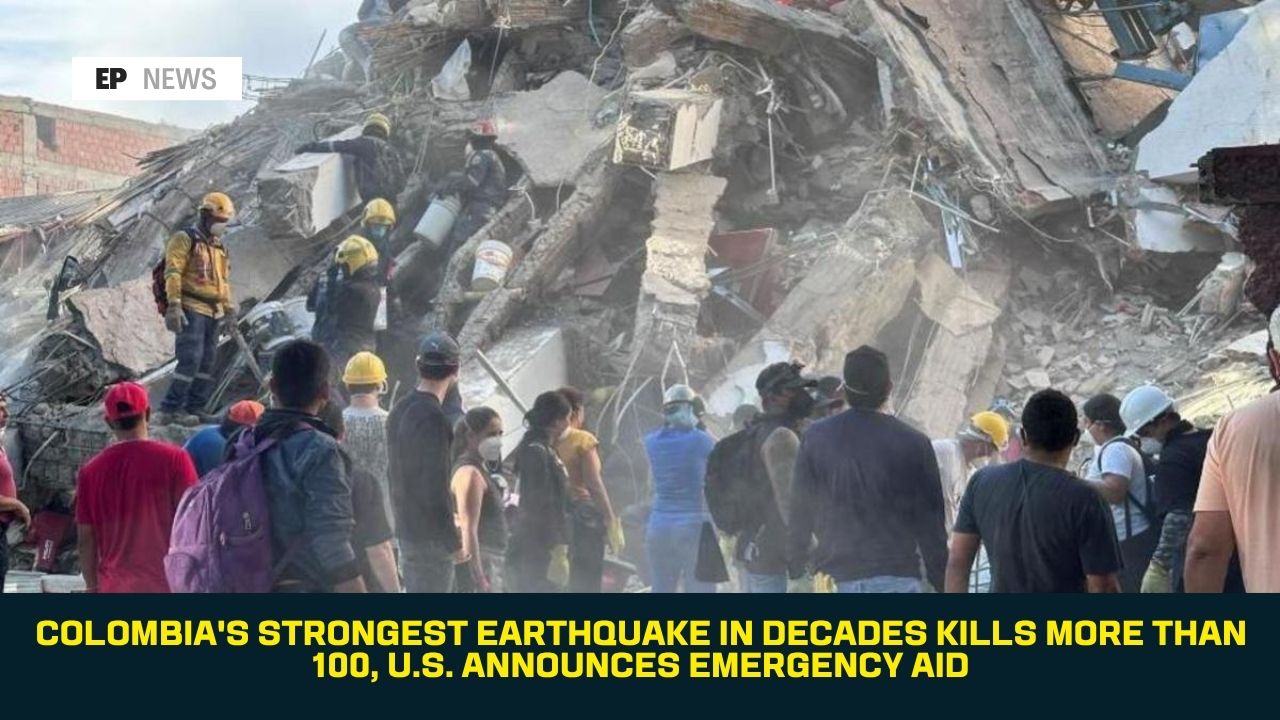
Colombia’s Strongest Earthquake in Decades Kills More Than 100, U.S. Announces Emergency Aid
A powerful 7.4-magnitude earthquake struck western Colombia on Monday, August 10, killing more than 100 people, collapsing buildings across several major cities, and triggering the country’s largest disaster response in years. The United States has pledged $15 million in emergency assistance as search and rescue operations continue.
What Happened
The earthquake struck at approximately 8:34 a.m. ET, with its epicenter in San José del Palmar, a rural community in Colombia’s Chocó department roughly 250 miles west of the capital, Bogotá, according to the U.S. Geological Survey and its Colombian counterpart, cited by CBS News. The quake struck at a depth of roughly 66 to 68 miles below the surface and was followed by a 5.0-magnitude aftershock less than an hour later, with at least 21 total aftershocks recorded within hours, according to Al Jazeera.
Colombia’s Geological Service described it as the country’s strongest recorded earthquake of the 21st century. Roughly 10.5 million people experienced strong to very strong shaking, according to USGS data cited by CBS News, with tremors felt as far away as Bogotá and the coastal city of Barranquilla, and across the border in Ecuador, Venezuela, and Panama.
The Toll So Far
Casualty figures have continued climbing as search and rescue operations proceed, with different sources reporting varying totals as the situation develops. Colombian President Abelardo De La Espriella cited preliminary figures of 111 deaths and 87 injuries shortly after the quake, according to Al Jazeera. By Tuesday, the nonprofit Colombian Association of Capital Cities reported the toll had risen further, with NBC News citing at least 169 deaths and Time citing 132 deaths and at least 570 injuries based on the same organization’s tracking. Given how rapidly these figures have moved and varied across sources during the initial rescue period, the final toll remains unconfirmed and is likely to continue changing as authorities complete their assessment.
President De La Espriella declared a national emergency to expedite disaster funding and response efforts, according to Direct Relief’s tracking of the disaster.
Where the Damage Is Worst
The earthquake caused severe damage across multiple cities in western Colombia, with Cali, Pereira, Quibdó, Manizales, and Armenia among the hardest hit, according to NBC News. Those cities remain under Colombia’s highest-level disaster alert. Local officials reported at least 20 buildings had fully collapsed and 380 more damaged in Cali alone, trapping people inside, according to Al Jazeera.
In Cali, Colombia’s third-largest city, search teams and civilian volunteers worked together picking through rubble, passing broken concrete down long lines of people, according to CBC News. Álvaro López, a Cali resident, described the scene to CBC: “Our building has basically been left in ruins, and the building next to ours? Completely collapsed.”
The quake’s disruption extended well beyond collapsed buildings. Seven airports suspended operations, and hospitals, roads, transportation, water systems, energy, and telecommunications were all disrupted in the hardest-hit areas, according to NBC News.
Why This Earthquake Caused So Much Damage
Colombia sits along the seismically active Pacific Ring of Fire, where lower-intensity tremors are common, but earthquakes above magnitude 6 remain rare, according to Al Jazeera. Northwestern University seismologist Suzan van der Lee told Reuters, in comments relayed by Al Jazeera, that the quake’s depth, inland location, and strike-slip fault motion likely amplified the shaking’s impact on populated valleys in ways that wouldn’t typically be expected from an earthquake originating so far below the surface. “This one was far below the crust, and in theory, it shouldn’t cause as much shaking,” she said. “At this magnitude, it did actually cause a lot of shaking.”
For historical context, Colombia’s deadliest recent earthquake occurred in 1999, when a 6.2-magnitude quake near the city of Armenia killed more than 1,100 people, according to Al Jazeera.
The Regional Context
Monday’s earthquake follows a difficult stretch of seismic activity across the region. A 5.5-magnitude earthquake had struck the Pacific just seven hours before Monday’s larger quake, affecting three cities in neighboring Ecuador, according to Direct Relief. The disaster also echoes recent devastation in Venezuela, where back-to-back earthquakes above magnitude 7 struck in June, killing more than 6,000 people, according to Time’s reporting — a comparison that has heightened regional anxiety about the current disaster’s own final toll.
The U.S. Response
The U.S. Department of State announced Monday night it would provide $15 million in emergency assistance to support Colombia’s disaster response, according to Al Jazeera. Separately, Direct Relief, a U.S.-based nonprofit with an extensive history of medical support across South America, said it was actively monitoring health needs in the region and communicating with local and regional organizations to assess immediate medical requirements. The organization noted it has sent more than $27 million in medical aid to Colombian health organizations since 2015, and maintains stockpiles of emergency medicines commonly needed after earthquakes, including wound care supplies, antibiotics, and field medic packs for search-and-rescue teams.
Continued Risk From Landslides and Flooding
Beyond the immediate structural damage, USGS has warned that a significant portion of the areas surrounding the earthquake remain at elevated risk of landslides and flooding, according to Direct Relief — a secondary hazard that could complicate ongoing rescue efforts and further endanger residents in the affected mountainous terrain of the Chocó region in the days ahead.
FAQ
How many people have died in the Colombia earthquake? Estimates have varied and continued rising as search and rescue proceeded, ranging from roughly 111 to more than 160 deaths depending on the source and timing of the report, with the final toll not yet confirmed.
Where was the earthquake’s epicenter? San José del Palmar, a rural community in Colombia’s Chocó department, about 250 miles west of Bogotá.
What magnitude was the earthquake? 7.4, making it Colombia’s strongest recorded earthquake of the 21st century, according to the Colombian Geological Service.
Which cities were hit hardest? Cali, Pereira, Quibdó, Manizales, and Armenia, all of which remain under Colombia’s highest-level disaster alert.
Is the United States providing aid? Yes. The State Department pledged $15 million in emergency assistance, and the nonprofit Direct Relief is separately mobilizing medical aid based on its established relief network in the region.
Conclusion
Colombia’s strongest earthquake in decades has left a still-climbing death toll and widespread destruction across several major cities, with ongoing landslide and flooding risks compounding an already difficult rescue and recovery effort. With international aid, including from the United States, now mobilizing and search teams continuing to work through collapsed buildings in Cali and elsewhere, the coming days will likely bring a clearer picture of both the disaster’s final human toll and the scale of rebuilding needed across the affected region.
Sources: CBS News, CBC News, NBC News, Al Jazeera, Time, Direct Relief, Wikipedia (reporting dated August 10-12, 2026).