
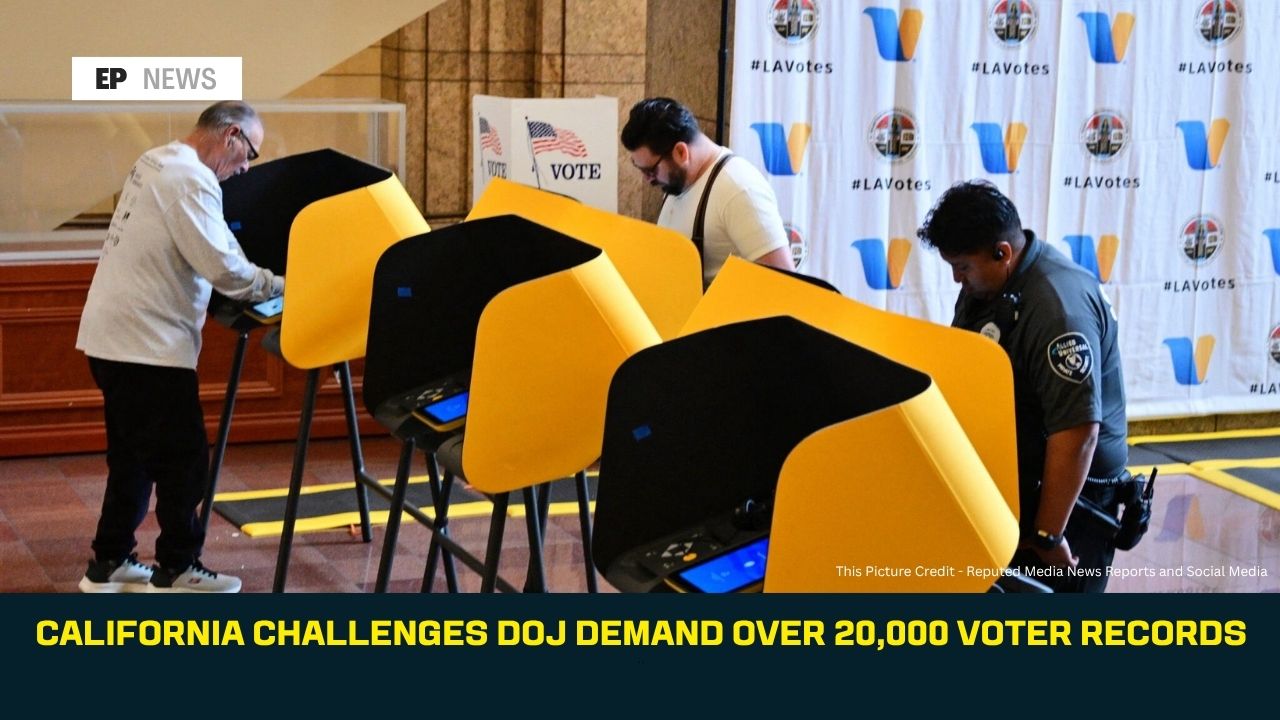
California Election Officials Challenge DOJ Demand Over 20,000 Voters Ahead of Midterms
LOS ANGELES, October 25, 2026 — California election officials are challenging a demand from the U.S. Department of Justice (DOJ) to set aside ballots associated with approximately 20,000 voters whom federal authorities suspect may be noncitizens. The dispute comes just days before the November 3, 2026, U.S. midterm elections and has intensified an ongoing legal confrontation between California and the Trump administration.
According to an Associated Press report published on October 25, federal officials sent letters to county election offices on Friday requesting sensitive voter information, including Social Security numbers. The letters established a 48-hour deadline and warned of possible legal consequences for officials who knowingly count ballots cast by noncitizens.
California election officials have questioned the accuracy of the federal government’s list. Some counties reported apparent errors, while officials in Los Angeles County cited a preliminary review suggesting that many names on the list did not match the government’s allegations.
The Justice Department says its requests are intended to protect election integrity and that it is not asking California to carry out a broad voter-registration purge. The disagreement now raises questions about federal authority, state election administration, voter privacy and how election officials should handle disputed records shortly before voting deadlines.
The matter is also part of a wider legal battle over whether California must comply with federal demands concerning mail-in ballots linked to people suspected of being ineligible to vote.
What Did the Justice Department Ask California to Do?
The Justice Department sent letters to California county registrars on Friday, October 23, requesting information about roughly 20,000 voters whom federal authorities believe may be noncitizens.
The letters sought sensitive personal information, including Social Security numbers, and asked county officials to respond within 48 hours. Federal officials warned that legal action could follow if election officials knowingly counted ballots from people who were not eligible to vote.
The request came as California counties were already processing mail-in ballots ahead of the November 3 midterm elections.
Under U.S. law, noncitizens are generally prohibited from registering to vote or casting ballots in federal elections. The central disagreement is whether the federal government’s list accurately identifies people who are ineligible and what election officials must do when a voter’s status is disputed.
The federal government has sought to prevent California from counting certain mail-in ballots associated with people it has identified as likely noncitizens. California officials, however, have raised concerns about errors in the underlying data and the short deadline for responding.
The letters have therefore created both a legal question and a practical challenge for county election offices: how to evaluate federal allegations without mistakenly affecting eligible voters or disrupting ongoing election operations.
Why California Election Officials Are Raising Concerns
Several county officials have questioned the reliability of the federal list and said they need clearer guidance before deciding how to respond.
John Tuteur, the registrar of voters for Napa County, told the Associated Press that his office intended to continue election operations. Officials in other counties described confusion over the requests and uncertainty about the legal consequences of their decisions.
California’s attorney general’s office has also argued that the letters contain errors. In one example cited in a state court filing, Mendocino County officials received information about people who were not residents of that county.
Such discrepancies matter because voter eligibility is determined through legal requirements and individual records, not simply by a name appearing on a government list.
A person may have an inaccurate record, a registration that has already been canceled, or information that has been matched incorrectly. Those possibilities need to be assessed before authorities draw conclusions about whether an individual was eligible to vote.
County officials are also dealing with a time-sensitive process. Mail ballots have already been returned and counting activity is underway in some places. Any instruction to separate or withhold ballots must be considered alongside state election law, court orders and procedures designed to protect eligible voters.
The disagreement does not establish that every person on the federal list is eligible, nor does it establish that every person listed is ineligible. Each allegation requires appropriate verification.
What Does the Preliminary Los Angeles County Review Show?
Los Angeles County officials have challenged the accuracy of the federal list in court.
According to the Associated Press, a preliminary analysis of 200 names drawn from the statewide list found that more than 40% had canceled voter registrations. More than 70% had no voting history, and nearly four in 10 were born in the United States.
The findings were cited in a court filing by county officials. They raise questions about whether the federal list reliably identifies people who are both registered and potentially ineligible to vote.
However, the sample should not be treated as a final assessment of all approximately 20,000 names. A preliminary review of 200 records cannot, by itself, establish the status of every person on the full list.
The distinction is important in a politically sensitive election dispute. Officials need to establish the accuracy of the records and follow the law before making decisions that could affect ballots.
The Justice Department maintains that its actions are intended to support election security. California officials say the information they have received contains errors and requires further scrutiny.
The dispute will depend in part on the quality of the underlying data and how the courts interpret the government’s authority to demand the requested actions.
DOJ Says It Is Not Seeking a Voter-Registration Purge
The Justice Department has defended the letters as a request for cooperation rather than an effort to cancel registrations on a large scale.
Department spokesperson Kiersten Pels said on Saturday that the department was not requesting a purge, cancellation of registrations or a broad programmatic action.
Instead, the department said it wanted cooperation to help ensure election security.
The distinction matters because identifying potentially ineligible voters and canceling registrations are not the same process. Election officials must apply relevant laws and procedures to individual cases, while also protecting eligible citizens from wrongful removal or improper treatment.
Federal officials have argued that noncitizen voting must be addressed when evidence suggests it has occurred. California officials, meanwhile, have emphasized concerns about the accuracy of the information and the risk of taking action based on incorrect records.
The disagreement reflects a broader debate over how federal authorities and state governments should share responsibility for administering elections.
The legal outcome may help clarify what information the federal government can demand from local election offices and what steps officials must take when the parties disagree over voter eligibility.
Why the Dispute Matters Before the November 3 Midterms
The timing of the letters has increased the stakes.
The November 3 midterm elections will determine control of Congress and shape the political environment for the remainder of President Donald Trump’s term. California has a large electorate, and election offices across the state are already handling ballots and preparing for Election Day.
A dispute over voter eligibility shortly before an election can create uncertainty for election workers, candidates and voters. Officials must balance legal requirements with the need to process ballots accurately and on time.
If county officials receive conflicting interpretations of their obligations, they may need rapid guidance from state authorities or the courts. That guidance is particularly important when the federal government’s deadline is short and ballots are already being processed.
At the same time, allegations of voter ineligibility should be assessed on the evidence. The presence of a name on a disputed list is not, by itself, proof that a person illegally registered or voted.
For voters, the most important practical issue is that eligible ballots are handled according to applicable law and that election officials communicate clearly about any changes to procedures.
The Legal Battle Between California and the Trump Administration
The letters are the latest development in a legal dispute between California and the Justice Department over federal efforts to restrict the counting of ballots linked to people authorities suspect are noncitizens.
The federal government filed a lawsuit on October 15 seeking to prevent California from counting certain mail-in ballots associated with people identified as likely noncitizens.
The state has challenged the federal approach, including the accuracy of the information used to identify voters.
The legal question involves the respective powers of federal authorities and state election officials. Federal law prohibits noncitizens from voting in federal elections, but election administration involves detailed procedures for maintaining voter rolls, verifying eligibility and processing ballots.
The courts will need to consider the applicable statutes, the evidence supporting the government’s demands and the legal protections governing election administration.
The Associated Press reported that a panel of judges on the 9th U.S. Circuit Court of Appeals was scheduled to hear arguments on Sunday, October 25, over whether California can be compelled to comply with the federal demands.
The hearing could become an important step in determining how the dispute proceeds, although a hearing does not necessarily mean the court will issue an immediate final ruling.
What Happens if County Officials Do Not Comply?
The Justice Department’s letters warned of possible legal action against officials who knowingly count ballots cast by noncitizens.
Bill Essayli, the top federal prosecutor in Los Angeles, also warned that election officials who failed to comply could face prosecution, according to AP reporting.
However, the exact legal consequences for a particular county or official would depend on the applicable law, the instructions issued, the facts of the case and any court rulings.
County officials have indicated that they need reliable guidance before making decisions that could affect election procedures. Some said they would continue counting ballots while seeking clarification from state authorities.
That approach underscores the difficulty of managing competing demands close to Election Day. Officials must comply with the law, but they also need to ensure that eligible voters are not incorrectly treated as ineligible because of inaccurate records.
The next legal developments may clarify what counties are required to do and whether the federal government’s requested actions can be enforced.
Why Accurate Voter Records Matter
Voter registration systems contain personal information used to determine eligibility and administer elections. Those records must be accurate enough to identify eligible voters while helping officials detect registrations that do not meet legal requirements.
Errors can occur when records are outdated, information is mismatched or databases contain incomplete details. A canceled registration or a person who has never voted may appear on a list for reasons that do not establish illegal voting.
At the same time, authorities can investigate credible evidence of unlawful registration or voting. The important question is whether claims are supported by reliable information and handled through the appropriate legal process.
In the California dispute, the preliminary review cited by county officials raises questions about the accuracy of the federal list, but it does not resolve the status of every individual on it.
Clear verification procedures and timely legal guidance will be important to avoid errors as counties continue processing ballots.
What Voters Should Know
California voters should follow official communications from their county election offices and the California Secretary of State for instructions about registration, ballot submission and election deadlines.
The federal-state dispute does not, by itself, mean that all California ballots are affected or that voters should change their plans.
Voters should not assume that their eligibility is in question simply because of a news report about a government list. Anyone with a specific concern about their registration or ballot should contact the appropriate election office using official contact details.
The legal process is ongoing, and the requirements for county officials may change if courts issue new orders. For that reason, voters should rely on current official guidance rather than speculation on social media.
What Comes Next?
The next major development is the legal review of the federal government’s demand. The 9th Circuit hearing scheduled for October 25 could help clarify whether California must comply with the requested actions.
County election officials will also continue assessing the information they received and seeking guidance about their legal obligations.
Further court filings may provide additional details about the federal list, including how the names were identified and whether the underlying data can be independently verified. Officials may also release updated information about how counties are handling the requests.
Until the courts or relevant authorities provide further clarity, the dispute remains unresolved.
The central issues are whether the federal government can require the requested action, whether its data accurately identifies potentially ineligible voters and how election officials can protect the integrity of the process without improperly affecting eligible voters.
Frequently Asked Questions
1. What is the DOJ asking California to do?
The Justice Department has asked California county election officials to provide information about approximately 20,000 voters suspected by federal authorities of being noncitizens and has demanded action concerning associated ballots.
2. Why are California officials questioning the list?
Some officials say the information contains errors. A preliminary Los Angeles County analysis of 200 names found that many had canceled registrations, no voting history or were born in the United States.
3. Does appearing on the list prove someone voted illegally?
No. Being named on a disputed list is not, by itself, proof of illegal registration or voting. Individual records and relevant evidence must be assessed.
4. What did the Justice Department say about its request?
The DOJ said it was seeking cooperation to protect election integrity and was not requesting a broad voter-registration purge or automatic cancellation of registrations.
5. When is the 2026 U.S. midterm election?
Election Day is scheduled for November 3, 2026.
6. Is California required to comply with the federal demand?
The dispute is being considered through the courts. The legal obligations of state and county officials depend on applicable law and any relevant court orders.
7. Could the dispute affect eligible voters?
County officials have raised concerns about the accuracy of the list. That is why individual records and legal requirements must be carefully reviewed before decisions are made about ballots.
8. Where can voters check their registration or ballot status?
Voters should use their official county election office or the California Secretary of State’s website for current information.
Conclusion
The dispute between California election officials and the Justice Department has become a significant election-law issue ahead of the November 3 midterms. Federal authorities are seeking information and action involving approximately 20,000 voters they suspect may be noncitizens, while California officials have questioned the accuracy of the records and the short deadline for responding.
The case now turns on the evidence, the legal authority behind the federal demand and the courts’ interpretation of the parties’ responsibilities. Protecting election integrity requires enforcing voter eligibility laws while also ensuring that eligible voters are not wrongly affected by inaccurate data.
Further court decisions and official statements will determine how the dispute proceeds and what county election offices must do next.