
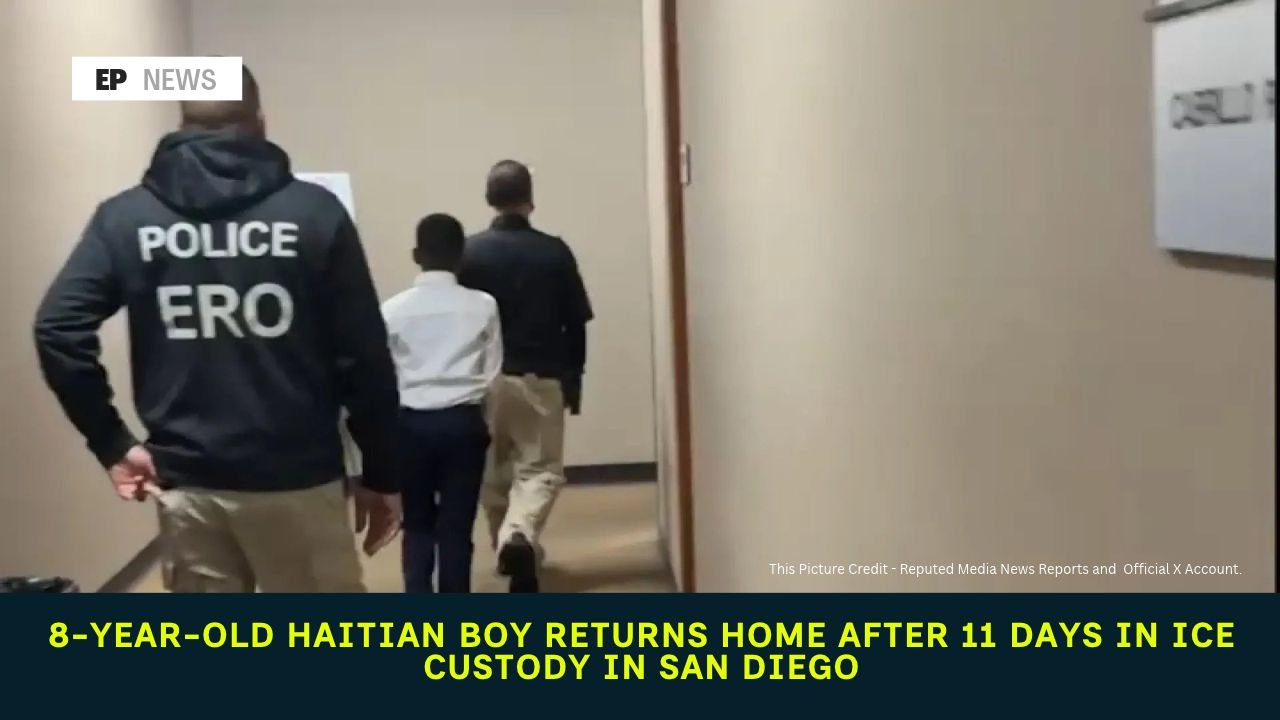
8-Year-Old Haitian Boy Returns Home After 11 Days in ICE Custody in San Diego
November 18, 2026 | U.S News
An eight-year-old Haitian boy who was detained by U.S. Immigration and Customs Enforcement (ICE) in San Diego has been reunited with his family after spending 11 days in federal custody.
The child’s release was confirmed by the Haitian Bridge Alliance, an immigration advocacy organization, and the San Diego Unified School District. The boy returned to his family in California and went back to school, bringing an end to a detention that had attracted national attention and raised questions about immigration enforcement involving children.
The boy was taken into federal custody after attending an immigration check-in appointment with his uncle on November 4, 2026. Federal officials said the adult accompanying him could not establish legal guardianship, leading authorities to place the child in the care of the Office of Refugee Resettlement.
The Department of Homeland Security (DHS) later confirmed that the child had been returned to his uncle after guardianship was established.
The case has generated strong reactions from immigration advocates, local officials and lawmakers. It has also renewed discussions about how federal immigration authorities handle children who are living with relatives after a parent has been deported.
What Happened to the 8-Year-Old Haitian Boy?
The child is a third-grade student at Fay Elementary School in San Diego’s City Heights neighborhood.
According to reporting by CBS News, ABC News and other outlets, he had been living with relatives after his father was deported to Mexico in 2025.
On November 4, the boy accompanied his uncle to an immigration check-in appointment in San Diego. During that appointment, immigration officials questioned the uncle’s legal authority to care for the child.
DHS said the uncle could not establish legal guardianship at that time. Federal authorities therefore treated the child as an unaccompanied minor and transferred responsibility for his care to the Office of Refugee Resettlement.
The incident attracted public attention after images and video showed federal immigration agents escorting the young student inside a federal building in San Diego.
Haitian Bridge Alliance said the separation caused distress among the child’s relatives, particularly his cousins, who were reportedly present when he was taken into custody.
The child’s detention also became a subject of concern for Democratic lawmakers, who sought information from federal agencies about the circumstances surrounding the case.
Why Did ICE Take the Child Into Federal Custody?
The Department of Homeland Security said the decision was made because officials could not verify that the uncle had legal guardianship of the child.
According to DHS, immigration authorities acted out of concern for the child’s safety and placed him under the care of the Office of Refugee Resettlement.
The agency said federal law requires certain children who are in the United States without a parent or legal guardian to be referred to the appropriate child-care system.
DHS also provided additional details about the family’s immigration history. A spokesperson said the child had initially entered the country with a man who allegedly claimed to be his father. The agency said that man had previously been removed to Mexico by Customs and Border Protection.
These statements reflect the federal government’s explanation of the case. The advocacy group’s account emphasized that the boy had been living with his uncle and relatives following his father’s deportation.
The central issue was the legal status of the uncle as the child’s caregiver.
Federal authorities ultimately returned the child to his uncle after guardianship was established, according to DHS.
The case demonstrates how questions about legal guardianship can become especially complicated when families are affected by immigration enforcement and a parent is no longer living in the United States.
The Boy Spent 11 Days in Federal Custody
The child remained in government custody for 11 days.
According to ABC News, he was initially referred to the Office of Refugee Resettlement, which operates under the Department of Health and Human Services.
The agency is responsible for the care of certain children who enter federal custody without a parent or legal guardian.
Reports said the boy was transferred to a facility in Texas, away from his home and family in San Diego.
Representative Juan Vargas, a Democrat representing California, publicly discussed the child’s release and welcomed his return to his relatives.
The Haitian Bridge Alliance also confirmed the reunification and said it had been advocating for the child’s release.
For the family, the return meant that the boy could again live with his relatives and continue his education in California.
The San Diego Unified School District said school leaders and counselors met with the student after his return to ensure that he and his family received appropriate support.
The district confirmed that the child returned to school and attended class.
DHS Confirms the Child Was Returned to His Uncle
The Department of Homeland Security confirmed that the child had been released from federal custody.
According to ABC News, a DHS spokesperson said the boy was returned to his uncle once the adult was able to establish guardianship under the Trafficking Victims Protection Reauthorization Act.
The department said the Office of Refugee Resettlement is responsible for protecting children referred to its care.
A Department of Health and Human Services spokesperson also explained that the agency’s responsibility includes the safety and welfare of children who are not in the care of a parent or legal guardian.
The spokesperson said family reunification is the goal for every child and that placement decisions are based on safety and the child’s best interests.
The federal government’s explanation is important because it provides the legal and administrative reasoning behind the child’s placement.
At the same time, the incident has prompted questions about whether family guardianship arrangements can be verified quickly enough to avoid prolonged separation.
Immigration Advocates Criticize the Detention
The Haitian Bridge Alliance strongly welcomed the child’s release but criticized the circumstances that led to his detention.
Guerline Jozef, executive director of the organization, said an eight-year-old child should be in school and surrounded by family rather than held in immigration detention.
The organization argued that the child should not have had to experience detention and separation from relatives before being reunited with them.
Advocates also raised concerns about the impact of immigration enforcement on children whose parents are deported or otherwise removed from their households.
The organization said family separation can create emotional and psychological difficulties for children and their relatives.
However, the federal government has maintained that its actions were intended to protect the child’s welfare because legal guardianship had not initially been established.
The disagreement highlights two different perspectives on the case: the government’s responsibility to verify the safety and legal status of a child’s caregiver, and advocates’ concerns about the consequences of removing a child from a familiar family environment.
San Diego Officials Demand Changes to Immigration Procedures
The child’s release did not end the public discussion in San Diego.
Local officials and education leaders called for changes to immigration procedures to help prevent similar situations involving school-age children.
According to Times of San Diego, San Diego Unified Superintendent Fabi Bagula, school district trustees and local elected officials sent a joint letter to Homeland Security Secretary Markwayne Mullin and Health Secretary Robert F. Kennedy Jr.
The letter welcomed the child’s return but said the experience had caused disruption and emotional distress for the student, his relatives and the school community.
Officials said the district was providing counseling and additional support to people affected by the incident.
They also called on the federal government to establish clearer protocols for situations involving children who are living with relatives after a parent has been deported.
The officials requested that immigration enforcement near schools and other sensitive locations be reconsidered.
They also called for the restoration of Temporary Protected Status for eligible Haitian immigrants.
The letter reflects the concerns of local officials and educators. It does not itself change federal immigration law or ICE enforcement procedures.
How Haiti’s Temporary Protected Status Is Connected to the Case
The incident has also drawn attention to the immigration status of Haitian nationals living in the United States.
Temporary Protected Status, commonly known as TPS, is a federal immigration program that can provide eligible nationals of designated countries with temporary protection from deportation and authorization to work in the United States.
The program is generally intended for people whose countries face conditions that make safe return difficult, such as armed conflict, environmental disasters or other extraordinary circumstances.
CBS News reported that approximately 350,000 Haitians lost TPS-related protections following developments in the Trump administration’s immigration policy in 2026.
The boy’s case is not itself a TPS court case, and his detention should not be described as a direct consequence of a particular TPS decision without further evidence.
However, the broader policy debate is relevant because changes in immigration status can affect families, employment and the risk of separation.
Immigration advocates argue that children can experience serious disruption when parents or caregivers face deportation proceedings.
The administration, meanwhile, has defended its immigration enforcement policies and emphasized its responsibility to enforce federal immigration laws.
What Happens to the Child Now?
The child has been reunited with his uncle and returned to school in San Diego.
The San Diego Unified School District confirmed that school leaders and counselors met with him after his return to make sure that support was available.
The Haitian Bridge Alliance also said the boy would continue living with his uncle.
The immediate family separation has therefore ended, but questions about the circumstances of the detention remain.
Representative Juan Vargas said he would seek answers from the Trump administration about the incident.
Local officials are also calling for clearer procedures to protect children who are living with relatives when their parents are no longer available to provide care.
No broader change to federal immigration policy was announced as part of the child’s release.
Why This Case Matters for U.S. Immigration Policy
The case has become an example of the difficult situations that can arise when immigration enforcement intersects with family relationships and child welfare.
Federal agencies must follow laws governing the care of children who are not accompanied by a parent or legal guardian.
At the same time, families may have informal or complicated caregiving arrangements that are difficult to document quickly, especially after a parent has been deported.
For schools, the situation also raises practical concerns. Teachers and administrators may be left supporting children whose family circumstances change suddenly because of immigration enforcement.
The debate is not limited to Haitian families or San Diego. Similar questions can arise in communities across the United States when parents are detained or deported and children remain with relatives.
The case has also highlighted the importance of communication between federal agencies, schools, local officials and family members.
Clearer documentation and procedures could help authorities verify guardianship while reducing unnecessary disruption to a child’s education and family life.
Conclusion
The release of the eight-year-old Haitian boy after 11 days in ICE custody has brought relief to his family and renewed national attention to immigration enforcement involving children.
The federal government said the child was initially placed in protective care because his uncle could not establish legal guardianship. DHS later confirmed that the boy was returned to his uncle after the necessary guardianship requirements were met.
Immigration advocates and San Diego officials have welcomed the reunification while calling for changes that could prevent similar family separations.
The child has returned to school, but the wider debate over immigration enforcement, family guardianship and child welfare remains unresolved.
For now, the case stands as a reminder that immigration decisions can have consequences extending beyond the adults directly involved, particularly when children depend on relatives for care and stability.
Frequently Asked Questions (FAQs)
1. Why was the 8-year-old Haitian boy detained by ICE?
ICE took the child into federal custody after officials said his uncle could not establish legal guardianship during an immigration check-in appointment in San Diego.
2. Has the Haitian boy been released from ICE custody?
Yes. The child was released after 11 days in federal custody and reunited with his uncle and family in California.
3. When was the child detained?
The incident occurred on November 4, 2026, when the boy attended an immigration check-in appointment with his uncle.
4. Where was the child held?
Reports said the child was transferred to a facility in Texas while in the care of the Office of Refugee Resettlement.
5. What did DHS say about the release?
DHS said the boy was returned to his uncle after the uncle established guardianship under the Trafficking Victims Protection Reauthorization Act.
6. Did the child return to school?
Yes. The San Diego Unified School District confirmed that the student returned to school and received support from school leaders and counselors.
7. Why are San Diego officials concerned?
Local officials said the incident caused disruption and emotional distress for the child, his relatives and the school community. They are calling for clearer procedures to prevent similar family separations.
8. Is this case directly related to Haiti’s Temporary Protected Status?
The case has been discussed alongside broader changes to Haitian immigration protections, but the child’s detention was specifically explained by DHS as a guardianship issue. The two matters should not be treated as identical.
Sources and References
- CBS News – 8-year-old Haitian boy detained by ICE in San Diego released from custody.
- ABC News – 8-year-old Haitian boy who was detained by ICE is released from custody.
- The Guardian – Eight-year-old Haitian boy returns home after release from ICE custody.
- Times of San Diego – San Diego officials call for immigration policy changes after 8-year-old’s detention.
- San Diego Unified School District – Statement confirming the student’s return to school.