
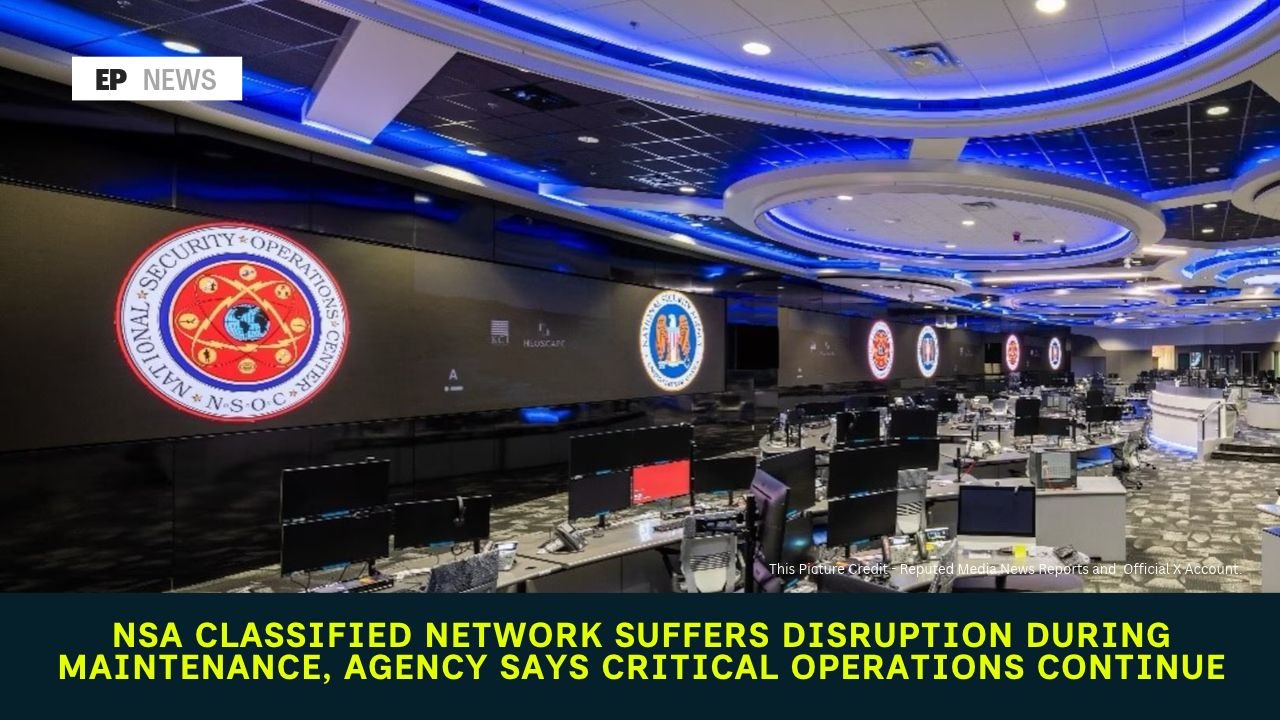
NSA Classified Network Disrupted During Routine Maintenance
November 18, 2026 | U.S National Security News
The National Security Agency (NSA), one of America’s most important intelligence organizations, experienced a disruption to its classified internal communications network on November 17, raising questions about the reliability of critical government technology systems.
The incident affected NSANet, an internal network used by NSA employees to communicate and share classified information. The disruption occurred during scheduled maintenance, according to a statement released by the agency.
The NSA described the problem as a temporary degradation affecting some internal systems. It also emphasized that its mission-critical capabilities remained operational and that its ability to defend U.S. national security continued.
The incident attracted national attention because it involved a classified communications system at an agency responsible for collecting foreign signals intelligence, identifying cyber threats and protecting sensitive government communications.
Reports about the disruption also emerged during a week in which several major technology systems in the United States had experienced technical problems.
However, U.S. officials said there was no evidence connecting these incidents or showing that they were caused by a coordinated cyberattack.
As of November 18, the NSA had not publicly disclosed the full technical cause, duration or scope of the disruption.
What Happened to the NSA’s Classified Network?
The disruption involved NSANet, a classified internal communications network used by employees of the National Security Agency.
According to reporting by The Associated Press, a defense official confirmed that the network was affected on Tuesday, November 17.
The agency subsequently acknowledged that some internal systems had experienced temporary degradation during scheduled routine maintenance.
In its statement, the NSA said:
“While some internal systems were affected, mission-critical capabilities remain fully operational and our ability to defend national security continues.”
The agency also explained that its infrastructure includes multiple layers of redundancy designed to maintain operations during planned maintenance and unexpected technical problems.
The statement was important because it indicated that the disruption did not mean the entire intelligence agency had stopped functioning.
However, the NSA did not provide a detailed technical explanation of what happened or specify exactly which internal systems were affected.
The agency also did not publicly establish how long the disruption lasted.
What Is NSANet and Why Is It Important?
NSANet is an internal communications system used by personnel at the National Security Agency to exchange classified information.
Unlike ordinary public internet services, classified government networks operate within controlled security environments and are designed to protect sensitive information from unauthorized access.
Such networks are essential for intelligence organizations because employees need secure ways to share reports, analysis and other sensitive material.
The NSA conducts several important national-security functions, including:
- Collecting and analyzing foreign signals intelligence.
- Monitoring communications and electronic activity relevant to national security.
- Identifying and helping counter foreign cyber threats.
- Supporting U.S. military and intelligence operations.
- Protecting sensitive government communications and information systems.
The agency works within the wider U.S. intelligence community and cooperates with other national-security organizations.
A classified communications network helps employees share information without relying on ordinary public communication platforms.
That makes reliability particularly important.
A technical disruption can create operational difficulties even when the agency’s most important capabilities remain available through alternative systems.
However, the NSA has not publicly explained which specific workflows or departments experienced problems during this incident.
Why Did the Network Experience an Outage?
The NSA attributed the disruption to scheduled routine maintenance.
The agency said some internal systems experienced temporary degradation while maintenance was taking place.
The Associated Press also cited a person familiar with the incident who said the problem occurred during routine patching.
Software patching is a normal part of maintaining computer networks. It involves installing updates designed to correct software vulnerabilities, improve performance and address technical problems.
Government agencies regularly update their systems to maintain security and reliability.
However, updates can sometimes create unexpected compatibility problems or interrupt services if a component does not function as intended.
In this case, the NSA did not publicly identify a specific software defect, failed update or hardware problem.
It would therefore be premature to claim that a particular vendor, software product or technical component caused the disruption.
The agency’s statement provides the clearest official explanation available as of November 18: the incident occurred during scheduled maintenance.
The precise technical circumstances remain undisclosed.
Did the NSA Face a Cyberattack?
One of the biggest questions following the incident was whether the disruption resulted from a cyberattack.
The concern was understandable because NSANet handles classified information and supports an agency responsible for protecting U.S. national security.
However, available reporting did not establish that hackers had attacked the network.
Two U.S. officials told CBS News that there was no evidence at that point that the disruption had been caused by a cyberattack.
The NSA itself described the incident as temporary degradation during scheduled maintenance.
The Associated Press also reported that the agency attributed the problem to routine maintenance and that officials had not established a connection to malicious activity.
These details are important because a network outage and a cyberattack are not the same thing.
A network can become unavailable because of software updates, configuration errors, hardware failures, maintenance work or other technical problems.
A cyberattack, by contrast, involves malicious activity intended to compromise systems, disrupt services, steal information or achieve another unauthorized objective.
As of November 18, there was no publicly confirmed evidence that an attacker had compromised NSANet.
That does not mean every technical detail of the incident has been disclosed. It means the available official statements and reporting do not support describing the event as a confirmed cyberattack.
Were NSA Employees Asked to Change Their Reporting Times?
CBS News reported that some personnel at NSA headquarters in Fort Meade, Maryland, were given staggered arrival times during the disruption.
According to people familiar with the matter, the agency wanted to avoid having large numbers of employees attempting to access the affected network at the same time.
The arrangement was reportedly referred to as “Code Gray” and involved a modified reporting schedule for some personnel.
The report also said that some activities were redirected to other NSA facilities around the country.
These details came from sources familiar with the situation rather than a complete public explanation from the agency.
The NSA has not publicly provided a full account of how the disruption affected employee schedules or individual departments.
It is also important not to confuse a change in reporting arrangements with a shutdown of the agency’s headquarters.
The available reporting did not indicate that Fort Meade itself had been closed.
Instead, the reported adjustments were intended to manage access and maintain operations while technical problems were being addressed.
What Did the NSA Say About Its Backup Systems?
The NSA emphasized that its infrastructure is designed with multiple layers of redundancy.
Redundancy is an important concept in critical technology systems.
It means that an organization has alternative equipment, systems, connections or procedures that can help maintain operations if one component becomes unavailable.
For example, a government agency may have backup communication routes or separate systems that allow essential functions to continue during a technical failure.
The NSA’s statement indicated that its infrastructure is designed to maintain operations during both planned maintenance and unexpected disruptions.
This was particularly relevant because the affected network was used for classified internal communications.
The agency said mission-critical capabilities remained operational.
However, the NSA did not publish a technical breakdown of the backup systems used during this incident.
It would therefore be inaccurate to claim that every employee or every internal service continued operating without interruption.
The confirmed point is narrower: the agency said its most important national-security capabilities remained functional.
Why Did the Incident Attract Attention Across Washington?
The NSA disruption occurred during a period of heightened attention to technology reliability across the United States.
In the days before the incident, several government and private-sector systems had experienced interruptions or technical problems.
These included:
- A nationwide aviation disruption affecting air traffic control systems.
- Technical problems involving JPMorgan Chase’s banking services.
- An internal systems disruption at United Airlines.
- Problems affecting Microsoft services.
- Service interruptions involving Apple products and services.
Each incident involved different organizations and technical circumstances.
The FAA disruption, for example, involved air traffic control communications and router installations. JPMorgan Chase described a temporary software-related issue. The NSA described its own incident as a disruption during scheduled maintenance.
These events should not automatically be treated as one coordinated incident.
U.S. officials emphasized that there was no evidence connecting the outages or showing that they were caused by a hostile foreign actor.
The number of disruptions nevertheless raised questions about the resilience of important digital infrastructure.
Government agencies, airlines, banks and technology companies increasingly depend on complex computer networks.
Even a temporary technical failure can affect employees, customers and public services.
What Did Marco Rubio Say About the Recent Technology Disruptions?
Secretary of State Marco Rubio addressed concerns about the recent technology problems during President Donald Trump’s international trip.
According to AP reporting, Rubio said there was no evidence that the various outages were connected or caused by a malicious actor.
His comments came as questions grew about whether the disruptions could indicate a broader security problem.
Rubio’s position was that officials had no information demonstrating that the incidents were part of a coordinated hostile operation.
Director of National Intelligence Jay Clayton also suggested that simultaneous system upgrades and security patches could have contributed to some of the disruptions.
Sen. Mark Warner, the top Democrat on the Senate Intelligence Committee, said early evidence pointed toward legitimate efforts to address vulnerabilities, while emphasizing that the incidents still required investigation.
These statements do not establish a single technical explanation for every outage.
They reflect the information available to officials at the time and underline the importance of separating verified findings from speculation.
How Does the NSA Protect America’s National Security?
The National Security Agency is a central part of the U.S. intelligence and cybersecurity system.
Its responsibilities include collecting foreign signals intelligence and helping protect national-security communications.
Signals intelligence involves collecting and analyzing information from electronic signals and communications.
This information can help U.S. officials understand foreign military activity, security threats and developments that may affect American interests.
The NSA also works to protect national-security systems from cyber threats.
Its responsibilities include supporting government cybersecurity efforts and helping safeguard sensitive information.
The agency works with other federal organizations, including U.S. Cyber Command, although their responsibilities and organizational structures are distinct.
Because of these functions, the reliability of its internal communications systems is important.
Employees need secure access to information so that intelligence assessments can be prepared, reviewed and shared with authorized personnel.
A disruption does not automatically mean intelligence collection has stopped or that classified information has been compromised.
Those are separate questions that require evidence.
In this incident, the NSA said its mission-critical capabilities remained operational.
What Are the Risks When Classified Government Networks Fail?
A disruption involving a classified government network can create several potential challenges.
The exact consequences depend on which systems are affected, how long the disruption lasts and whether backup arrangements are available.
Possible operational concerns include:
1. Delayed information sharing
Employees may have difficulty exchanging reports or accessing certain internal resources while a network is unavailable.
2. Changes to employee workflows
Staff may need to use alternative procedures, different facilities or backup systems.
3. Additional technical workload
Information technology teams may need to investigate the problem, verify system integrity and restore normal services.
4. Security verification
After a disruption, agencies may need to confirm that systems are functioning correctly and that sensitive information remains protected.
5. Coordination challenges
Intelligence organizations work with multiple government partners. Disruptions can make some communication and administrative tasks more complicated.
These are general risks associated with classified network disruptions, not confirmed consequences of the November 17 incident.
The NSA has not publicly stated that classified information was stolen, exposed or compromised.
It has also not announced that its intelligence operations were suspended.
Has the NSA Confirmed That the Network Is Fully Restored?
As of November 18, the NSA had not publicly released a detailed statement confirming the exact restoration timeline or explaining whether every affected internal system had returned to normal operation.
The agency’s statement said the disruption was temporary and that mission-critical capabilities remained operational.
However, those statements should not be interpreted as confirmation that every component of NSANet was fully restored at a particular time.
The agency has not publicly disclosed the precise duration of the disruption, the full list of affected systems or a detailed technical report.
For that reason, the status of individual services should be treated cautiously until the NSA provides further information.
What Happens Next?
The next important step is for the NSA and relevant technical teams to complete their assessment of the disruption.
The agency may need to verify that affected systems are operating as expected and that maintenance procedures have not created additional problems.
It may also review the effectiveness of its backup arrangements and determine whether any changes are necessary to prevent similar disruptions.
Because the network handles classified information, the agency is unlikely to release every technical detail publicly.
However, additional information could become available through official statements, congressional oversight or reporting by journalists.
For the broader U.S. government, the incident is another reminder that maintaining secure and reliable digital infrastructure is a national-security priority.
Government agencies must balance the need to install security updates with the need to keep essential services available.
The NSA’s emphasis on redundant systems suggests that continuity of operations remains a central part of its technology strategy.
Conclusion
The National Security Agency’s classified internal communications network experienced a temporary disruption during scheduled maintenance on November 17, 2026.
The affected system, known as NSANet, is used by agency employees to communicate and share classified information.
The NSA said some internal systems were affected but emphasized that mission-critical capabilities remained operational.
Reports from CBS News and other outlets indicated that some employees received adjusted reporting arrangements while technical teams addressed the problem.
Although the incident attracted attention because of its timing alongside other technology disruptions in the United States, officials said there was no evidence that the outages were connected or caused by a coordinated cyberattack.
The exact technical cause, duration and full scope of the NSA disruption had not been publicly established by November 18.
For now, the most important confirmed information is that the agency acknowledged a temporary maintenance-related disruption and said its essential national-security capabilities continued operating.
The incident highlights the importance of reliable classified networks, backup infrastructure and careful maintenance procedures across America’s intelligence community.
Frequently Asked Questions (FAQs)
1. What happened to the NSA network on November 17, 2026?
The NSA’s classified internal communications network experienced a temporary disruption during scheduled routine maintenance, affecting some internal systems.
2. What is NSANet?
NSANet is a classified internal network used by National Security Agency employees to communicate and share sensitive information.
3. Did the NSA confirm a cyberattack?
No. The NSA described the incident as temporary degradation during scheduled maintenance. U.S. officials told CBS News that there was no evidence at that point that the disruption was caused by a cyberattack.
4. Did the NSA stop its intelligence operations?
The agency said its mission-critical capabilities remained operational. It did not announce a suspension of its essential national-security functions.
5. Where is the NSA headquarters located?
The NSA headquarters is located at Fort George G. Meade in Maryland, between Baltimore and Washington, D.C.
6. Why is NSANet important?
The network supports secure internal communications and the sharing of classified information among authorized