
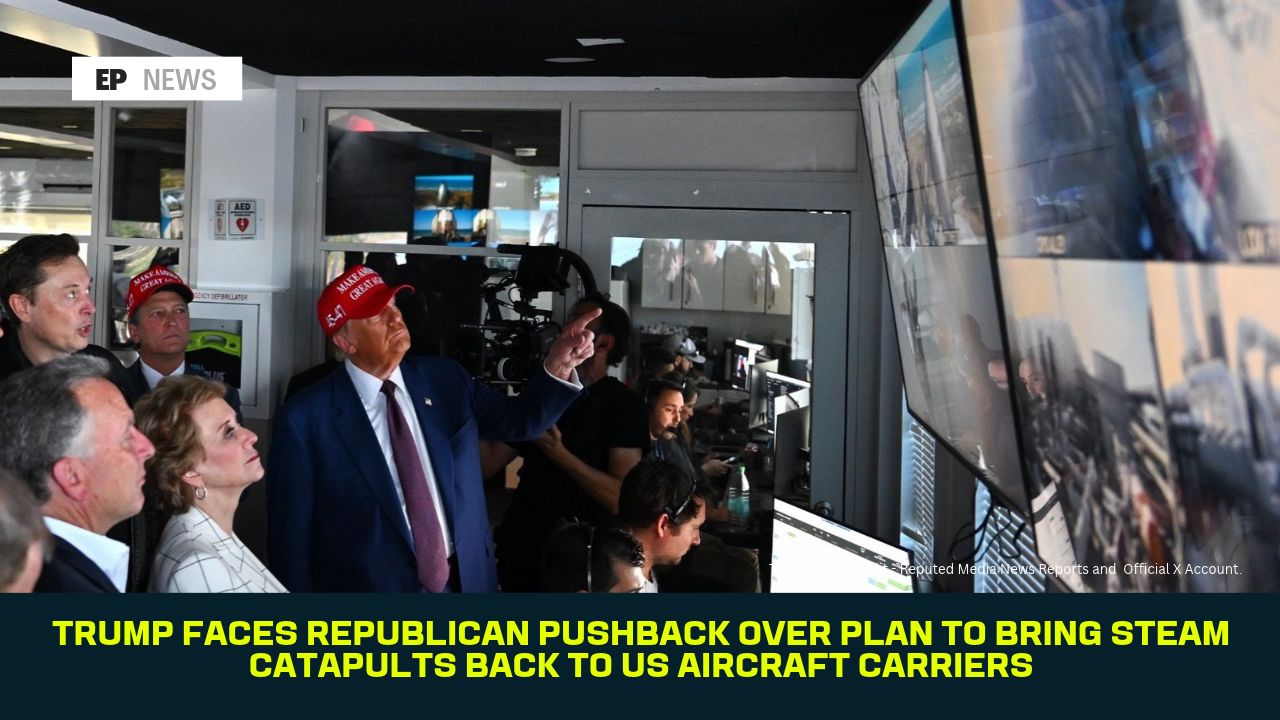
Trump Faces GOP Pushback Over Navy Steam Catapult Plan
November 18, 2026 | U.S. News / Military & Defense
Republican senators are challenging President Donald Trump’s order to replace modern electromagnetic aircraft-launch systems with older steam technology on future Ford-class carriers, warning that the change could cost billions of dollars and delay Navy shipbuilding.
A growing disagreement over the future of America’s aircraft carriers has emerged in Washington, where Republican lawmakers are pushing back against President Donald Trump’s plan to replace advanced electromagnetic aircraft-launch systems with traditional steam-powered catapults.
The dispute became more visible on November 17, 2026, during a Senate Armed Services Committee hearing involving acting Navy Secretary Hung Cao, who is seeking confirmation for the permanent position.
Sen. Roger Wicker, a Mississippi Republican and chairman of the Senate Armed Services Committee, delivered a direct message about the proposed change: returning to steam-powered catapults was a “nonstarter.”
The disagreement is significant because the Ford-class aircraft carriers represent the Navy’s newest and most technologically advanced carrier design. Their electromagnetic launch systems were developed to improve aircraft-launch operations, reduce some manpower requirements and support a wider range of aircraft.
Trump has repeatedly criticized the electromagnetic technology and wants the Navy to return to older steam-powered systems. However, Republican lawmakers have raised concerns that redesigning ships already developed around electromagnetic equipment could increase costs, create further construction delays and affect military capabilities.
The debate is now reaching the congressional defense-budget process. A Senate defense appropriations measure calls for a detailed comparison of the two technologies before the Navy makes a major change to the Ford-class design.
Why Are Republican Senators Challenging Trump’s Aircraft Carrier Order?
President Trump has long expressed dissatisfaction with the Navy’s electromagnetic aircraft-launch technology.
In August 2026, he issued a directive instructing the Pentagon and Navy to develop a plan to replace the Electromagnetic Aircraft Launch System, commonly known as EMALS, with traditional steam-powered catapults on future Ford-class aircraft carriers.
The directive also called for replacing the ships’ electromagnetic Advanced Weapons Elevators with older hydraulic systems.
Trump has argued that complicated technology and repeated design changes have contributed to problems in American naval shipbuilding. His administration has emphasized the need for systems it considers proven, reliable and affordable.
However, lawmakers from both political parties have questioned whether returning to older technology would actually solve the Navy’s problems.
During the November 17 hearing, Sen. Roger Wicker publicly opposed the proposal. His comments were particularly notable because he is a Republican who chairs the committee responsible for overseeing important Navy and defense matters.
The Senate Appropriations Committee has also expressed concerns in its fiscal year 2027 defense appropriations materials.
Lawmakers warned that such a major redesign could create billions of dollars in additional costs and several years of schedule delays. They argued that a decision of this scale should not proceed without detailed analysis, justification and congressional approval.
The disagreement does not mean Trump’s directive has automatically been cancelled. Instead, it shows that Congress may demand additional evidence before supporting the proposed changes.
What Is the Electromagnetic Aircraft Launch System?
The Electromagnetic Aircraft Launch System, or EMALS, is a modern technology designed to launch military aircraft from an aircraft carrier’s flight deck.
Traditional aircraft carriers use steam-powered catapults. These systems generate the force needed to accelerate aircraft along the deck so they can take off within the limited space available on a carrier.
EMALS uses electromagnetic energy rather than steam to launch aircraft.
The system was developed for the Navy’s Ford-class carriers and is installed aboard the USS Gerald R. Ford. It is also part of the design of the USS John F. Kennedy and USS Enterprise.
The technology is intended to provide more controlled acceleration and greater flexibility for launching different types of aircraft.
Supporters say electromagnetic catapults offer several potential advantages:
- More controlled launches: The system can adjust the force applied during an aircraft launch.
- Aircraft flexibility: It is designed to support a wider range of aircraft weights and configurations.
- Operational efficiency: The technology is intended to improve the speed and efficiency of flight-deck operations.
- Reduced manpower requirements: Compared with older steam systems, electromagnetic technology can reduce some of the personnel needed to operate launch equipment.
- Modernization: It forms part of a broader effort to equip the Navy’s newest carriers with advanced systems.
However, EMALS also experienced development and integration challenges during the construction of the first Ford-class carrier.
Trump has cited concerns about the technology’s complexity and the delays associated with the Ford-class program.
The current debate is therefore not simply about whether modern technology is better than older technology. It is about whether the benefits of EMALS justify its costs and whether changing the design now would create even greater problems.
How Do Traditional Steam Catapults Work?
Steam catapults have been used on American aircraft carriers for decades.
The technology uses high-pressure steam to move a piston or launch mechanism that accelerates an aircraft along the carrier’s flight deck.
The aircraft gains sufficient speed to take off from the short runway available on the ship.
Steam-powered systems have a long operational history and have been used on older generations of U.S. aircraft carriers.
Their supporters point to their established performance and decades of experience within the Navy.
However, traditional systems also have limitations.
They require steam infrastructure, additional maintenance and personnel to operate. They can also involve more complicated mechanical processes compared with some newer technologies.
A major challenge is that Ford-class carriers were designed around electromagnetic systems and associated equipment. Replacing those systems with older technology would involve more than simply removing one machine and installing another.
The ship’s design, engineering arrangements, supporting equipment and construction plans would all need to be considered.
That is one reason lawmakers are concerned that a return to steam could become an expensive and lengthy project.
Why Could the Proposed Change Cost Billions of Dollars?
The financial impact is one of the biggest issues in the debate.
The Ford-class aircraft carriers are built around a particular design and technology architecture. Changing major launch and weapons-elevator systems after construction planning and engineering work have advanced can create additional expenses.
The Navy would potentially need to redesign equipment arrangements, review structural requirements, modify supporting systems and conduct additional testing.
The USS Doris Miller, the fourth Ford-class carrier, has been identified as the first ship that could receive the proposed changes.
According to USNI News, preliminary estimates for the design work required to return to steam systems were around $10 billion. That figure should be treated as an early estimate reported by the outlet, not a final approved project budget.
The Senate Appropriations Committee has warned that the broader redesign could cost many billions of dollars and add years to the shipbuilding schedule.
These concerns are especially important because the Navy is already working through challenges involving construction timelines, costs, workforce availability and complex shipbuilding programs.
If the Navy spends additional money redesigning major systems, those resources may have to compete with other modernization and readiness priorities.
The financial debate is therefore about more than the price of a new catapult. It involves the total cost of changing a major part of an aircraft carrier after its original design has been established.
What Did the Senate Defense Appropriations Committee Propose?
The Senate Appropriations Committee has proposed a requirement for the Navy to provide a detailed report comparing electromagnetic and steam-powered systems.
The committee’s explanatory statement for the fiscal year 2027 defense appropriations measure expresses concern about major changes to the Ford-class design without sufficient evidence and congressional approval.
The proposed reporting requirement covers several areas.
1. Aircraft-launch performance
The Navy would need to compare aircraft sortie-generation rates under electromagnetic and steam-powered systems.
A sortie is an individual operational flight by an aircraft. The number of sorties a carrier can generate is an important measure of its ability to conduct sustained air operations.
2. Manned and unmanned aircraft
The comparison would examine the types of manned and unmanned aircraft that can be launched by each system.
This is important because future carrier operations may involve a wider combination of conventional aircraft and unmanned platforms.
3. Redesign costs
The Navy would need to assess the cost of redesigning aircraft and other platforms that were not originally developed to operate with the higher stresses associated with legacy launch systems.
4. Weapons-elevator performance
The report would compare the speed and efficiency of the Ford-class Advanced Weapons Elevators with older weapons-elevator technology.
These elevators are important because they move weapons from storage areas to the flight deck for aircraft operations.
5. Construction delays
The committee wants an estimate of how a redesign could affect the construction schedule and cost of Ford-class carriers.
6. Military effectiveness
The report would also need to consider how the proposed changes could affect carrier survivability and combat effectiveness.
The committee’s proposed requirement calls for the report to be submitted within 90 days after enactment of the relevant appropriations measure.
The measure and its explanatory statement should not be confused with a final enacted law. Congressional action and the final legislative process will determine the requirement’s legal status.
Why Is the USS Gerald R. Ford Important to This Debate?
The USS Gerald R. Ford is the lead ship of the Ford-class aircraft carriers and the first U.S. carrier designed around EMALS and the Advanced Weapons Elevators.
The ship provides an important real-world example of how the newer systems perform during operations.
During its recent deployment, the carrier’s electromagnetic launch technology became part of the debate over whether the Navy should continue using the system on future ships.
Republican lawmakers and supporters of the technology have pointed to operational experience suggesting that the electromagnetic system can launch more aircraft in less time and with fewer sailors than older steam-powered arrangements.
The Senate committee’s explanatory statement also refers to recent combat experience and says Ford-class operations appear to demonstrate improved sortie rates, readiness and combat effectiveness compared with previous-generation carriers.
These are assessments cited by lawmakers and should be considered alongside the Navy’s detailed operational data.
The key issue is whether the Navy should replace a system that has faced development challenges but is now operating on its first carrier, or continue improving the existing technology for future ships.
Why Is the USS Doris Miller at the Center of the Proposed Change?
The USS Doris Miller is the fourth planned Ford-class aircraft carrier.
Trump’s August directive identified it as the first ship that could be affected by the return to steam-powered catapults and hydraulic weapons elevators.
The ship is being developed by Huntington Ingalls Industries’ Newport News Shipbuilding in Virginia.
The timing of the proposed change is important. Redesigning a major system while a carrier is under development can affect engineering, manufacturing, testing and construction schedules.
In earlier reporting, the Washington Post, citing the Associated Press, noted that work on the launch and arresting systems for the Doris Miller had already progressed, creating additional integration and schedule risks if the Navy changed direction.
The ship’s design is therefore a central part of the congressional debate.
Lawmakers want the Navy to establish whether a redesign would deliver enough military value to justify the additional costs and potential delays.
What Did Hung Cao Say During the Senate Hearing?
Acting Navy Secretary Hung Cao defended the administration’s approach during his November 17 confirmation hearing.
Cao argued that electromagnetic launch and weapons-elevator systems have contributed to delays in the Ford-class program.
He said the administration wanted to accelerate shipbuilding and address problems that have affected the Navy’s ability to deliver new vessels.
However, Democratic Sen. Tim Kaine challenged the proposed return to steam.
Kaine said he had spoken with sailors who had operated the electromagnetic launch system aboard the USS Gerald R. Ford and heard positive feedback about their experience.
He urged Cao to consider the views of the sailors and the operational evidence before supporting a more expensive and potentially less capable system.
Cao appeared to stand behind Trump’s directive, arguing that the Navy needed to address delays.
The exchange showed that the debate involves different assessments of the technology’s performance, construction problems and future costs.
The confirmation hearing also covered broader Navy issues, including the strain of extended deployments and the impact of the Iran conflict on sailors and military readiness.
What Could This Mean for America’s Naval Strength?
Aircraft carriers remain a major part of the United States’ military presence around the world.
They allow the Navy to deploy aircraft, support military operations and maintain a presence in strategically important regions without depending entirely on land-based airfields.
The systems used to launch and recover aircraft are therefore central to a carrier’s operational effectiveness.
A decision to replace electromagnetic catapults with steam technology could influence future carrier construction, maintenance requirements, personnel needs and aircraft-launch performance.
Supporters of EMALS argue that the Navy should continue developing the modern system rather than return to technology that requires more personnel and may be less efficient.
Supporters of Trump’s position argue that the Navy should prioritize reliable systems and avoid allowing complicated technology to delay shipbuilding.
The debate also has an international dimension. China’s newest aircraft carriers use electromagnetic launch technology, while France has also planned to use the system on its next carrier.
This makes the American decision relevant to the wider competition over naval modernization.
However, the future effectiveness of a carrier depends on much more than its launch system. Aircraft, weapons, radar, communications, maintenance, trained personnel and operational readiness all play important roles.
What Happens Next?
The next major step will be congressional consideration of the fiscal year 2027 defense appropriations measure and the Navy’s response to lawmakers’ concerns.
The proposed report would provide a detailed comparison of electromagnetic and steam-powered systems, including costs, performance, construction timelines and military effectiveness.
The Navy and Pentagon will also need to work with Congress as the administration’s proposed changes move through the defense-planning process.
The debate could influence decisions about the USS Doris Miller and future Ford-class carriers.
As of November 18, 2026, there was no confirmed final decision cancelling Trump’s directive or establishing that the Navy would definitely return to steam-powered catapults.
The issue remains under discussion, and congressional oversight could play a significant role in determining what happens next.
Frequently Asked Questions (FAQs)
1. Why does Donald Trump want steam catapults on aircraft carriers?
Trump has criticized the complexity and performance of electromagnetic launch systems. His administration argues that traditional steam technology could offer a more reliable and affordable approach to future carrier construction.
2. Why are Republican senators opposing Trump’s plan?
Some Republican senators believe returning to steam could cost billions of dollars, delay shipbuilding and reduce the capabilities of America’s newest aircraft carriers. They want detailed evidence before supporting such a major redesign.
3. What is EMALS on a U.S. aircraft carrier?
EMALS stands for Electromagnetic Aircraft Launch System. It uses electromagnetic energy to accelerate aircraft from an aircraft carrier’s flight deck instead of relying on traditional steam-powered catapults.
4. Which aircraft carrier could receive the new steam system?
The USS Doris Miller, the fourth planned Ford-class aircraft carrier, has been identified as the first ship that could be affected by the proposed change.
5. How much could the redesign cost?
USNI News reported that preliminary estimates for the design work were around $10 billion. The Senate committee has separately warned that a major redesign could cost many billions more and cause years of delays. These are not final approved project costs.
6. What did Senator Roger Wicker say about returning to steam?
Sen. Roger Wicker, the Republican chairman of the Senate Armed Services Committee, said during the November 17 hearing that returning to steam was a “nonstarter.”
7. Has the U.S. Navy officially cancelled electromagnetic catapults?
No final cancellation of the electromagnetic system was confirmed as of November 18, 2026. The administration has directed the Navy to develop a plan for the proposed change, while lawmakers are demanding further analysis and congressional oversight.
8. Why is the electromagnetic system important for modern aircraft carriers?
EMALS is designed to provide controlled aircraft launches, support different aircraft types and improve operational efficiency. It is a central technology in the Navy’s Ford-class carrier design.
Conclusion
The disagreement over aircraft-carrier launch systems has become an important test of the Trump administration’s defense-modernization plans.
President Trump wants the Navy to return to traditional steam-powered catapults on future Ford-class carriers, but Republican senators are questioning whether the change makes financial and military sense.
The concerns are substantial: a redesign could cost billions of dollars, delay construction and potentially affect the capabilities of some of America’s most advanced warships.
The Senate’s demand for a detailed comparison suggests that Congress wants more evidence before allowing a major change to the Navy’s carrier program.
For now, the future of the USS Doris Miller and the next generation of American aircraft carriers remains part of an ongoing policy and budget debate.
This article is based on information available as of November 18, 2026. It may be updated when the Navy, Pentagon or Congress releases further verified information.