
New Orleans Cruise Ship Collision: 32 Hospitalized After Tanker Crashes Into American Heritage on Mississippi River
Category: U.S. News / Breaking News / Public Safety
New Orleans Cruise Ship Collision Leaves 32 People Hospitalized
A major maritime accident on the Mississippi River near the Port of New Orleans triggered an extensive emergency response on Friday, November 13, after a tanker struck a docked river cruise ship carrying passengers and crew members.
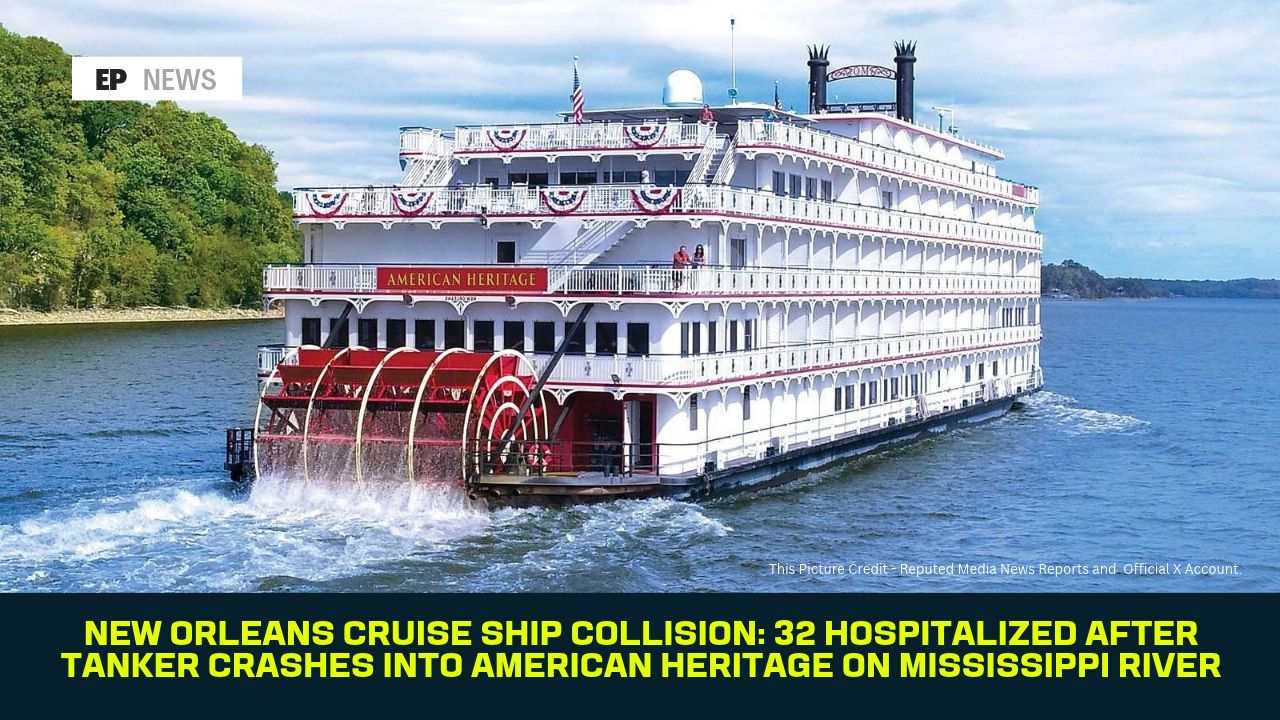
The collision involved the Atlantic Asphalt tanker and American Cruise Lines’ American Heritage, a paddlewheel-style passenger vessel that was docked near the Port of New Orleans in Louisiana.
The impact caused the American Heritage to take on water, roll onto its side and become partially submerged in the Mississippi River. Passengers and crew members were forced to evacuate as emergency responders, nearby vessels and local authorities rushed to assist people in the water.
The accident initially raised fears of a major maritime disaster because a large number of people were aboard the passenger vessel.
However, authorities later confirmed that everyone aboard had been accounted for.
New Orleans Mayor Helena Moreno said 32 people were transported to local hospitals with noncritical injuries. Officials reported no fatalities.
The incident prompted a large response involving the U.S. Coast Guard, New Orleans emergency services, harbor police, state authorities and other maritime personnel.
The National Transportation Safety Board also launched an investigative team to examine the circumstances surrounding the collision.
The accident has raised fresh questions about maritime navigation, vessel safety and emergency preparedness along one of America’s most important commercial waterways.
What Happened on the Mississippi River?
The collision occurred at approximately 12:30 p.m. local time on Friday, November 13, near the Port of New Orleans.
According to Port of New Orleans officials, the American Heritage was docked along the Mississippi River near 1350 Port of New Orleans Place when the Atlantic Asphalt tanker struck it.
The passenger vessel had reportedly arrived around two hours earlier and was preparing for passenger disembarkation.
The collision occurred while the cruise ship was stationary at the dock.
The Atlantic Asphalt tanker struck the American Heritage broadside, causing extensive damage and destabilizing the passenger vessel.
Videos and photographs from the scene showed the riverboat gradually leaning onto its side before becoming partially submerged.
Passengers wearing life jackets were seen in the water, while nearby vessels and emergency personnel worked to bring people to safety.
The incident developed rapidly, creating a challenging situation for passengers, crew members and first responders.
Because the accident occurred in a busy section of the Mississippi River, authorities also had to coordinate the emergency response while managing commercial vessel traffic.
The U.S. Coast Guard responded to the incident and temporarily closed a section of the river to allow rescue operations to continue safely.
What We Know About the Two Ships
The accident involved two different types of commercial vessels.
American Heritage River Cruise Ship
The American Heritage is operated by American Cruise Lines.
It is a paddlewheel-style river cruise vessel designed for passenger travel along American waterways, including the Mississippi River.
The ship was built in 2015 and has a reported passenger capacity of approximately 150 people.
It offers multi-day river cruises that allow travelers to explore destinations along the Mississippi River.
At the time of the collision, the vessel was reportedly carrying approximately 129 passengers, in addition to crew members, according to information provided by Port of New Orleans officials.
Other reports described the total number of passengers and crew aboard as approximately 180 to 197 people. The published figures vary, but authorities ultimately confirmed that everyone aboard was accounted for.
Atlantic Asphalt Tanker
The second vessel involved was the Atlantic Asphalt.
Unlike the passenger riverboat, the tanker is designed to transport asphalt and bitumen, materials used in road construction, roofing and other industrial applications.
The vessel is approximately 520 feet long, according to published reporting.
The tanker struck the American Heritage while navigating the Mississippi River near the Port of New Orleans.
The precise circumstances surrounding the collision remain under investigation.
How the Cruise Ship Capsized After the Collision
The impact caused the American Heritage to take on water and gradually lose stability.
Witness videos showed the passenger vessel leaning heavily to one side after the tanker struck it.
As the situation developed, passengers and crew members attempted to evacuate.
Some people entered the river, while others were assisted by emergency responders and nearby vessels.
The Mississippi River presents particular challenges during rescue operations because of its strong currents, commercial traffic and large volume of water.
The temperature of the river was reported to be approximately 66 degrees Fahrenheit during the incident.
Even when water temperatures are not extremely cold, remaining in the water for extended periods can create medical risks, particularly for older passengers and individuals who are injured.
Emergency personnel therefore needed to move people out of the water as quickly as possible.
The American Heritage eventually rolled onto its side and became largely submerged.
The vessel’s condition made it clear that the accident was not a minor collision.
However, the rapid response from nearby ships and emergency teams helped prevent the incident from becoming a mass-fatality disaster.
Rescue Operation: Everyone Was Accounted For
The rescue operation involved several agencies and maritime organizations.
The U.S. Coast Guard coordinated with local and state emergency responders to locate and assist passengers and crew members.
The New Orleans Fire Department, New Orleans Police Department, Port of New Orleans Harbor Police and emergency medical personnel were among those involved.
Nearby vessels also helped people who had entered the water.
Passengers were brought to safety and taken to the Port of New Orleans Administration Building, where officials coordinated assistance and medical evaluation.
The initial rescue phase was particularly difficult because emergency personnel had to account for everyone aboard the passenger vessel.
Authorities conducted checks and worked to establish whether anyone remained missing.
Later on Friday, Mayor Helena Moreno confirmed that all passengers and crew members had been accounted for.
Louisiana Governor Jeff Landry also praised the emergency response.
The successful rescue effort was widely described by officials as a remarkable outcome given the size of the accident and the conditions on the river.
New Orleans officials subsequently shifted their attention toward medical assistance, passenger support and the investigation.
Thirty-Two People Hospitalized With Noncritical Injuries
Although everyone aboard survived, the collision resulted in numerous injuries.
Mayor Helena Moreno said 32 people were transported to local hospitals.
Officials described the injuries as noncritical.
Reports also indicated that two harbor police officers involved in the rescue operation were among those who received hospital treatment.
Some passengers experienced bumps, bruises and other injuries during the evacuation.
The difference between being accounted for and being medically cleared is important.
Even when passengers have been rescued, healthcare professionals may need to examine individuals for injuries, exposure to river water and other complications.
Passengers who entered the water may require medical evaluation even if they initially feel well.
The available official information did not establish that every person involved suffered an injury.
The reported hospitalizations instead reflected the people who required additional medical attention following the collision and rescue operation.
No fatalities were reported in the official updates available after the accident.
Why Did the Atlantic Asphalt Hit the Cruise Ship?
One of the biggest unanswered questions concerns the cause of the collision.
New Orleans Mayor Helena Moreno said the tanker appeared to have lost control before striking the passenger vessel.
Local harbor police officials also discussed the possibility of a steering problem.
However, investigators had not established a definitive mechanical failure or other cause.
A possible loss of steering is an investigative lead, not a final finding.
There are several issues investigators may need to examine.
These include the tanker’s steering and propulsion systems, bridge communications, navigation equipment, crew actions, weather and river conditions, and the vessel’s movements before impact.
Investigators will also likely review available video recordings, vessel tracking information and witness accounts.
The Mississippi River is a busy commercial waterway where large vessels must navigate carefully.
The river’s bends, currents, changing water conditions and proximity to docks require coordination and accurate navigation.
A large tanker losing its ability to maneuver in a crowded section of the river could create serious risks for nearby vessels.
However, it would be premature to identify a specific mechanical or human cause before investigators complete their work.
NTSB Launches Investigation Into the Maritime Accident
The National Transportation Safety Board announced that it was sending an investigative team to examine the collision.
The NTSB is an independent federal agency responsible for investigating major transportation accidents in the United States.
Its work includes examining aviation, railroad, highway, marine and pipeline incidents.
In a maritime accident of this scale, investigators may examine vessel records, navigation systems, mechanical components and operational procedures.
They may also interview crew members and witnesses and analyze video footage.
The U.S. Coast Guard also has an important role in maritime safety and marine casualty investigations.
The investigation will need to establish what happened before the tanker struck the American Heritage and why the passenger vessel capsized.
One important area will be determining whether the Atlantic Asphalt experienced a steering or propulsion problem.
Investigators may also examine whether any communication or operational issues contributed to the accident.
The NTSB’s findings could help identify safety improvements and reduce the risk of similar accidents.
A final investigative report may take time, and early statements should not be treated as definitive conclusions.
Mississippi River Traffic Disrupted After the Collision
The accident also affected commercial activity along the Mississippi River.
Following the collision, the U.S. Coast Guard closed a section of the river near the accident site.
The closure covered the area around mile markers 93 to 96.
The temporary restriction was necessary to allow rescue teams and emergency vessels to operate without additional commercial traffic creating risks.
The Mississippi River is a major transportation route for the United States.
It supports the movement of agricultural products, petroleum, industrial materials, construction supplies and other commercial cargo.
Ports and shipping facilities along the river play an important role in regional and national supply chains.
Even temporary restrictions can affect vessel schedules and commercial operations.
The Regional Transit Authority also suspended cross-river ferry service as part of the emergency response.
Officials needed to balance the importance of restoring normal transportation operations with the need to protect passengers, responders and other vessels.
The Coast Guard’s closure was a safety measure connected to the immediate emergency response.
Any decision to reopen the affected section would depend on operational and safety assessments.
How American Cruise Lines Is Supporting Passengers
American Cruise Lines confirmed that its American Heritage riverboat had been involved in the collision.
The company said it was coordinating with the U.S. Coast Guard and local authorities.
It also confirmed that guests and crew members had been evacuated.
The company expressed concern for everyone affected and said it would provide additional information as it became available.
The accident created practical challenges for passengers beyond the immediate rescue.
Some people lost access to personal belongings, including phones, identification documents, keys and luggage.
Passengers who were traveling from other states also needed assistance with accommodation and return transportation.
Local officials and the cruise line worked to arrange hotel accommodations for affected travelers.
These arrangements were particularly important because the cruise had been disrupted and the passenger vessel was no longer capable of continuing its scheduled journey.
The company will also need to coordinate with passengers regarding travel arrangements, personal belongings and other post-incident support.
Travelers affected by the accident should communicate directly with the cruise line for official information about refunds, replacement travel arrangements and claims.
What Does the Accident Mean for Mississippi River Maritime Safety?
The collision has highlighted the importance of safety standards for commercial vessels operating on heavily used waterways.
The Mississippi River supports an enormous amount of commercial transportation.
Large tankers, cargo vessels, passenger boats, tugboats and other commercial ships regularly operate in the same general network.
Each vessel must follow applicable navigation requirements and maintain appropriate safety systems.
For passenger ships, evacuation procedures are particularly important.
Cruise operators must prepare for emergencies that could require passengers to leave a vessel quickly.
Life jackets, trained crew members, emergency communication systems and coordinated evacuation procedures can make a significant difference during an accident.
The New Orleans collision also demonstrates the importance of cooperation between commercial vessels and emergency responders.
Nearby ships that assist people in distress can become an important part of the rescue operation.
The investigation may identify additional safety recommendations for vessels navigating near passenger docks and commercial port facilities.
It may also examine whether existing emergency procedures performed as expected during the accident.
Any recommendations will depend on the findings of the investigation.
What Passengers Should Know About River Cruise Safety
The New Orleans accident may cause some travelers to reconsider the safety of river cruises.
However, one accident should not be interpreted as proof that all river cruise travel is unsafe.
Commercial passenger vessels operate under federal maritime regulations and applicable safety requirements.
Passengers can take several practical steps before and during a cruise.
Pay attention to safety briefings. Passengers should understand emergency instructions and evacuation procedures.
Locate life jackets. Travelers should know where safety equipment is stored and how it is used.
Follow crew instructions. During an emergency, passengers should follow instructions from trained crew members and emergency personnel.
Keep important documents accessible. Identification, emergency contacts and essential medication should be easy to access.
Understand evacuation routes. Knowing how to reach an emergency exit can save valuable time.
These precautions do not eliminate every risk, but they can help passengers respond more effectively during unexpected situations.
Frequently Asked Questions
1. What happened in the New Orleans cruise ship accident?
A tanker called Atlantic Asphalt struck the docked American Heritage river cruise ship on the Mississippi River near the Port of New Orleans on November 13, 2026. The passenger vessel took on water and capsized.
2. How many people were injured?
Mayor Helena Moreno reported that 32 people were transported to hospitals. Their injuries were described as noncritical.
3. Were there any fatalities?
No fatalities were reported. Officials confirmed that everyone aboard the passenger vessel had been accounted for.
4. How many passengers were aboard the American Heritage?
Port officials initially reported approximately 129 passengers, in addition to crew members. Other later reports gave higher total figures for passengers and crew. Everyone aboard was ultimately accounted for.
5. What caused the tanker to hit the cruise ship?
The exact cause remains under investigation. Officials discussed a possible loss of control or steering problem, but no definitive cause had been established.
6. Which agencies are investigating the accident?
The U.S. Coast Guard is involved in the maritime response and investigation. The National Transportation Safety Board has also launched an investigative team.
7. Is the Mississippi River open after the collision?
The Coast Guard initially closed a section between mile markers 93 and 96 for rescue operations. Travelers and commercial operators should check current Coast Guard and Port of New Orleans notices for the latest navigation status.
8. What happened to the passengers after the rescue?
Passengers received assistance at the Port of New Orleans facility. Hotel accommodations and travel support were arranged for affected travelers.
9. Is the American Heritage still operating?
The vessel was severely damaged and capsized during the accident. Its return to commercial passenger service would depend on recovery, inspection, repairs and applicable safety approvals.
10. When will investigators release the cause of the accident?
Investigators have not announced a final cause. The NTSB and Coast Guard will need to examine evidence before reaching conclusions.
Conclusion: A Major Maritime Accident Ends Without Loss of Life
The collision between the Atlantic Asphalt tanker and American Heritage on the Mississippi River was a serious maritime accident that could have resulted in a much greater tragedy.
The passenger vessel was struck while docked near the Port of New Orleans, took on water and eventually rolled onto its side.
The emergency response involved federal, state and local agencies, as well as nearby vessels that helped rescue people from the river.
The confirmation that everyone aboard was accounted for and that no fatalities occurred was the most important development following the accident.
However, the hospitalization of 32 people and the extensive damage to the passenger vessel demonstrate the seriousness of the incident.
The next major priority is determining exactly why the collision happened.
The National Transportation Safety Board and Coast Guard investigations will be important in establishing whether mechanical problems, navigation difficulties, human decisions or other factors contributed to the accident.
For the maritime industry, the incident is a reminder that even a vessel docked at a port can face significant risks from nearby commercial traffic.
For passengers, it highlights the importance of emergency preparedness and effective evacuation procedures.
As investigators examine the evidence, the New Orleans collision may provide important lessons for passenger vessel operators, tanker crews, port authorities and maritime safety regulators throughout the United States.
The successful rescue operation prevented a devastating loss of life. Ensuring that similar accidents are prevented in the future will now be the most important responsibility for the authorities involved.
Sources and Reporting References
- Associated Press – All passengers and crew on New Orleans cruise ship survive crash with tanker on Mississippi River.
- Reuters – Freighter collides with cruise ship in New Orleans, passengers in the water.
- CBS News/AP – River cruise ship and tanker crash on Mississippi River in New Orleans; passengers rescued.
- The Associated Press reporting carried by WWNO – Tanker strikes paddlewheel cruise ship in New Orleans; 32 injured, no passengers missing.
- U.S. Coast Guard – Official response information reported by local and national media.
- National Transportation Safety Board – Investigation announced November 13, 2026.
Editorial Disclosure: This article is independently written using published reporting. The collision’s cause has not been established. Early reports about a possible steering failure are treated as an investigative possibility, not a confirmed finding. Passenger and crew totals differ across reports; the article distinguishes the Port’s initial passenger count from later total-occupant estimates.