
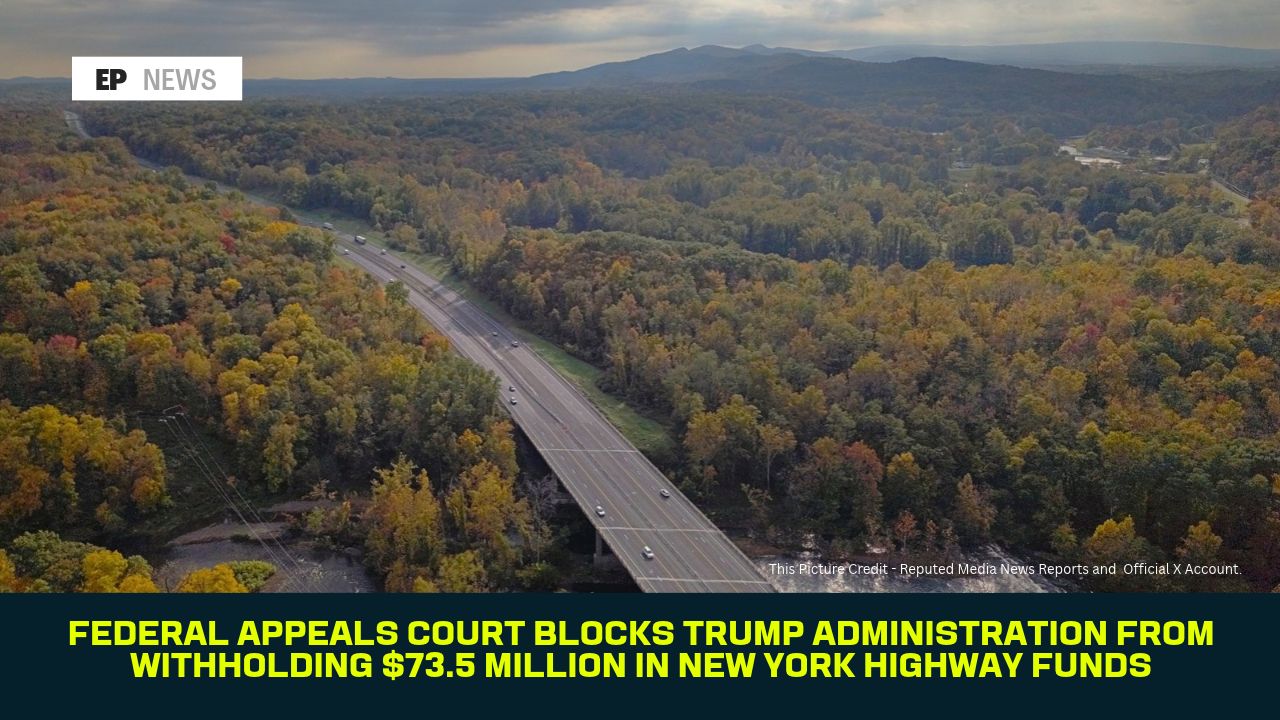
Federal Appeals Court Blocks Trump Administration From Withholding $73.5 Million in New York Highway Funds
Category: U.S. Politics / Government / Legal News
Federal Appeals Court Rules Against Trump Administration in New York Funding Dispute
A major legal dispute between the Trump administration and New York reached an important turning point on Friday, November 13, after a federal appeals court ruled that the federal government exceeded its authority when it withheld $73.5 million in highway funding from the state.
The decision by the U.S. Court of Appeals for the Second Circuit represents a significant setback for the administration’s attempt to enforce its interpretation of federal commercial driver’s license requirements through transportation funding penalties.
The dispute began after the U.S. Department of Transportation (USDOT) challenged New York’s handling of certain commercial driver’s licenses issued to noncitizens. Federal officials argued that the state was not following federal requirements concerning how long these licenses could remain valid.
New York rejected the federal government’s position and challenged the funding penalty in court.
The appeals court ultimately sided with New York, finding that the transportation department had relied on a regulatory requirement that did not exist in the applicable federal rules at the relevant time.
The ruling is important not only because of the $73.5 million involved but also because it addresses the limits of federal agency authority when imposing financial penalties on states.
According to Reuters, the court found that the Transportation Department’s decision exceeded its legal authority and failed to follow the principles of fair notice and the applicable regulatory language.
Why Did the Trump Administration Withhold $73.5 Million?
The disagreement centered on commercial driver’s licenses, commonly known as CDLs.
These licenses are required for people operating certain commercial vehicles, including large trucks, buses and other vehicles used to transport passengers or goods.
Commercial transportation plays a major role in the American economy. Truck drivers move products between states, support retail supply chains and help businesses maintain regular deliveries.
Because commercial vehicles operate across state borders, federal regulations establish minimum standards that states must follow when issuing commercial driver’s licenses.
The Federal Motor Carrier Safety Administration (FMCSA), an agency within the Department of Transportation, oversees important aspects of these federal standards.
In 2026, federal transportation officials reviewed New York’s licensing practices and concluded that the state was not complying with their interpretation of the rules governing certain non-domiciled commercial driver’s licenses.
The federal government argued that New York should match the expiration dates of these licenses with the expiration dates of the documents establishing the driver’s lawful presence in the United States.
New York disagreed with that interpretation.
Following the dispute, the Transportation Department issued a final determination in April 2026 and announced that it would withhold four percent of the state’s federal-aid highway funding for fiscal year 2027.
The financial penalty amounted to approximately $73.5 million.
The federal government also warned that continued noncompliance could lead to a larger funding penalty in a subsequent year.
New York challenged the determination, arguing that the federal government was attempting to enforce a requirement that was not clearly established in the regulations applicable during the relevant period.
What Did the Second Circuit Court Decide?
The U.S. Court of Appeals for the Second Circuit issued its decision on November 13, 2026, in the case involving the State of New York and the U.S. Department of Transportation.
The case number was 26-1097.
The court examined whether the Federal Motor Carrier Safety Administration had acted lawfully when it determined that New York was substantially noncompliant with federal commercial driver’s license regulations.
The judges concluded that the agency’s determination could not stand.
A central issue was whether the federal regulations in force during the relevant period actually required states to match the expiration dates of non-domiciled commercial driver’s licenses with the expiration dates of the documents used to establish lawful presence.
The court found that the applicable regulatory text did not contain such an expiration-matching requirement.
The agency’s own position during the litigation also acknowledged that the plain text of the regulations did not expressly establish that requirement.
As a result, the court granted New York’s petition for review and set aside the agency’s final determination.
The ruling means the challenged funding penalty cannot stand on the legal basis used by the agency in that determination.
Importantly, the court did not rule that every commercial driver’s license issued by New York was valid under every applicable law. Instead, it addressed the specific regulatory interpretation that formed the basis of the federal funding penalty.
This distinction is important for understanding the actual scope of the decision.
Why the Court Focused on Federal Regulatory Authority
The ruling highlights an important principle of American administrative law: federal agencies must act within the authority granted to them by Congress and must follow the regulations that apply to their decisions.
Government agencies can enforce federal requirements, investigate violations and impose certain penalties when the law authorizes them to do so.
However, an agency cannot simply create a new obligation through enforcement and then punish a state for failing to follow that obligation as though it had always existed.
In this case, the Second Circuit examined the language and structure of the relevant commercial driver’s license regulations.
The court concluded that the agency’s interpretation went beyond what those regulations required at the time.
The judges also raised concerns about fair notice.
Fair notice is an important legal principle because states, businesses and individuals should be able to understand the rules they are expected to follow.
If an agency changes its interpretation of a regulation, it must respect the legal requirements governing that change.
The court’s reasoning therefore focused on the legality of the federal agency’s action rather than making a broader political judgment about the Trump administration or New York’s immigration policies.
The decision also recognized that the federal government could pursue new requirements through the appropriate rulemaking process.
That means the ruling should not be interpreted as preventing federal regulators from introducing lawful licensing standards in the future.
What Was New York’s Argument?
New York challenged the federal government’s decision after the Department of Transportation announced the funding penalty.
The state argued that the federal agency had applied an interpretation that was not supported by the regulations in force when the licensing decisions were made.
The dispute concerned non-domiciled commercial driver’s licenses issued to eligible individuals who were not domiciled in the United States but met the applicable federal and state licensing conditions.
New York’s licensing system generally used standard validity periods for certain licenses, including five years following initial issuance and eight years following renewal.
Federal transportation officials argued that the state should instead match the license expiration dates to the expiration dates on the relevant lawful-presence documentation.
New York maintained that the existing regulations did not clearly impose that requirement.
The state also raised concerns about the potential consequences of revoking affected licenses.
Commercial drivers are important to multiple sectors of the economy, including transportation, logistics, manufacturing, agriculture and public transportation.
New York argued that widespread license revocations could disrupt industries that depend on commercial drivers.
The state also warned that potential shortages of qualified bus drivers could affect schools and families.
These arguments formed part of the broader dispute over how federal licensing standards should be interpreted and enforced.
Could the Decision Affect New York’s Transportation Projects?
The $73.5 million funding dispute is important because federal highway assistance supports transportation infrastructure across New York.
Federal-aid highway funding helps states support eligible transportation projects, including road improvements, infrastructure maintenance and other federally supported highway activities.
A reduction in federal assistance can create additional financial pressure on state transportation budgets.
New York argued that withholding the money would put residents at risk and could affect transportation-related services.
The appeals court’s decision removes the specific federal funding penalty challenged in this case.
However, it would be inaccurate to assume that every transportation project in New York will immediately receive additional money or that all infrastructure funding questions have been resolved.
The ruling addresses the legal validity of the agency’s final determination.
The actual administration of federal funding, including any necessary financial adjustments, remains a separate implementation matter.
State transportation officials and federal agencies will need to address the consequences of the court’s decision through the appropriate administrative processes.
Why the $147 Million Warning Matters
Another important part of the dispute involves the possibility of additional federal funding penalties.
According to Reuters, the Transportation Department had warned that continued noncompliance could result in an additional annual withholding of approximately $147 million.
The court opinion explains that the initial penalty represented four percent of New York’s federal-aid highway funding for fiscal year 2027.
A subsequent withholding could reach eight percent if the state continued to be found substantially noncompliant.
The distinction between the two amounts is important.
The $73.5 million was the funding penalty imposed in the challenged determination.
The approximately $147 million represented a potential future penalty, not money that had already been withheld under that same determination.
The November 13 ruling set aside the challenged final determination.
Therefore, the larger amount should not be described as an additional confirmed loss for New York.
The case also demonstrates how significant financial consequences can arise when federal agencies and state governments disagree about regulatory requirements.
A Wider Pattern of Legal Disputes Between Washington and States
The New York highway funding case is part of a broader pattern of legal disagreements involving federal transportation funding.
Several states and local governments have challenged decisions by the Trump administration concerning transportation projects and federal financial assistance.
Reuters has reported on other disputes involving the Hudson Tunnel rail project connecting New York and New Jersey, New York City’s congestion pricing program and federal funding for rail projects in Chicago.
In the Hudson Tunnel dispute, a court required the federal government to continue making payments for the major rail project.
In another case, a court blocked federal efforts to stop New York City’s congestion pricing program.
Separately, a judge ordered the Transportation Department to unfreeze approximately $3 billion in funding for Chicago rail projects after a dispute involving previously approved federal grants.
These cases involve different legal questions and should not be treated as identical.
Nevertheless, they illustrate the growing importance of judicial review when state and federal governments disagree over the use of transportation funding.
For states, federal grants can be essential to long-term infrastructure planning.
For federal agencies, ensuring that public money is distributed according to applicable laws and regulations remains a major responsibility.
The courts play an important role in resolving disputes over whether those responsibilities have been exercised lawfully.
What Happens Next After the Court Ruling?
The November 13 decision establishes an important legal outcome, but several practical questions remain.
Federal transportation officials must determine how to respond to the ruling and address the consequences for the funding determination.
New York, meanwhile, will need to work through the relevant federal funding procedures.
The ruling does not eliminate the federal government’s ability to regulate commercial driver’s licenses.
It also does not prevent the Transportation Department from pursuing new requirements through lawful regulatory procedures.
However, any future enforcement action must comply with the governing statutes and regulations.
The court’s decision sends a clear message that federal agencies must provide a valid legal basis before imposing significant financial penalties on states.
Further developments may include administrative implementation, additional statements from government officials or other legal proceedings.
Reuters reported that representatives for Transportation Secretary Sean Duffy and New York Governor Kathy Hochul had not immediately commented following the decision.
The next significant development will be how the federal government and New York handle the funding consequences of the ruling.
What This Means for American Drivers and Businesses
Although the legal dispute directly involved the state government and federal transportation officials, it also has implications for the wider transportation industry.
Commercial drivers play a central role in the movement of goods throughout the United States.
Trucking companies, freight operators, manufacturers and retailers depend on a reliable supply of qualified drivers.
Licensing requirements help establish minimum standards for operating commercial vehicles.
At the same time, uncertainty surrounding licensing rules can create operational challenges for drivers and employers.
Businesses need clear requirements to make hiring decisions, maintain compliance and plan their transportation operations.
The court’s decision does not remove federal licensing standards or automatically change the status of individual drivers.
Instead, it clarifies that the particular funding penalty imposed on New York was not legally supported by the regulations applicable to that determination.
For transportation businesses, the broader lesson is that licensing requirements and enforcement policies must be clearly established and consistently applied.
Frequently Asked Questions
1. Why did a federal court rule against the Trump administration?
The Second Circuit found that the Department of Transportation exceeded its legal authority when it withheld funding based on an expiration-matching requirement that was not contained in the applicable regulations.
2. How much highway funding was involved?
The disputed amount was approximately $73.5 million, representing four percent of New York’s federal-aid highway funding for fiscal year 2027.
3. Which court issued the decision?
The U.S. Court of Appeals for the Second Circuit issued the decision on November 13, 2026.
4. What was the dispute about?
The dispute concerned federal requirements governing the expiration dates of certain non-domiciled commercial driver’s licenses issued by New York.
5. Did the court eliminate federal commercial driver’s license requirements?
No. The decision addressed a specific regulatory interpretation used to justify the funding penalty. Federal and state licensing requirements remain applicable.
6. Could New York have faced another $147 million penalty?
The federal government had warned of a possible future withholding of approximately $147 million annually if noncompliance continued. This was a potential future penalty, not an additional confirmed withholding under the challenged determination.
7. Does the ruling mean all affected commercial driver’s licenses are valid?
No. The court did not determine the validity of every individual license. It ruled that the specific agency determination used to impose the highway funding penalty could not stand.
8. Can the federal government introduce new licensing requirements?
Yes. The court recognized that the agency could pursue new requirements through the appropriate rulemaking process, subject to applicable law.
Conclusion: A Significant Legal Setback for the Trump Administration
The November 13 appeals court ruling marks an important development in the ongoing legal relationship between the Trump administration and New York.
By setting aside the decision to withhold $73.5 million in federal highway funding, the Second Circuit reinforced the principle that federal agencies must operate within the authority provided by existing laws and regulations.
The dispute began with disagreements over commercial driver’s license expiration dates but developed into a larger question about the limits of federal regulatory power.
For New York, the ruling removes the legal basis for the challenged funding penalty. For the Trump administration, it represents a setback in its effort to enforce its interpretation of commercial driver’s license requirements through transportation funding restrictions.
The case also carries a wider message for state governments, federal agencies and businesses that depend on clear regulatory standards.
Federal authorities can establish and enforce transportation rules, but those rules must have a lawful foundation.
As the government responds to the decision, attention will turn toward the practical handling of the disputed funds and any future regulatory changes.
For now, the court’s November 13 decision is a significant reminder that federal funding decisions remain subject to judicial review and that government agencies must follow the law when imposing financial penalties on states.
Sources and Reporting References
- Reuters – Appeals court rules against Trump administration on New York highway funds, November 13, 2026.
- U.S. Court of Appeals for the Second Circuit – State of New York et al. v. U.S. Department of Transportation et al., Case No. 26-1097, decided November 13, 2026.
Editorial Disclosure: This article is an independently written news explainer based on published reporting and the court’s decision. It distinguishes the court’s legal findings from the arguments made by the federal government and New York. No unverified government response or funding transfer is presented as confirmed.