
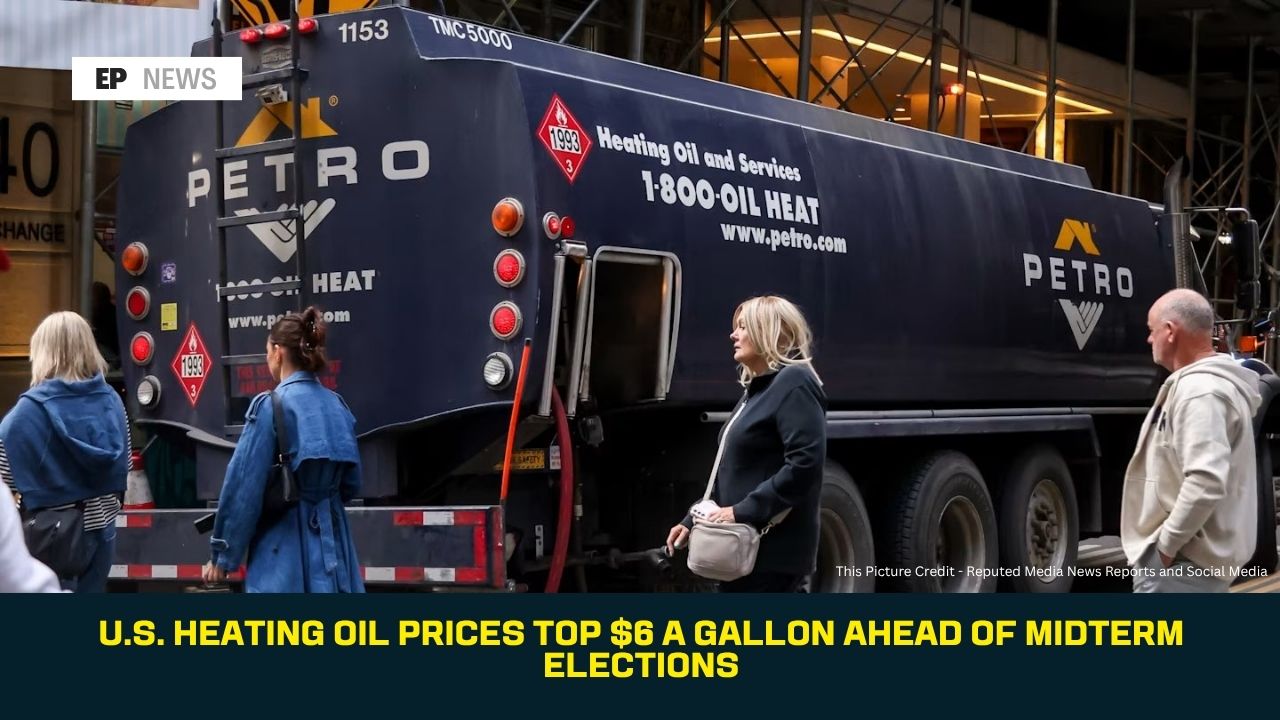
U.S. Heating Oil Prices Top $6 a Gallon, Creating New Challenge for Republicans Ahead of Midterms
WASHINGTON, October 25, 2026 — Rising home-heating costs are becoming a growing economic and political concern in the United States as winter approaches, with heating oil prices climbing above $6 per gallon nationally and putting additional pressure on household budgets.
A Reuters report published on October 24 found that higher fuel costs are emerging as an important issue in competitive U.S. Senate races in New Hampshire, Maine and Alaska ahead of the November 3 midterm elections. The price increases are particularly significant in these northern states, where many households depend on heating oil to keep their homes warm during colder months.
According to the U.S. Energy Information Administration, the national price of heating oil has risen from approximately $3.50 per gallon a year earlier to more than $6. The increase comes amid disruptions to global fuel supplies associated with the U.S. war with Iran, which has affected diesel supplies and increased costs across parts of the energy market.
The higher bills are placing pressure on families, fishermen, farmers and residents of remote communities. Democrats have criticized the Trump administration over rising energy costs, while Republicans have pointed to measures intended to ease supply pressures and assist affected households.
The issue illustrates how international conflicts and energy-market disruptions can affect everyday expenses in the United States. It also creates a challenge for lawmakers campaigning on affordability as voters prepare to choose members of Congress.
Why Are Heating Oil Prices Rising in the United States?
Heating oil is an important source of home heating in parts of the northeastern United States and in some remote communities in Alaska. Its price is influenced by crude oil markets, refining capacity, transportation costs, seasonal demand and the availability of related fuels such as diesel.
Reuters reported that heating oil prices have risen sharply as global diesel supplies have been disrupted by the U.S. war with Iran. Diesel and heating oil are closely related petroleum products, meaning changes in the diesel market can affect the cost of heating fuel.
The national heating oil price has climbed above $6 per gallon, compared with about $3.50 a year earlier, according to the Energy Information Administration figures cited by Reuters.
For households that depend on heating oil, the increase can translate into significantly higher costs over the course of winter. Families that use oil as their primary heating source may have limited options to avoid the expense, particularly when temperatures fall and heating becomes essential.
The impact can be especially severe for people living in older homes, rural areas or remote communities where alternative heating systems and fuel-delivery options may be limited.
However, prices are not identical across the country. Local costs can vary depending on delivery distances, regional supply conditions, storage capacity and transportation infrastructure.
How Rising Heating Costs Affect American Families
Heating is a basic household need, and higher fuel prices can force families to make difficult financial decisions.
When the cost of heating oil rises, households may have less money available for groceries, medical expenses, transportation, rent or mortgage payments. The effect can be especially difficult for older adults, low-income families and residents whose homes require substantial amounts of fuel to maintain comfortable temperatures.
Some households may try to reduce heating consumption, delay other purchases or use alternative heating methods. But switching fuels is not always practical or affordable, especially when a home has an oil-based heating system.
The consequences can extend beyond winter utility bills. Higher fuel costs can also increase operating expenses for businesses that rely on diesel-powered equipment or transportation.
Fishermen and farmers, for example, may face higher fuel costs for equipment, vehicles and other operations. Businesses can pass some of those expenses to customers, potentially adding to the price of goods and services.
These effects help explain why energy prices have become a prominent issue in the current election campaign.
New Hampshire: Heating Oil Becomes an Election Issue
New Hampshire is one of the states where heating oil prices are attracting particular attention.
Reuters reported that approximately 43% of New Hampshire residents use heating oil. That dependence makes the price of fuel an important consideration for households preparing for winter.
The report highlighted Rick Russman, an 80-year-old resident of Kingston, New Hampshire, who said the rising price of heating oil had become a major financial burden. He plans to rely more heavily on a wood stove rather than heating oil alone this winter.
Russman also said he intended to vote for Democratic candidate Chris Pappas over Republican John Sununu in the state’s closely watched Senate race.
His experience illustrates how household expenses can influence voters’ perceptions of the economy and the performance of elected officials. It does not, however, establish how other voters will decide or predict the outcome of the race.
Pappas has made energy costs a central campaign concern, according to Reuters. Sununu’s campaign did not respond to several requests for comment at the time of the report.
The race is part of a wider national contest in which control of the Senate could have major consequences for the administration’s legislative agenda.
Alaska: Remote Communities Face Even Higher Fuel Costs
The situation is particularly difficult in some remote Alaskan communities, where fuel must travel long distances before reaching households and businesses.
Reuters reported that roughly 30% of Alaska residents rely on heating oil. In the Yukon River community of St. Mary’s, Mayor Sven Paukan said heating fuel had risen to about $10 per gallon, approximately $2 more than a year earlier.
In remote areas, fuel costs affect more than home heating. Diesel is also used to generate electricity and power transportation, meaning higher prices can increase the cost of other essential services and consumer goods.
The high cost of transporting fuel to isolated communities adds another layer of financial pressure. When transportation expenses rise, residents may face higher prices for a range of products, not just heating oil.
Alaska’s Senate race between Republican incumbent Dan Sullivan and Democratic challenger Mary Peltola has therefore become another arena for debate over energy affordability.
Sullivan has supported a temporary pause on American diesel exports, a policy President Donald Trump has considered, according to Reuters. A spokesperson for Peltola’s campaign linked higher heating fuel, gasoline and grocery costs to the war with Iran.
The debate reflects a broader policy question: whether domestic supply measures can provide meaningful relief to consumers when international markets are under pressure.
Maine: Families, Fishermen and Farmers Feel the Pressure
Maine is another state where rising heating oil prices could influence voters ahead of Election Day.
Reuters reported that approximately 54% of homes in Maine use heating oil. The state also has fishing and farming communities whose members depend on diesel for equipment and transportation.
Higher fuel costs can therefore affect households and businesses at the same time. Residents may face larger heating bills while fishermen and farmers pay more to operate equipment and transport products.
Mark Brewer, chair of the political science department at the University of Maine, told Reuters that the impact can be particularly difficult for people with lower incomes who already face high energy expenses.
The Senate contest between Republican incumbent Susan Collins and Democratic challenger Troy Jackson has featured the cost of living as a major issue.
Collins has supported assistance for low-income households and urged the administration to use the heating oil reserve. Reuters also reported that she pushed for the release of federal heating assistance funds for Maine.
Some voters remain supportive of Collins because of her seniority and influence in the Senate. Others say the administration’s energy policies and the war with Iran have contributed to higher costs.
The issue demonstrates that voters may consider both the immediate cost of living and their assessment of individual candidates’ ability to secure assistance for their states.
What Is the Trump Administration Doing About Fuel Costs?
The Trump administration has faced criticism over rising energy prices, particularly from voters who connect higher fuel costs to the war with Iran and disruptions to global oil supplies.
Reuters reported that the U.S. Energy Department released heating oil from reserves in the Northeast in an effort to address supply pressures.
When asked about the political impact of rising heating oil costs, the White House pointed to that release. An analyst cited by Reuters said the move was unlikely to have a major effect on prices.
The administration’s response highlights the difficulty of reducing consumer energy costs when global markets are experiencing significant disruptions.
Releasing fuel from reserves may help make additional supplies available, but the effect on prices depends on the volume released, the pace of delivery, local demand and conditions in the wider energy market.
Other proposals, including changes to fuel exports, could also influence domestic supply. Their actual effects would depend on implementation and the response of producers, distributors and consumers.
For households preparing for winter, the immediate concern remains whether heating fuel will be available at a price they can afford.
Why Heating Oil Prices Matter in the Midterm Elections
The November 3 midterm elections will determine control of Congress and influence the remainder of President Donald Trump’s term.
Economic conditions are often important to voters in midterm elections, particularly when households are struggling with everyday expenses. Fuel prices can become politically significant because they affect both direct heating costs and the cost of transporting goods.
The Senate races in New Hampshire, Maine and Alaska are especially relevant because all three states have substantial populations that depend on heating oil, and each has a competitive contest.
Democratic candidates have argued that the administration’s policies and the war with Iran have contributed to rising costs. Republicans face the challenge of responding to those concerns while highlighting their own proposals and actions.
Reuters reported that nearly 80% of Americans blamed Trump administration policies for higher costs, including energy, in an October Reuters/Ipsos poll. That finding reflects reported public opinion, not proof that any single policy accounts for the entire increase in heating oil prices.
Energy markets are affected by multiple factors, including global supply disruptions, refining and distribution costs, weather and regional demand. Political arguments about responsibility should therefore be distinguished from the underlying market data.
The election results may show how voters weigh household affordability alongside other issues when deciding which candidates to support.
Could Heating Oil Prices Increase Other Household Expenses?
Higher heating oil prices can affect household budgets directly, but the economic consequences may extend further.
Diesel is widely used in freight transportation, agriculture, construction and other industries. When diesel becomes more expensive, businesses may face higher costs to move products, operate machinery or deliver supplies.
Some businesses absorb those costs, while others pass part of them to customers. As a result, fuel-price increases can contribute to higher prices for groceries and other consumer goods.
The size and timing of these effects vary. Not every increase in fuel costs translates immediately into higher retail prices, and other factors can influence what consumers pay.
Nevertheless, households already facing high costs for food, housing and transportation may find it increasingly difficult to manage another essential expense.
For families using heating oil, the winter season can make the issue especially urgent because heating demand generally rises as temperatures fall.
What Should Consumers Watch Before Winter?
Consumers preparing for colder weather can monitor local fuel prices, compare delivery quotes where possible and check whether they qualify for energy-assistance programs.
The Low Income Home Energy Assistance Program, known as LIHEAP, is a federal program that helps eligible households with energy expenses through state and local agencies. Eligibility rules, funding availability and application procedures vary by location.
Residents should consult official state agencies or local program administrators to determine what assistance is available. They should not assume that funding is automatic or that every household qualifies.
Where practical, households may also consider reducing heat loss through weatherstripping, sealing drafts and maintaining heating equipment. These measures cannot eliminate the impact of high fuel prices, but they may help some households reduce energy use.
Any decision to switch heating systems should account for installation costs, safety requirements and local conditions. For many families, replacing an existing heating system is not an immediate or affordable option.
What Happens Next?
The immediate outlook for heating oil prices will depend on global fuel supplies, regional distribution and demand as winter approaches.
The political impact will also become clearer as candidates campaign in the final days before the November 3 election. Voters in New Hampshire, Maine and Alaska will be weighing fuel costs alongside other concerns, including healthcare, employment, housing and national security.
Government fuel releases and potential policy changes may affect supply, but their impact on retail prices remains uncertain.
For now, the rise in heating oil costs highlights the connection between global events and household finances. The issue is both an economic concern for families preparing for winter and a political challenge for candidates seeking support in competitive Senate races.
Frequently Asked Questions
1. How much does heating oil cost in the United States?
Heating oil prices had risen above $6 per gallon nationally, compared with approximately $3.50 a year earlier, according to Energy Information Administration figures cited by Reuters on October 24, 2026.
2. Why are heating oil prices rising?
Reuters linked the increase to disruptions in global diesel supplies associated with the U.S. war with Iran. Regional supply conditions, transportation costs and seasonal demand can also influence local prices.
3. Which states are particularly affected?
New Hampshire, Maine and Alaska are highlighted in Reuters’ reporting because many households in those states rely on heating oil, and each has a competitive Senate race ahead of the midterms.
4. How many homes use heating oil in Maine?
Reuters reported that approximately 54% of homes in Maine use heating oil.
5. What is happening with heating oil in Alaska?
Some remote communities face particularly high costs because fuel must be transported over long distances. Reuters reported that heating fuel in St. Mary’s had reached about $10 per gallon.
6. Is the Trump administration releasing fuel reserves?
Reuters reported that the Energy Department released heating oil from reserves in the Northeast. The effect on retail prices remains uncertain.
7. Could rising heating oil prices affect the November midterm elections?
They could influence voter concerns about affordability, especially in states where heating oil is widely used. However, the impact on election results cannot be predicted with certainty.
8. Where can eligible households seek help with heating bills?
Households can check the federal LIHEAP program through official state or local administrators to learn about eligibility, available assistance and application requirements.
Conclusion
Rising heating oil prices are creating an additional financial challenge for American households as winter approaches. With national prices above $6 per gallon and some remote communities facing considerably higher costs, families are preparing for a season that could place further pressure on already stretched budgets.
The issue has also become politically important in New Hampshire, Maine and Alaska, where competitive Senate races are approaching. Government assistance and fuel-reserve measures may help, but the ultimate effect on household bills will depend on global supply conditions and local fuel markets.
As voters prepare for the November 3 midterms, heating affordability is likely to remain part of the wider debate over economic policy and the cost of living.