
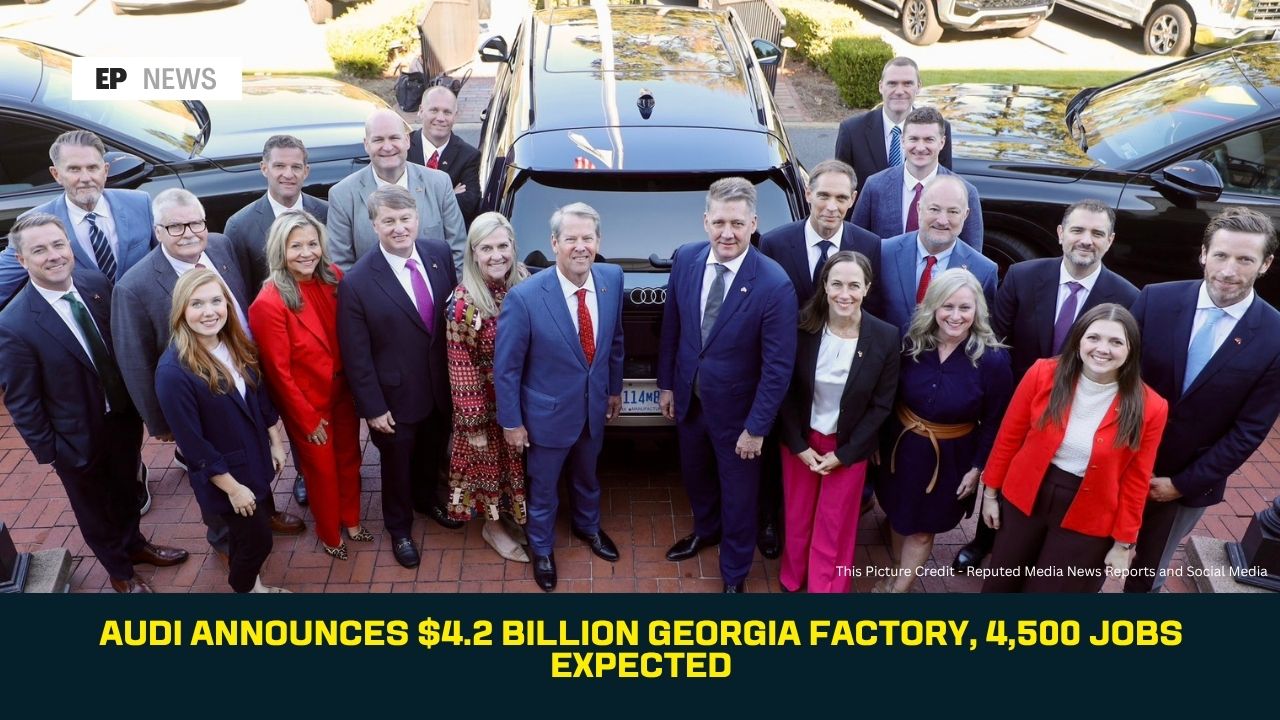
Audi Announces $4.2 Billion Georgia Factory, Projected to Create 4,500 Jobs
PERRY, Georgia — October 25, 2026: German luxury automaker Audi plans to invest $4.2 billion in a new automobile factory near Macon, Georgia, in a major proposed manufacturing project announced by President Donald Trump at a campaign rally on Saturday.
The facility is expected to produce approximately 200,000 vehicles annually, focusing on Audi’s largest and most premium sport utility vehicles (SUVs). According to the Associated Press, Audi says the project could create around 4,500 jobs, with construction scheduled to begin in 2027 and production expected to start in the early 2030s.
The announcement brings fresh attention to Georgia’s role in the U.S. automotive industry and the broader debate over American manufacturing, tariffs and foreign investment. Trump presented the proposed factory as evidence that his trade policies are encouraging international companies to expand production in the United States.
Audi Chairman of the Board of Management Gernot Döllner, who appeared alongside Trump at the rally, described the investment as a long-term commitment to the American market.
The project remains a future investment plan rather than an operating factory. Its expected employment, production capacity and opening timeline will depend on implementation over the coming years.
What Audi Announced in Georgia
President Trump announced the proposed factory at a campaign rally in Perry, Georgia, on Saturday, October 24. The plant is planned for the Macon area and would be Audi’s first manufacturing facility in Georgia.
Audi, the German luxury vehicle brand owned by Volkswagen Group, intends to focus production on its largest and most premium SUVs. The planned annual capacity of approximately 200,000 vehicles would make the facility a substantial addition to the company’s U.S. manufacturing footprint if the project proceeds as announced.
The $4.2 billion investment represents a significant commitment to a state that has become increasingly important to the American automotive and mobility sectors.
However, the announced investment should not be confused with immediate spending or jobs already created. The construction phase is scheduled to begin in 2027, while vehicle production is expected to start in the early 2030s.
That timeline means the project’s direct effect on employment and factory output will unfold gradually. Construction activity may create opportunities before the plant opens, while permanent factory positions would be associated with the facility’s eventual operations.
The company has not yet begun producing vehicles at the proposed location.
How Many Jobs Could the Audi Factory Create?
Audi has said the proposed plant could create approximately 4,500 jobs, according to AP reporting. That figure is one of the most closely watched elements of the announcement because major manufacturing projects can affect employment beyond the factory itself.
A new automotive facility can require workers for construction, equipment installation, manufacturing operations, maintenance, logistics and administrative functions. It can also generate demand for outside suppliers, transportation companies and other businesses that support industrial production.
Nevertheless, the 4,500-job figure should be treated as the company’s projected employment impact rather than a count of positions already available.
The final number of jobs will depend on how the project develops, the factory’s operating model, production requirements and the schedule for bringing the facility online. Details about hiring dates, individual roles, wages, training programs and application procedures were not fully provided in the initial announcement.
People seeking employment should therefore wait for official recruitment information from Audi rather than assume applications are already open.
Potential Opportunities for Georgia Workers
If the project proceeds as planned, the factory could create opportunities for workers with experience in automotive manufacturing, industrial maintenance, quality control, supply-chain management and production technology.
Manufacturing plants also typically need employees in areas such as safety, inventory management, engineering, equipment repair and facility operations.
The precise mix of jobs at Audi’s proposed Georgia site remains to be confirmed. Prospective applicants should look for official company announcements as construction advances and hiring plans become clearer.
Possible Effects on Local Businesses
Large industrial investments can support local businesses by increasing demand for housing, transport, food services, construction materials and professional services.
Suppliers may also consider establishing or expanding operations near a new factory to reduce delivery times and improve coordination with production schedules.
These are potential economic effects, not guaranteed outcomes. Their scale will depend on how much of the project’s supply chain is located in Georgia, how many workers are hired locally and how the regional economy responds.
Why Georgia Matters to the Automotive Industry
Georgia has become an important location for automotive manufacturing, logistics and electric-vehicle-related investment. Its transportation connections, industrial sites and access to major markets can make it attractive to companies considering U.S. production.
A major factory near Macon could add to that industrial base and strengthen the region’s position in the automotive supply chain.
The project’s potential significance extends beyond the plant itself. If suppliers and supporting businesses expand nearby, the investment could help create a broader manufacturing network.
However, the long lead time between the announced investment and expected production means the economic effects will not appear all at once. Construction is scheduled to begin in 2027, and production is not expected until the early 2030s.
Local governments, workers and businesses will likely be watching for additional information about infrastructure requirements, workforce development, supplier opportunities and the project’s implementation schedule.
Trump Credits Tariffs for the Investment
Trump attributed Audi’s planned factory investment to his administration’s tariff policies during the Georgia rally.
Tariffs are taxes applied to certain imported goods. Depending on the product, the rate, exemptions and the way companies organize their supply chains, tariffs can affect the cost of importing vehicles and components into the United States.
Supporters of tariffs argue that they can encourage companies to manufacture more goods domestically, protect certain industries and support U.S. jobs. Companies may decide that producing vehicles within the United States could help them manage exposure to import duties or improve access to local customers.
Critics, however, argue that tariffs can raise costs for businesses and consumers, particularly when manufacturers depend on imported components or when trading partners respond with tariffs of their own.
The Audi announcement is therefore likely to feature in the continuing debate over whether tariffs are an effective way to attract long-term manufacturing investment.
Although Trump credited his trade policies for the proposed factory, the initial announcement does not independently establish how much the tariffs influenced Audi’s decision. Major manufacturing investments can involve numerous considerations, including customer demand, logistics, workforce availability, production capacity and long-term business strategy.
Audi’s stated rationale and further details about the investment will be important for understanding the company’s decision.
What Audi Says About the U.S. Market
Audi Chairman Gernot Döllner described the proposed factory as a long-term investment, saying the company believes in the American market, AP reported.
The planned focus on the brand’s largest and most premium SUVs is significant because the United States is an important market for larger luxury vehicles.
Local production could eventually help Audi serve American customers through a U.S.-based manufacturing operation. The actual benefits, however, will depend on the factory’s costs, production efficiency, supply arrangements and consumer demand when the facility begins operating.
The announced capacity of 200,000 vehicles annually is a target for the proposed plant, not a guarantee that it will produce that volume from its first day of operation.
Factories often take time to reach planned production levels as equipment is tested, workers are trained and manufacturing processes are refined. Audi’s precise production ramp-up schedule has not been fully detailed in the initial announcement.
What the Investment Could Mean for U.S. Manufacturing
Foreign companies have long invested in American factories, employing U.S. workers while serving domestic and international markets. Audi’s proposal would add another major project to that wider pattern of international investment.
For the United States, a successful project could support manufacturing activity, create jobs and generate business for suppliers. It could also provide an opportunity to develop workers’ skills in advanced automotive production.
But the project’s long timeline means its ultimate impact remains uncertain. Changes in market demand, vehicle technology, manufacturing costs and trade policy could affect the economics of the plant before production begins.
The announcement also raises questions about the balance between attracting investment and keeping consumer prices competitive. If domestic production reduces certain import-related costs, companies may gain flexibility. If tariffs increase costs for imported parts or raw materials, some of those expenses could also affect manufacturing decisions.
The final outcome will depend on the details of Audi’s operations and broader economic conditions in the years ahead.
Political Significance Ahead of the Midterm Elections
The announcement came during Trump’s campaign rally in Georgia, where he was seeking to support Republican candidates before the November 3 midterm elections.
Georgia is a politically competitive state, and manufacturing investment has become a central theme in discussions about jobs, trade and the economy.
Trump presented the Audi project as evidence that his administration’s policies are attracting investment and strengthening domestic production. Republican candidates at the event welcomed the announcement.
The political context does not change the basic status of the project: it is an announced future investment, with construction and production scheduled for later years.
Voters evaluating the announcement may want to distinguish between the projected benefits and results that have already occurred. The investment amount, expected job creation and production capacity are company plans; the factory has not yet started construction.
The project’s longer-term economic impact will be clearer as implementation proceeds.
What Happens Next?
The next major milestone is the planned start of construction in 2027. Before the factory can begin producing vehicles, Audi will need to move through the development and construction process, install manufacturing equipment and prepare its operations.
Additional details may emerge about the site’s development, supplier arrangements, workforce training and recruitment.
Production is expected to begin in the early 2030s, according to the announcement reported by AP. That leaves several years between the proposed investment and the first expected vehicles.
For job seekers, local businesses and suppliers, official Audi updates will be the most useful source of information about opportunities and timelines. For policymakers and residents, further details about infrastructure, public incentives, environmental requirements and workforce needs may help clarify the project’s regional impact.
The announcement is a significant development for Georgia’s manufacturing outlook, but the ultimate results will depend on whether the plan moves forward on schedule and delivers the projected investment and employment.
Frequently Asked Questions
1. How much is Audi investing in Georgia?
Audi announced a planned investment of $4.2 billion in a new automobile factory near Macon, Georgia.
2. How many jobs could the factory create?
Audi says the project could create approximately 4,500 jobs. This is a projected figure, not a count of jobs already filled.
3. When will construction begin?
Construction is scheduled to begin in 2027, according to the announcement reported by the Associated Press.
4. When will Audi start making cars in Georgia?
Production is expected to begin in the early 2030s. The exact opening and production ramp-up schedule may depend on how the project develops.
5. How many vehicles will the factory produce?
The planned facility is expected to have capacity for approximately 200,000 vehicles per year, with a focus on Audi’s largest and most premium SUVs.
6. Is this Audi’s first factory in Georgia?
Yes. The announcement describes the proposed plant as Audi’s first manufacturing facility in Georgia.
7. Did Trump say tariffs attracted Audi’s investment?
Yes. Trump credited his administration’s tariff policies for the company’s decision. However, the initial report does not independently establish how much the tariffs influenced Audi’s investment decision.
8. Can people apply for jobs at the factory now?
The initial announcement did not provide a full hiring schedule or confirm that applications are open. Applicants should check Audi’s official careers website for verified vacancies and recruitment updates.
Conclusion
Audi’s planned $4.2 billion factory near Macon could become a major addition to Georgia’s automotive manufacturing sector. With projected annual capacity of 200,000 vehicles and approximately 4,500 potential jobs, the project could create opportunities for workers and supporting businesses if it proceeds as announced.
Construction is scheduled for 2027, while production is expected to begin in the early 2030s. Until those milestones are reached, the investment and employment figures should be understood as projections rather than completed results.
The announcement also adds a new example to the national debate over tariffs, foreign investment and the future of American manufacturing. Its real economic impact will become clearer as Audi releases further details and the project advances.