Trump Says U.S. Is Talking With Russia and China About Nuclear Disarmament
Publication Date: October 16, 2026
Category: U.S. Politics / World News
Location: Washington, D.C.
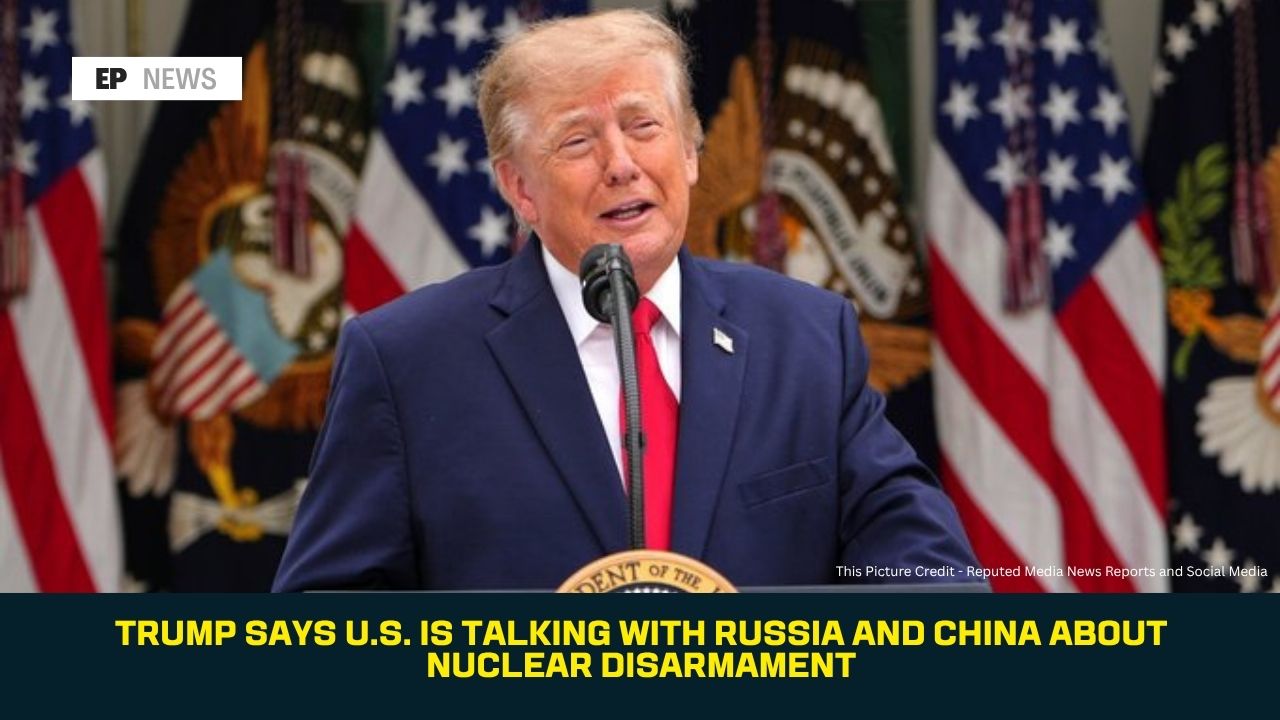
U.S. President Donald Trump says Washington is holding discussions with Russia and China about denuclearization, raising a potentially significant diplomatic issue as the world’s major nuclear powers face growing uncertainty over arms control. Trump made the comments during an interview with Newsmax, according to a Reuters report published on October 16.
The president said he would like to see nuclear weapons reduced if an agreement can be reached. The remarks come after the expiration of the New START treaty earlier in 2026, removing a key framework that had placed limits on U.S. and Russian strategic nuclear forces.
However, the announcement does not yet establish that a new agreement has been reached. Publicly available information in the Reuters report does not outline a negotiating timetable, proposed limits, verification arrangements, or a formal agreement involving all three countries.
The central question now is whether the reported discussions can develop into a concrete diplomatic process capable of reducing nuclear risks.
What Did Trump Say About Nuclear Disarmament?
Trump said the United States was talking with both Moscow and Beijing about denuclearization. During his Newsmax interview, he expressed a desire to reduce nuclear weapons and described the situation as something he would like to change.
Reuters reported that Newsmax also said Trump had spoken with Chinese President Xi Jinping about denuclearization. The precise details of any conversation, including whether specific proposals were discussed, were not provided in the Reuters report.
Trump also said he expected China to catch up with the United States in nuclear capabilities within the next five years. That statement highlights Washington’s concern about China’s expanding nuclear arsenal, although it should be understood as the president’s assessment rather than a confirmed prediction that China will match the U.S. arsenal by a particular date.
For now, the announcement signals an expressed interest in discussions rather than proof that a comprehensive disarmament agreement is close.
Why Talks With Russia and China Matter
The United States, Russia and China occupy central positions in international nuclear security. Their decisions influence military planning, diplomatic relations, arms-control policy and the calculations of other countries.
Russia and the United States possess the largest nuclear arsenals. China’s arsenal is substantially smaller, but it is expanding and being modernized, making Beijing an increasingly important participant in debates about future nuclear limits.
According to the Stockholm International Peace Research Institute (SIPRI), the world had an estimated 12,187 nuclear warheads in January 2026. Approximately 9,745 were in military stockpiles potentially available for use, while an estimated 4,012 were deployed with missiles and aircraft.
SIPRI estimated Russia’s total inventory at 5,420 warheads, the United States at 5,042 and China at 620. These are estimates, not independently verified counts of every weapon. The figures also distinguish between total inventories, military stockpiles and deployed warheads, which are different measures.
The three countries have different security priorities. Washington must consider its own deterrent and the defense commitments it maintains with allies. Moscow views nuclear forces as a central element of its national security strategy. Beijing has been expanding and modernizing its forces while maintaining its own approach to deterrence.
An agreement involving all three would therefore be diplomatically complex. It would require the countries to address different military capabilities, strategic concerns and expectations about fairness.
New START Expiration Adds Urgency to the Debate
A major development in nuclear arms control occurred earlier this year when the New Strategic Arms Reduction Treaty, commonly known as New START, expired.
Signed by the United States and Russia in 2010, the treaty established limits on certain deployed strategic nuclear weapons and delivery systems. It was extended once, for five years, by the administrations of Joe Biden and Vladimir Putin.
The agreement provided a framework for limiting parts of the two countries’ strategic nuclear forces. Its expiration has increased uncertainty about what arrangements, if any, will replace it.
Without a successor agreement, the two governments face a more uncertain environment for managing their strategic arsenals. That does not automatically mean either country will immediately expand its deployed forces, but the absence of a binding framework can make future decisions harder to predict.
It can also complicate efforts to build confidence, assess military developments and reduce the risk of miscalculation.
Trump’s latest remarks are significant in this context because they point toward discussions that could, if developed further, address a gap in the arms-control framework.
Still, talks alone cannot replace the practical provisions of a treaty. Any meaningful arrangement would need clearly defined obligations, agreed limits, and a way for participating governments to assess compliance.
China’s Growing Nuclear Arsenal Is a Key Factor
China’s nuclear expansion is one of the main reasons that future arms-control discussions may differ from previous U.S.-Russian agreements.
For decades, major strategic arms-control arrangements largely focused on the United States and Russia because their arsenals were much larger than those of other nuclear-armed countries.
China’s capabilities and military planning have since become a greater focus of international security debates. SIPRI’s 2026 assessment estimated China’s inventory at around 620 nuclear warheads in January, while warning that the country’s arsenal is expanding faster than any other nuclear power’s.
The same assessment said China could potentially have at least as many intercontinental ballistic missiles as either Russia or the United States by the end of the decade, depending on how it structures its forces. This is a projection concerning missiles, not a finding that China will necessarily possess the same total number of nuclear warheads as either country.
The distinction matters. Nuclear arsenals include different types of warheads, delivery systems and operational arrangements. Comparing them requires more than a single number.
For Washington, involving Beijing in future arms-control efforts could help address a strategic challenge that a bilateral U.S.-Russia treaty would not fully cover. For Beijing, however, negotiations would raise questions about its security requirements and whether limits should reflect the much larger existing U.S. and Russian arsenals.
Those differences would need to be addressed before any three-country agreement could become practical.
What Would a Nuclear Disarmament Agreement Need?
A serious agreement would need to move beyond general statements of intent. Several issues would likely require detailed negotiations.
1. Clear limits on nuclear forces
The countries would need to determine which weapons and delivery systems were covered. An agreement could focus on deployed strategic warheads, launch systems or other categories, depending on the participants’ objectives.
The precise scope would be a central negotiating question. No new limits were specified in the Reuters report about Trump’s comments.
2. Verification and transparency
Governments would need a way to assess whether the parties were meeting their obligations. Depending on the agreement, this could involve data exchanges, inspections, notifications or other verification measures.
Verification is particularly important because nuclear forces are closely linked to national security. Each government would want sufficient confidence that the others were complying without exposing sensitive information unnecessarily.
3. A framework acceptable to all three countries
The United States, Russia and China do not have identical arsenals or strategic priorities. Negotiators would need to determine whether the same limits should apply to all three countries or whether different obligations would be necessary.
That question could prove difficult because Washington and Moscow have historically maintained much larger arsenals than Beijing.
4. A process for resolving disputes
Even a carefully designed agreement could encounter disagreements over implementation. A durable framework would need procedures for consultation, clarification and addressing alleged violations.
Without a process for handling disputes, mistrust could undermine the agreement before its objectives were achieved.
5. Long-term political commitment
Arms-control arrangements require sustained attention from governments. Changes in political leadership, international crises and military developments can affect negotiations.
A successful agreement would need support beyond a single public announcement and a process capable of surviving diplomatic tensions.
What the Talks Could Mean for U.S. National Security
If the reported discussions develop into formal negotiations, they could become an important part of the United States’ approach to managing nuclear competition.
Supporters of arms control argue that negotiated limits can reduce uncertainty and help governments avoid costly or destabilizing competition. Greater transparency can also make it easier to understand the other side’s capabilities and intentions.
But any agreement would need to be assessed against the United States’ defense requirements and the behavior of the other participants. A deal that lacks effective verification or fails to address important military capabilities may not deliver its intended security benefits.
U.S. policymakers would also have to consider allies who depend on American security commitments. Decisions about nuclear forces can affect how those allies assess deterrence and regional stability.
For these reasons, the details would matter as much as the political announcement. A credible agreement would need to balance the goal of reducing nuclear risks with the need to maintain confidence in national defense.
Why the Development Matters Beyond Washington
Nuclear arms control has consequences beyond the three countries involved. Other nuclear-armed states, U.S. allies and countries concerned about regional conflicts would all watch the process closely.
A successful agreement could create momentum for further negotiations and strengthen the principle that nuclear risks should be managed through communication and verifiable commitments.
On the other hand, unsuccessful negotiations could leave governments with fewer shared rules for managing competition. The absence of an agreement would not itself prove that conflict was imminent, but it could prolong uncertainty over future nuclear force levels.
SIPRI’s 2026 assessment warned that nuclear-armed countries continued modernizing their arsenals and that the risks of miscalculation and escalation were increasing. The organization also highlighted the weakening of international arms-control arrangements.
That broader context explains why even an early indication of discussions can attract attention. The potential value lies not simply in holding talks, but in whether they produce concrete and durable measures.
What Happens Next?
The next important indicators will be whether U.S. officials provide more information about the discussions, whether Russia and China publicly confirm their participation, and whether the governments identify a formal negotiating process.
Other signs of progress would include a published agenda, agreement on which nuclear systems should be covered, or the establishment of technical working groups.
Until such details emerge, it would be premature to describe the discussions as a completed deal or to claim that nuclear weapons are about to be eliminated.
Trump’s comments establish that he says discussions are taking place. They do not, by themselves, establish the positions of Moscow and Beijing or demonstrate that the parties have agreed on specific reductions.
Frequently Asked Questions
Is the United States negotiating nuclear disarmament with Russia and China?
President Donald Trump said the United States was talking with Russia and China about denuclearization, according to Reuters on October 16, 2026. The publicly reported information does not establish that a formal agreement has been reached.
Why is New START important?
New START was a 2010 U.S.-Russia treaty that limited certain deployed strategic nuclear weapons and delivery systems. Its expiration in 2026 left greater uncertainty about the future framework for managing the two countries’ strategic nuclear forces.
How many nuclear weapons do the United States, Russia and China have?
SIPRI estimated their total inventories in January 2026 at approximately 5,042 for the United States, 5,420 for Russia and 620 for China. These estimates cover total inventories and should not be confused with the smaller number of deployed warheads.
Has China agreed to reduce its nuclear arsenal?
The Reuters report about Trump’s remarks does not establish that China has agreed to reduce its arsenal. Details of any formal proposal or commitment have not been confirmed in that report.
Could the talks reduce the risk of nuclear conflict?
Potentially, if the discussions lead to effective agreements with clear limits, verification and mechanisms for resolving disputes. No such outcome can be assumed before the details and commitments are established.
Conclusion
Donald Trump’s statement that the United States is talking with Russia and China about nuclear denuclearization comes at a consequential moment for international arms control. The expiration of New START, the modernization of nuclear forces and China’s expanding arsenal have made the future of nuclear-risk management an important global issue.
The announcement could mark an opening for diplomacy, but its significance will depend on what follows. Confirmation from the other governments, a clear negotiating agenda and verifiable commitments would be necessary to turn the reported discussions into a meaningful arms-control process.
For now, the most accurate conclusion is that Trump has expressed interest in denuclearization and said talks are taking place. Whether those discussions produce measurable reductions in nuclear risks remains to be seen.
Sources for editorial verification:
- Reuters, October 16, 2026: “Trump says he is talking to Russia and China about denuclearization.”
- Stockholm International Peace Research Institute (SIPRI), Yearbook 2026: nuclear forces and arms-control assessment.
Editorial note: This article distinguishes confirmed reporting from possible future outcomes. Update it if the governments release new statements or formal negotiating details.