
Labor Day 2026 Travel: Higher Prices, Alaska Cruises, and When to Avoid the Roads
Americans heading out for the last long weekend of summer will pay more for nearly every part of their trip this year, according to AAA’s annual Labor Day travel report — even as demand for Alaska cruises, national parks, and a handful of major U.S. cities keeps travel volumes strong heading into the September 3-7 holiday period.
What’s More Expensive This Year
Domestic roundtrip airfare is averaging $750 this Labor Day, up 2% from last year, according to AAA’s report cited by CBS8. For the most popular destinations specifically, prices are running nearly 20% higher, averaging $790. Hotel costs are climbing too: domestic bookings are up 9% compared to last year, and international hotel prices are up 12% over the same period, according to Hotel Dive’s coverage of the AAA report.
Not every category of travel cost is rising, however. According to Hotel Dive, cruises and international flights are actually less expensive this year compared to last Labor Day, even as fuel and domestic airfare costs have climbed — meaning the overall cost picture varies significantly depending on how travelers choose to get to their destination.
Where Everyone’s Going
AAA booking data shows Seattle, Orlando, Boston, Denver, and New York as the top domestic destinations for Labor Day 2026, according to the company’s own newsroom release. Internationally, Rome, Vancouver, London, Dublin, and Paris top the list.
A clear thread runs through several of this year’s most popular choices: Alaska. According to 9News’s coverage of AAA’s rankings, Seattle, Anchorage, and Vancouver are seeing a surge in bookings tied specifically to Alaska cruise demand. Denver and Las Vegas are also drawing significant interest as gateway cities for travelers heading on to Rocky Mountain, Arches, Zion, and Grand Canyon national parks, according to Hotel Dive.
“Travelers are seeking memorable experiences, and these top Labor Day destinations reflect that desire,” said Stacey Barber, vice president of AAA Travel, according to AAA’s newsroom release. “AAA members are embarking on Alaska cruises and river cruises, touring National Parks, and sightseeing in Europe. Many of our members are also looking ahead to 2027 and booking cruises and tours now before they sell out.”
When Traffic Will Be Worst
Unlike longer holiday periods, Labor Day weekend travel tends to concentrate within a short window, according to transportation analytics firm INRIX, cited by AAA’s newsroom. Many travelers hit the road immediately after work Thursday or during the day Friday, layering holiday traffic directly on top of already-heavy normal commuter volumes.
INRIX’s specific congestion forecast, relayed by CBS8, pinpoints the worst windows: Thursday, September 3, from 2 p.m. to 7 p.m.; Friday, September 4, from noon to 8 p.m.; Saturday’s peak between 1 p.m. and 5 p.m.; and Monday between 2 p.m. and 5 p.m. INRIX recommends departing early and avoiding afternoon travel whenever possible, noting that even leaving an hour or two earlier than planned can make a meaningful difference in overall trip time.
What Last Year Looked Like
While AAA had not yet released a specific total traveler projection for 2026 as of the most recent reporting, the company’s 2025 Labor Day report counted approximately 17 million Americans traveling for the holiday, according to CBS8 — a baseline that offers some sense of scale heading into this year’s weekend, even without a formal 2026 comparison figure yet available.
Roadside assistance demand offers another way to gauge the weekend’s scale: last Labor Day, AAA responded to more than 400,000 roadside assistance calls, according to CBS8, underscoring both how many people are on the road and the practical value of basic vehicle maintenance checks before a long drive.
Practical Tips for This Year’s Trip
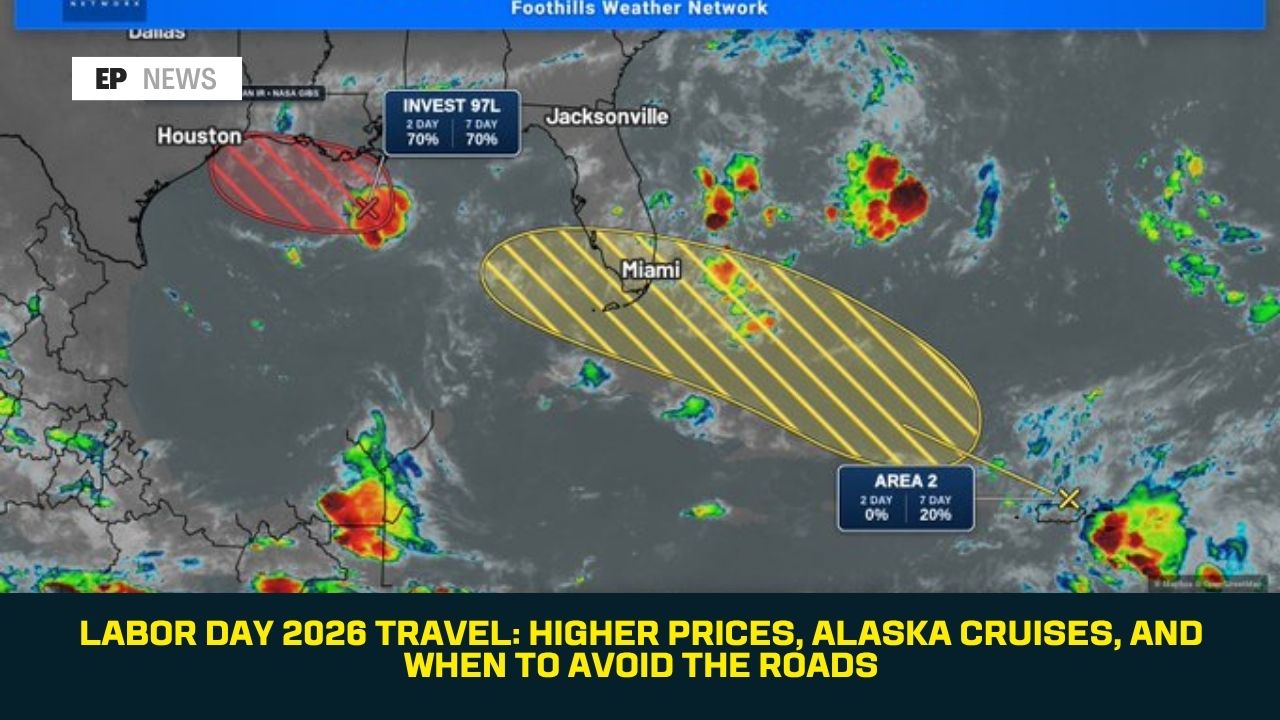
AAA’s standard holiday-travel advice applies directly to this year’s forecast: check tire pressure, battery condition, and fluid levels before heading out, particularly for longer road trips. Given hurricane season’s statistical peak falls in early September, according to the Farmers’ Almanac, travelers heading to Gulf Coast or Atlantic Coast beach destinations should also check the tropical weather outlook before finalizing plans, since storm activity in that window could affect both driving conditions and flight schedules along the coast.
FAQ
When is Labor Day weekend 2026? The holiday period runs Thursday, September 3, through Monday, September 7, with Labor Day itself falling on Monday, September 7.
How much more expensive is travel this year? Domestic roundtrip airfare is up 2% to an average of $750, with popular destinations averaging $790 (nearly 20% higher). Domestic hotel bookings are up 9%, and international hotels are up 12%.
What are the top domestic destinations this year? Seattle, Orlando, Boston, Denver, and New York, according to AAA booking data.
When will traffic be worst? Thursday from 2-7 p.m., Friday from noon-8 p.m., Saturday from 1-5 p.m., and Monday from 2-5 p.m., according to INRIX’s congestion forecast.
Why is Alaska such a popular theme this year? Strong demand for Alaska cruises is driving significant booking increases specifically to Seattle, Anchorage, and Vancouver, all common gateway or embarkation points for those trips.
Conclusion
This year’s Labor Day travel picture reflects a familiar late-summer pattern: higher costs across airfare and hotels, but undiminished enthusiasm for one last getaway before summer ends, with Alaska cruises and national park trips standing out as particular growth areas in this year’s bookings. With INRIX’s congestion windows offering a clear roadmap for when to avoid the worst traffic, and AAA’s standard vehicle-maintenance advice as relevant as ever, travelers hitting the road or skies this weekend have plenty of data to plan around, even if AAA’s total 2026 traveler count hadn’t been finalized as of the most recent reporting.
Sources: AAA Newsroom, CBS8, Hotel Dive, 9News, Asian Hospitality, Farmers’ Almanac (reporting dated August 24-30, 2026).