
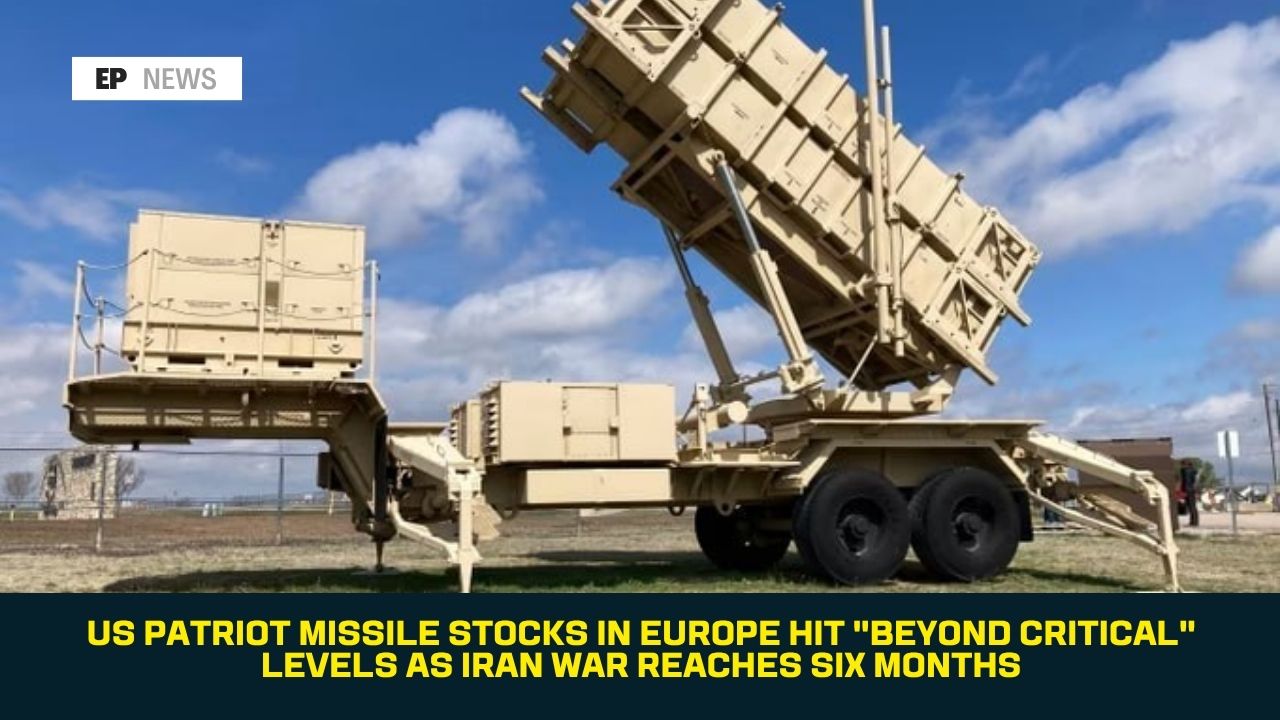
US Patriot Missile Stocks in Europe Hit “Beyond Critical” Levels as Iran War Reaches Six Months
The U.S. military is experiencing a “beyond critical” shortage of advanced missile interceptors in Europe, largely driven by the ongoing war with Iran, according to a U.S. defense official and a NATO official who spoke to the Associated Press — a shortfall officials warn could leave NATO countries vulnerable to a potential Russian attack just as the Iran conflict reaches its six-month mark.
What Officials Are Saying
The U.S. defense official said the most concerning shortfall specifically involves Patriot missile interceptors, which are used to shoot down Russia’s high-speed ballistic missiles, according to the Associated Press, via the Philadelphia Inquirer. A NATO official separately confirmed the low inventories of Patriots among American and NATO forces in Europe. Both officials spoke on condition of anonymity given the sensitivity of the military matters involved.
The practical risk, according to the U.S. official, is that in the event of a Russian ballistic missile assault on a target such as a military headquarters or power plant, NATO could find itself in a position similar to Patriot-starved Ukraine — forced “to take punch after punch in the mouth.”
The Pentagon’s Denial
Chief Pentagon spokesman Sean Parnell directly disputed the shortage claims in a Thursday statement. “We have everything required to strike at the time and place of the President’s choosing,” Parnell said, according to the Philadelphia Inquirer. “Across multiple combatant commands, we have already executed successful operations while maintaining a deep, ready arsenal to defend our people and our interests.”
This denial follows a pattern established earlier in the conflict. When CNN reported in early August that the U.S. military had depleted 80% of its THAAD interceptors and roughly half of its Patriot interceptors prior to the war, Defense Secretary Pete Hegseth swiftly contested the 80% figure on social media, posting “not true” and “shame on you,” according to Al Jazeera. No Trump administration official has publicly acknowledged threats posed by the reported munitions shortages, even as the administration requested $95 billion in its Fiscal Year 2027 defense budget along with a separate $21 billion supplemental funding request specifically to replenish weapons stores.
The Numbers Behind the Concern
Independent defense analysis has offered more specific figures than the government has been willing to confirm publicly. The Center for Strategic and International Studies estimated the U.S. had around 2,200 Patriots of the platform’s two most-modernized variants, along with 452 THAAD missiles, in its stockpile before the Iran war began, according to CNN. Following the fighting, CSIS’s more recent analysis put the Patriot stockpile at between 759 and 827 — a decrease of at least 65% since before the conflict started, according to Al Jazeera. THAAD interceptors fell from 452 before the war to between 232 and 262 at the start of an earlier ceasefire in April, though the U.S. was able to partially replenish that inventory to between 234 and 278 interceptors.
Retired U.S. Marine Corps Col. Mark Cancian, one of the CSIS analysis’s authors, described the underlying constraint bluntly to Al Jazeera: “We don’t have that many [interceptors] left, and there are no good substitutes.”
Replenishment rates remain slow relative to the scale of the drawdown. According to CNN, the Pentagon is currently receiving roughly 15 new Tomahawk missiles and 20 new Patriot missiles per month under current fiscal year delivery schedules, with CSIS estimating it could take three or more years to rebuild THAAD inventories back to pre-war levels.
The Impact on Ukraine
The interceptor shortage has had direct, visible consequences for Ukraine’s own air defense. Officials in Ukraine have been pleading for more Patriots to defend against Russian missile attacks, according to the Philadelphia Inquirer, with Kyiv maintaining that only U.S.-made Patriots can stop Russia’s advanced ballistic missiles — missiles that are increasingly getting through Ukrainian defenses, including during a barrage overnight into Thursday, August 27.
Broader Strategic Consequences
The Wall Street Journal reported Friday, August 28, that the extensive use of advanced weaponry in the Iran war has severely depleted U.S. military stockpiles broadly, limiting Washington’s ability to deter threats from both China and Russia simultaneously, according to The Express Tribune. Military planners reportedly expressed concern that the resource drain has forced U.S. European Command to adjust its operational plans, with some officials assessing that the U.S. could not fully execute contingency plans to defend Taiwan if a military operation occurred there in the short term.
In response to these production concerns, Deputy Defense Secretary Steve Feinberg wrote to defense industry leaders giving them no more than 21 days to submit plans for “significantly faster, more aggressive delivery schedules,” according to a memo obtained by The Washington Post and reported by Al Jazeera. “Years-long development cycles are not acceptable,” Feinberg wrote. “We must dramatically accelerate our program schedules and expand our production capacity now.”
Why the War Has Consumed So Much Ordnance
Beyond interceptors specifically, the war has drawn heavily on other categories of U.S. offensive munitions. Two sources told Reuters that “virtually all” of the Army’s highly accurate long-range, surface-to-air weapons — missiles that cost about $1 million each — had been used during the conflict, according to CNN. The U.S. has separately fired more than 850 Tomahawk missiles at Iran over the course of the war, according to The Express Tribune.
FAQ
How severe is the Patriot missile shortage in Europe? U.S. and NATO officials describe current inventories as “beyond critical,” with independent CSIS analysis estimating the overall U.S. Patriot stockpile has fallen by at least 65% since before the Iran war began.
Does the Pentagon acknowledge the shortage? No. Pentagon spokesman Sean Parnell has directly disputed shortage claims, and Defense Secretary Pete Hegseth has publicly contested specific figures reported by news outlets, even as the administration has requested substantial supplemental funding to replenish munitions stores.
How has this affected Ukraine? Ukrainian officials say they need more Patriot interceptors to defend against increasingly successful Russian ballistic missile attacks, with the shortage in Europe directly limiting how many interceptors are available to send.
Why is this connected to the Iran war specifically? The extensive use of interceptors and offensive missiles during the six-month U.S.-Israel war against Iran has significantly drawn down stockpiles that would otherwise be available for other theaters, including Europe and the broader effort to deter China and Russia.
What is the Pentagon doing to address production concerns? Deputy Defense Secretary Steve Feinberg gave defense industry leaders 21 days to submit plans for faster, more aggressive production and delivery schedules for critical weapons systems.
Conclusion
The gap between the Pentagon’s public denials and the specific, independently corroborated figures from defense analysts and anonymous officials has persisted for weeks now, even as the practical consequences — reduced Patriot availability for Ukraine, adjusted operational plans in Europe, and questions about Taiwan defense readiness — continue accumulating. With the Iran war reaching its six-month mark and replenishment rates measured in years rather than months, the tension between official reassurances and the underlying inventory data is likely to remain a persistent undercurrent of U.S. defense policy coverage for the foreseeable future.
Sources: Associated Press (via the Philadelphia Inquirer, Washington Times), Al Jazeera, CNN, The Express Tribune, Political Wire/Wall Street Journal, AOL/Al Jazeera (reporting dated August 4-29, 2026).