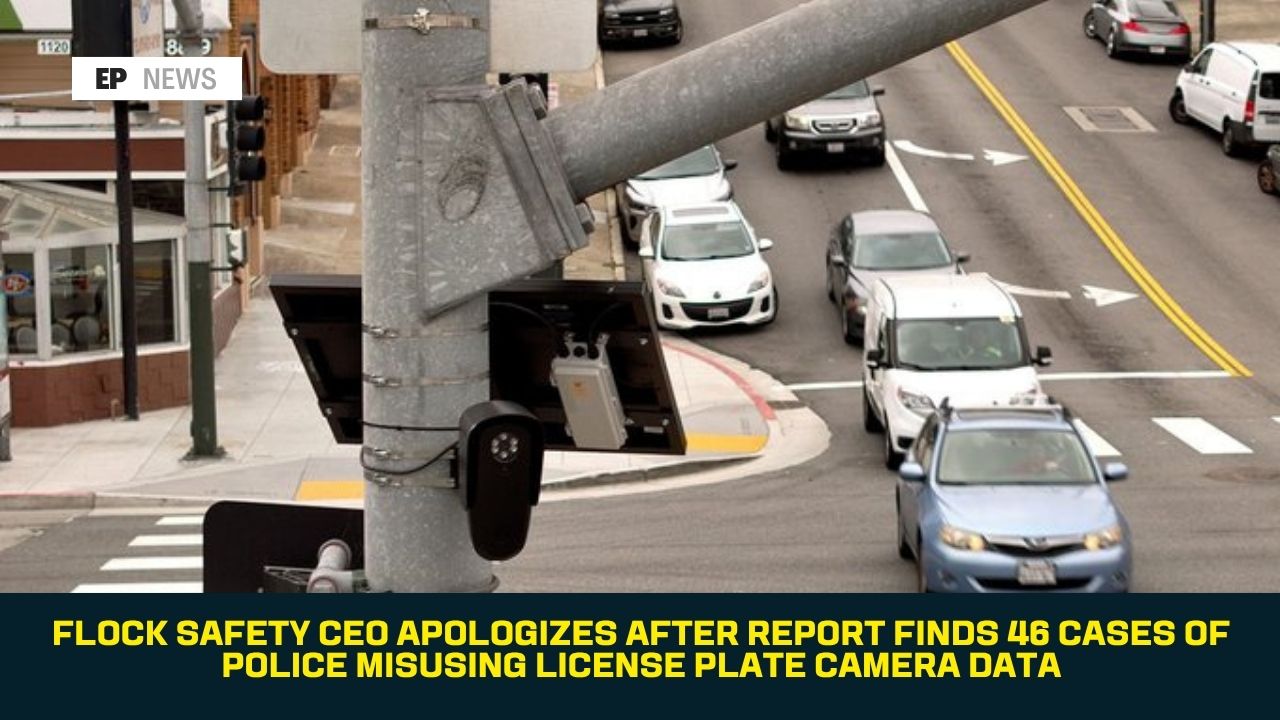
Flock Safety CEO Apologizes After Report Finds 46 Cases of Police Misusing License Plate Camera Data
The CEO of surveillance technology company Flock Safety apologized Thursday, August 13, for cases in which police officers misused the company’s automatic license plate reader network, including allegations that officers used the system to stalk women — while simultaneously announcing new safeguards and defending the broader value of the technology.
What Prompted the Apology
The apology followed a Washington Post investigation that found police officers had been accused in 46 cases of improperly using access to Flock’s license plate camera network, according to CBS News, with some of those cases allegedly involving officers stalking women. Flock CEO Garrett Langley said he had listened to one woman’s interview describing her experience Thursday morning. “I apologize,” Langley told CBS News. “It kills me that she went through that.”
Asked directly whether he had taken responsibility for the abuse allegations soon enough, Langley acknowledged the difficulty of that question. “Hindsight tends to be very clear,” he said, describing hindsight as “a brutal tool.”
What Changes Flock Is Making
Alongside the apology, Flock announced several operational changes to its system. According to CBS News, every search of Flock’s data will now require a case code to be entered beforehand, though that requirement can be overridden in emergency situations, such as a missing child case. The company also said its law enforcement customers can now limit which categories of offenses outside agencies are permitted to search for within the system, such as homicide, arson, or assault specifically.
By the end of the year, Flock said all of its law enforcement customers will be required to activate a tool designed to flag abnormal search behavior and automatically lock out users until an administrator reviews the flagged activity. According to CBS News, roughly a third of agencies using Flock’s system have already enabled that tool since it rolled out earlier this year.
Separately, according to The Drive’s coverage of a company press release addressing a different high-profile case, Langley said Flock will institute new mandatory audit monitoring specifically designed to detect unusual activity and repeated queries within its system.
How Langley Has Framed the Abuse Issue
In earlier public comments reviewed by The Drive, Langley had acknowledged that abuse of the platform “is a problem” that the company needs “to continue to get down to zero,” while also defending the system’s overall record. “I don’t think we should miss the fact that over a million cases were solved last year with this technology,” he said, according to The Drive’s reporting.
Langley has also pointed to what he describes as a comparative advantage in Flock’s auditing capabilities relative to other law enforcement technology systems more broadly. “I actually think this is a problem more broadly in law enforcement — that we’re one of the only systems that actually has auditing and has abnormal behavior detection in it,” he said, according to The Drive. He added that Flock’s own detection systems are often what surfaces abuse cases in the first place: “All these cases you see happening are because our system is flagging, ‘That’s pretty weird.'”
Why Critics Say the Changes Fall Short
Not everyone is satisfied that Flock’s response addresses the underlying concerns. Sen. Ron Wyden, D-Ore., has been directly critical of the company’s handling of privacy protections. In an October 2025 letter to Langley, Wyden wrote that Flock “cannot live up to its commitment to protect the privacy and security of Oregonians,” stating that “abuse of Flock cameras is inevitable, and Flock has made it clear it takes no responsibility to prevent or detect that.” Wyden’s office said its oversight found that privacy filters Flock had implemented for Oregon residents were easy to circumvent and lacked meaningful protection, and separately found that Flock had shared data with additional federal agencies — including Homeland Security Investigations, the Secret Service, and the Naval Criminal Investigative Service — beyond what state and local law enforcement customers had reportedly been told.
The American Civil Liberties Union has also criticized Flock’s practices, accusing the company of violating people’s privacy rights, according to CBS News. Separately, the Electronic Frontier Foundation documented what it described as troubling search patterns within Flock’s network in a 2025 year-in-review report, finding that more than 80 law enforcement agencies had used language reflecting harmful stereotypes against Romani people when conducting searches on the network between June 2024 and October 2025 — in some cases searching using ethnic slurs without citing any suspected crime.
The Company’s Response to That Broader Criticism
Langley addressed the broader regulatory gap directly in his comments to The Drive, expressing support for wider adoption of the kind of auditing standards Flock has implemented. “I wish more state regulations pushed that every system law enforcement uses needed to have this level of sophisticated auditing and abnormal detection,” he said. “We’ve got to do more there.”
Flock’s Scale and Growth
The controversy comes as Flock has grown rapidly as a company. According to TechCrunch, Flock raised $275 million in a funding round in March 2025 at a $7.5 billion valuation, with the company reporting more than $300 million in annual recurring revenue and 70% year-over-year growth at the time. Founded in 2017 through the Y Combinator startup accelerator, Flock has expanded beyond license plate recognition technology into gunshot detection systems marketed to schools and, following its acquisition of Aerodome, public safety drone technology.
FAQ
What prompted Flock Safety’s CEO to apologize? A Washington Post investigation that found police officers had been accused in 46 cases of improperly using access to Flock’s license plate camera network, including alleged stalking of women.
What changes is Flock making to its system? Requiring a case code before each data search (overridable in emergencies), allowing agencies to restrict which offense categories outside agencies can search for, and requiring all law enforcement customers to activate an abnormal-behavior detection tool by the end of the year.
Have lawmakers criticized Flock’s response? Yes. Sen. Ron Wyden has said Flock’s privacy protections for Oregon residents were easy to circumvent and that the company shared data with additional federal agencies beyond what customers were reportedly told.
Has Flock faced other criticism of its surveillance network? Yes. The Electronic Frontier Foundation documented searches using ethnic slurs against Romani people by dozens of law enforcement agencies, and the ACLU has separately accused the company of violating privacy rights.
How large is Flock Safety as a company? It was valued at $7.5 billion following a $275 million funding round in March 2025, with more than $300 million in annual recurring revenue and 70% year-over-year growth reported at the time.
Conclusion
Flock’s CEO struck a notably contrite tone Thursday while also defending the broader value of the company’s technology — a balancing act that hasn’t fully satisfied critics like Sen. Wyden, the ACLU, and the EFF, who point to a pattern of documented abuse extending well beyond the 46 cases identified in the Washington Post’s investigation. With new safeguards now being rolled out but full adoption still pending among the company’s law enforcement customers, the effectiveness of Flock’s response will likely depend on how consistently those changes are actually implemented across the thousands of agencies that use its surveillance network nationwide.
Sources: CBS News, Yahoo News, The Drive, Sen. Ron Wyden’s office, TechCrunch, Electronic Frontier Foundation (reporting dated August 13, 2026, and prior reporting from October 2025).