
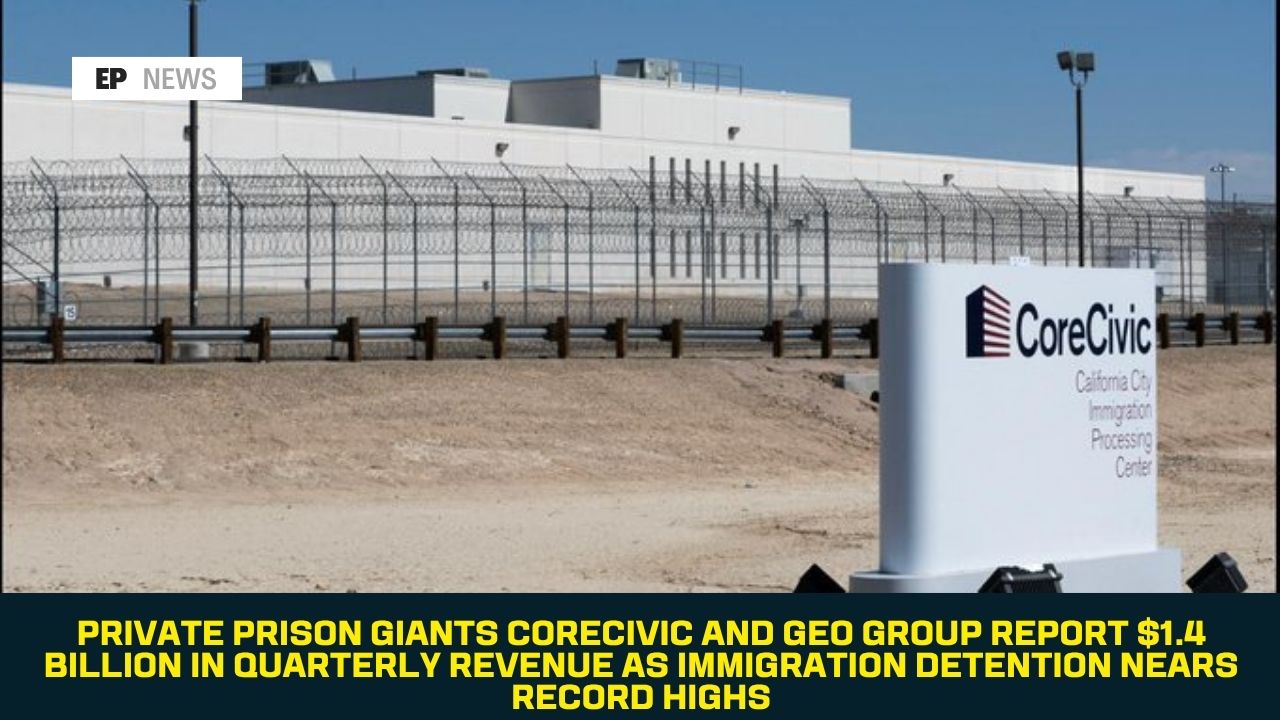
Private Prison Giants CoreCivic and GEO Group Report $1.4 Billion in Quarterly Revenue as Immigration Detention Nears Record Highs
CoreCivic and GEO Group, the two largest private prison companies in the country, reported a combined $1.4 billion in second-quarter revenue on Thursday, August 7, as U.S. immigration detention numbers climb back toward record territory.
The Numbers
CoreCivic’s total revenue rose just over 27% compared to the same quarter last year, reaching $684.9 million, according to NPR. CoreCivic President and CEO Patrick Swindle told investors the company exceeded expectations for a period that included the federal government shutdown.
GEO Group reported total revenue of $732.1 million, an increase of nearly $96 million, or 15%, over the same period last year, according to NPR’s reporting on comments from GEO Group CEO George Zoley during the company’s earnings call, which took place the same day as CoreCivic’s.
Neither of those figures includes a separate, additional windfall for CoreCivic: the company recently sold four of its detention facilities to the Department of Homeland Security, generating net proceeds of $1.6 billion. Swindle told investors that sale works out to an average rate of $307,000 per bed, according to both NPR and a KRIS TV investigation into the companies’ finances. Notably, selling the facilities to the government doesn’t end CoreCivic’s involvement — the company continues operating the sold detention centers under ongoing government contract, meaning it collects revenue both from the initial sale and from continued operations.
The Detention Numbers Driving the Growth
These earnings reflect a broader surge in immigration detention over the second quarter of 2026. As of the companies’ Thursday earnings calls, the U.S. was holding almost 66,000 people in immigration detention, nearing record levels not seen since January, according to figures from the Transactional Records Access Clearinghouse, a nonpartisan research center, cited by both NPR and MS NOW.
That detention growth ties directly into a stated administration goal. According to NPR, CoreCivic’s facility sales and continued operations are part of a larger strategy aimed at supporting President Trump’s goal of having 100,000 people in immigration detention at any given time — a target the industry has been actively building capacity toward, even as current numbers remain below that threshold.
Additional Revenue Streams
Beyond core detention bed capacity, both companies say they’re identifying other revenue opportunities tied to immigration enforcement. According to NPR, these include contracts for ankle monitors used to track Haitian immigrants who recently lost their Temporary Protected Status — an example of how the companies’ business has expanded beyond physical detention facilities into broader immigration enforcement infrastructure.
The Personnel Connection Between GEO Group and ICE
The relationship between GEO Group and the federal government extends beyond standard contracting arrangements. According to NPR, David Venturella, ICE’s acting director, is a former GEO Group executive. In a recent letter to lawmakers, Venturella stated he has divested his GEO Group stock, according to NPR’s reporting — an acknowledgment of the potential conflict of interest inherent in a former industry executive now overseeing the federal agency that serves as that industry’s largest customer.
How This Builds on Growth Reported Earlier in the Year
This quarter’s results continue a growth trajectory both companies have reported since Trump’s second term began. According to AOL’s earlier coverage of the companies’ first-quarter 2026 results, CoreCivic reported total revenue of $538.2 million in that quarter, a 9.8% increase from the same period in 2024, while GEO Group reported $636.2 million, up 5% over the same comparison period. GEO Group Chairman George Zoley said at the time that utilization of the company’s ICE contracts had grown from 15,000 to 20,000 beds — the highest level of ICE utilization in the company’s history — while CoreCivic CEO Damon Hininger said the message from the administration and DHS leadership since the election had been “pretty darn clear” that detention capacity would remain a policy priority.
Investor Reaction: Wanting Even Faster Growth
Despite the substantial revenue increases, some investors on the companies’ earnings calls have expressed frustration that detention numbers haven’t grown even faster. According to reporting from The Appeal earlier this year, one caller on a CoreCivic earnings call noted that “the pace of detention by ICE… has been below what investors thought it was going to be,” adding, “I think people thought we’d be at that 100,000 level. We’re at a little over 70,000.” That dynamic illustrates how closely tied these companies’ financial performance and investor expectations have become to the pace and scale of federal immigration enforcement decisions specifically.
FAQ
How much revenue did CoreCivic and GEO Group report combined? $1.4 billion in second-quarter 2026 revenue, not including a separate $1.6 billion in net proceeds CoreCivic generated from selling four detention facilities to the Department of Homeland Security.
What does the $307,000-per-bed figure refer to? It’s CoreCivic CEO Patrick Swindle’s description of the average rate generated by the company’s recent sale of four detention facilities to DHS.
How many people are currently in U.S. immigration detention? Almost 66,000 as of early August 2026, according to Transactional Records Access Clearinghouse data, nearing record levels not seen since January.
Is there a personnel connection between GEO Group and ICE leadership? Yes. ICE’s acting director, David Venturella, previously worked as a GEO Group executive. He has stated in a letter to lawmakers that he has since divested his GEO Group stock.
What other revenue sources are these companies pursuing? Both companies have cited additional opportunities such as ankle monitors for immigrants who have lost protected immigration status, expanding their business beyond traditional detention bed capacity.
Conclusion
CoreCivic and GEO Group’s latest earnings reflect a private detention industry whose financial performance has become closely tied to federal immigration enforcement policy, with both companies explicitly framing their business strategies around the administration’s stated detention capacity goals. With detention numbers still below the administration’s stated 100,000-person target and both companies continuing to expand capacity and pursue new contract types, this revenue growth is likely to remain a closely watched storyline in both financial and immigration policy coverage in the quarters ahead.
Sources: NPR, KRWG Public Media, KPCW, Democracy Now!, KRIS TV, AOL, MS NOW (reporting dated August 7-10, 2026).