
Another Aurora Chance This Week as G2 Solar Storm Hits, With More Activity Possible August 11-12
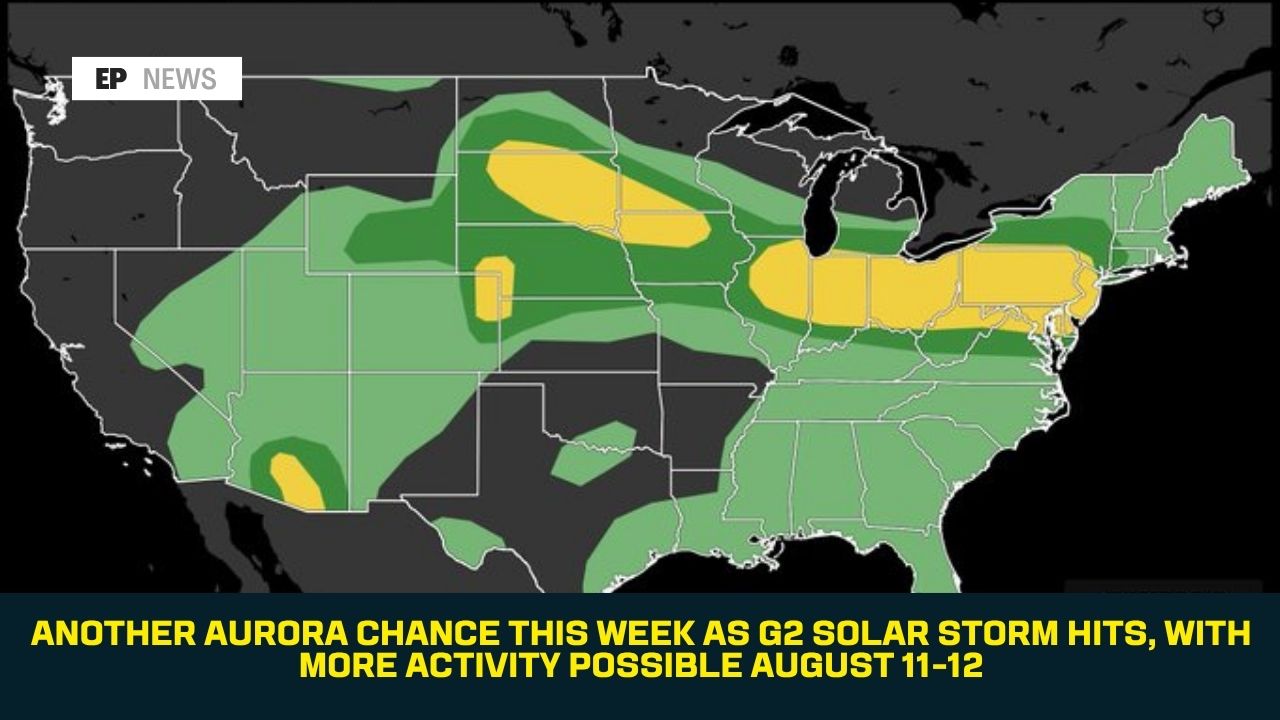
A coronal mass ejection that left the sun on August 4 swept past Earth over the weekend, driving a moderate G2 geomagnetic storm, and space weather forecasters say another period of unsettled conditions — with a chance of renewed aurora visibility across parts of the northern U.S. — is possible August 11-12.
What Happened Over the Weekend
According to EarthSky’s sun activity tracking, Earth’s magnetic field “lit up” overnight into August 9 as the August 4 coronal mass ejection, or CME, swept past the planet and drove geomagnetic storming to G2, or “moderate,” levels on NOAA’s five-level storm intensity scale. Summer twilight limited viewing opportunities for observers in the Northern Hemisphere, but the long winter darkness currently affecting the Southern Hemisphere offered a much clearer view — an all-sky webcam at Davis Station in Antarctica captured vivid auroral displays overnight on August 8-9, according to imagery from the Australian Antarctic Division cited by EarthSky.
This wasn’t an isolated event. The sun produced a similar CME-driven G2 storm just over a week earlier, on August 1-2, according to Forbes, which prompted forecasts of aurora visibility as far south as New York and Idaho at the time — though a full moon and short summer nights made the display difficult for most observers to see without a camera.
What’s Coming: The August 11-12 Forecast
Looking ahead, EarthSky’s forecast points to renewed geomagnetic activity heading into the middle of this week. Forecasters expect “a renewed period of unsettled-to-active conditions” on August 11-12, with the potential for G1 (minor) storm intervals and a slight chance of reaching G2 (moderate) levels again.
Two separate factors are driving that forecast. First, a glancing arrival from an August 8 disk-center filament CME is modeled to reach Earth around 12:56 UTC on August 11, with estimated Kp index readings between 3 and 5. Second, forecasters are watching the onset of a coronal hole high-speed stream, which could interact with the second CME’s flank and amplify effects around August 12. EarthSky was careful to flag the uncertainty involved, however, noting the CME arrival carries “low confidence” since the bulk of the material is expected to pass north of Earth rather than striking it directly.
If conditions do align favorably, aurora could become visible over Seattle, Minneapolis, and possibly as far south as Toronto and Chicago during the most active intervals, according to EarthSky’s forecast.
Why These Storms Keep Happening
This year’s frequent geomagnetic activity reflects a broader period of elevated solar activity that space weather researchers say isn’t a temporary blip. According to TechTimes, space weather researchers characterize the period running from early 2026 through mid-2027 as a window of sustained elevated risk for both satellite infrastructure and high-latitude power grids — explicitly not a return to the relatively quiet solar conditions observed in 2019 and 2020. Even as the sun moves through the declining phase of its roughly 11-year activity cycle, TechTimes noted that “quieter is not the same as safe” when it comes to the practical risks these storms pose.
Those risks aren’t purely theoretical. TechTimes cited the widely referenced example of February 2022, when a geomagnetic storm’s elevated atmospheric drag contributed to the loss of 40 out of 49 newly launched Starlink satellites — a case satellite operators have since incorporated directly into their contingency planning for storms of even moderate intensity.
How to Actually See the Aurora
For skywatchers hoping to catch a glimpse during any upcoming activity, timing and equipment matter significantly. According to TechTimes, a full or bright moon can complicate naked-eye viewing by competing with fainter auroral displays, particularly at the southern edge of the visibility zone — but cameras capable of multi-second exposures regularly detect aurora that the human eye simply can’t distinguish from an ordinarily moonlit sky.
The most reliable real-time resource for tracking actual conditions is NOAA’s Space Weather Prediction Center website, according to TechTimes, which publishes the planetary Kp index — the standard measure of geomagnetic disturbance — updated every three minutes. Forbes also recommends seeking out dark locations away from light pollution and checking real-time aurora forecasting apps, since visibility ultimately depends on a combination of factors including solar wind speed, the orientation of the interplanetary magnetic field, and simple local weather and light conditions.
FAQ
What caused the recent G2 geomagnetic storm? A coronal mass ejection that left the sun on August 4, 2026, swept past Earth and drove geomagnetic storming to G2 (moderate) levels by August 8-9.
When might the next storm occur? Forecasters are watching for renewed unsettled-to-active conditions on August 11-12, driven by a glancing CME arrival and a coronal hole high-speed stream, though the forecast carries low confidence.
Where might aurora be visible if the August 11-12 forecast holds? Potentially as far south as Seattle, Minneapolis, and possibly Chicago and Toronto during the most active intervals, according to EarthSky’s forecast.
Do geomagnetic storms pose any real-world risks beyond aurora? Yes. Even moderate storms can increase atmospheric drag on low-orbit satellites and pose risks to high-latitude power grids, with the February 2022 loss of dozens of Starlink satellites serving as a widely cited example.
What’s the best way to actually see or photograph the aurora? Seek dark locations away from light pollution, check NOAA’s Space Weather Prediction Center for real-time Kp index updates, and use a camera capable of multi-second exposures, since cameras can often detect aurora that isn’t visible to the naked eye, especially under bright moonlight.
Conclusion
With one moderate geomagnetic storm having just passed and forecasters flagging a real, if uncertain, chance of renewed activity later this week, northern-tier U.S. skywatchers have another opportunity on the horizon to catch the aurora — provided clear, dark skies align with the storm’s actual arrival. Given researchers’ broader assessment that this period of elevated solar activity is likely to continue well into 2027, this is unlikely to be the last aurora opportunity of the season for residents of the northern U.S.
Sources: EarthSky, Forbes, TechTimes (reporting dated August 2-9, 2026, based on NOAA Space Weather Prediction Center data).